ABC Family Arquivos Brasileiros de Cardiologia International Journal of Cardiovascular Sciences ABC Heart Failure & Cardiomyopathy ABC Imagem Cardiovascular
Português English
ABC Family
Português English
  • About
    • About ABC Family
    • Internal Regulation
    • Editorial Board
    • Brazilian Society of Cardiology (SBC)
  • Issues
  • SBC Guidelines
  • Content
    • Videos
    • Podcasts
    • News
  • About
    • About ABC Family
    • Internal Regulation
    • Editorial Board
    • Brazilian Society of Cardiology (SBC)
  • Issues
  • SBC Guidelines
  • Content
    • Videos
    • Podcasts
    • News

ABC Family

  • ABC Family
  • Arquivos Brasileiros de Cardiologia
  • International Journal of Cardiovascular Sciences
  • ABC Heart Failure & Cardiomyopathy
  • ABC Imagem Cardiovascular
Search in

No content found.

Journals
Ordering
Article types
Others

  1. Home
  2. Keyword: pulse pressure
Figure 1
ABC
Artigo Original

Acute Effects of Continuous Positive Air way Pressure on Pulse Pressure in Chronic Heart Failure

Mônica Quintão et al. Sérgio Chermont Luana Marchese Lúcia Brandão … Sabrina Pereira Bernardez Evandro Tinoco Mesquita Nazareth de Novaes Rocha Antônio Claudio L. Nóbrega

Background:

Patients with heart failure (HF) have left ventricular dysfunction and reduced mean arterial pressure (MAP). Increased adrenergic drive causes vasoconstriction and vessel resistance maintaining MAP, while increasing peripheral vascular resistance and conduit vessel stiffness. Increased pulse pressure (PP) reflects a complex interaction of the heart with the arterial and venous systems. Increased PP is an important risk marker in patients with chronic HF (CHF). Non-invasive ventilation (NIV) has been used for acute decompensated HF, to improve congestion and ventilation through both respiratory and hemodynamic effects. However, none of these studies have reported the effect of NIV on PP.

Objective:

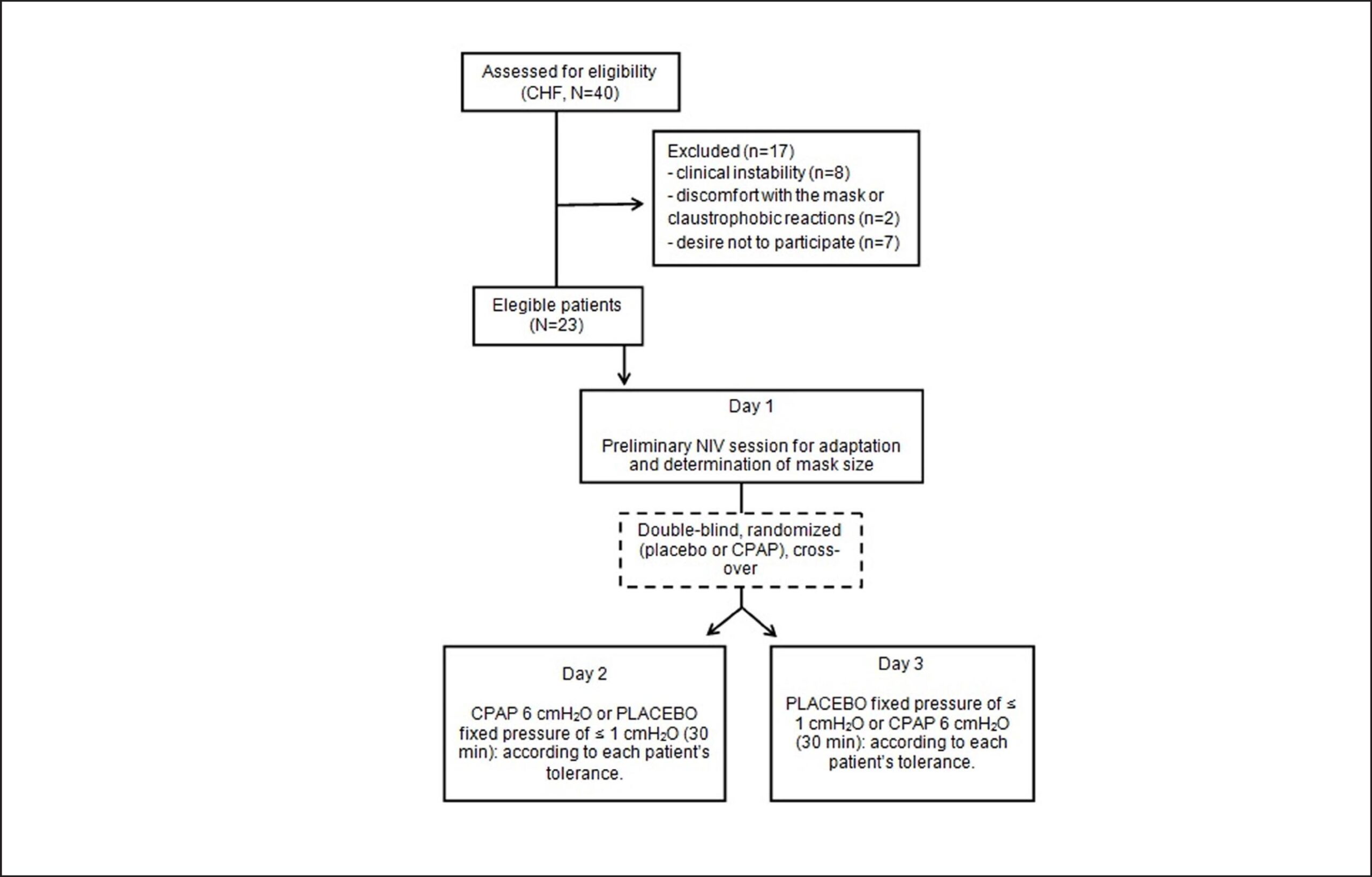
The objective of this study was to determine the acute effects of NIV with CPAP on PP in outpatients with CHF.

Methods:

Following a double-blind, randomized, cross-over, and placebo-controlled protocol, twenty three patients with CHF (17 males; 60 ± 11 years; BMI 29 ± 5 kg/cm2, NYHA class II, III) underwent CPAP via nasal mask for 30 min in a recumbent position. Mask pressure was 6 cmH2O, whereas placebo was fixed at 0-1 cmH2O. PP and other non invasive hemodynamics variables were assessed before, during and after placebo and CPAP mode.

Results:

CPAP decreased resting heart rate (Pre: 72 ± 9; vs. Post 5 min: 67 ± 10 bpm; p < 0.01) and MAP (CPAP: 87 ± 11; vs. control 96 ± 11 mmHg; p < 0.05 post 5 min). CPAP decreased PP (CPAP: 47 ± 20 pre to 38 ± 19 mmHg post; vs. control: 42 ± 12 mmHg, pre to 41 ± 18 post p < 0.05 post 5 min).

Conclusion:

NIV with CPAP decreased pulse pressure in patients with stable CHF. Future clinical trials should investigate whether this effect is associated with improved clinical outcome.
  • CPAP
  • Heart Failure
  • pulse pressure
Read Full Article
Creative Commons Attribution (CC BY) Creative Commons license
25/03/2014 DOI: 10.5935/abc.20140006
Pulse pressure measured by home blood pressure monitoring and its correlation to left ventricular mass index
ABC
Artigo Original

Pulse pressure measured by home blood pressure monitoring and its correlation to left ventricular mass index

André De Marco et al. Audes Magalhães Feitosa Marco Mota Gomes Giordano Bruno Parente Edgar Guimarães Victor

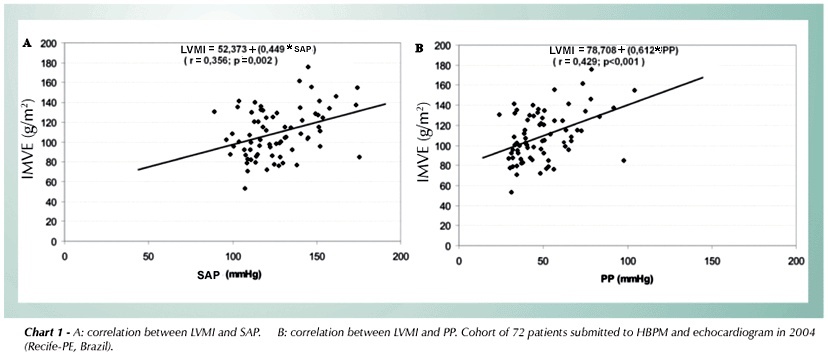
OBJECTIVE: Measure the systolic (SP), diastolic (DP) and pulse pressure (PP) using home blood pressure monitoring (HBPM) and correlate its values with the left ventricular mass index (LVMI). METHODS: In 2004, 127 individuals underwent HBPM in a private clinic. A total of 83 of these also underwent an echocardiographic study in a period shorter than 6 months. After excluding those with dilated or ischaemic cardiomyopathy and those with mitral or aortic valvopathies, 72 patients were evaluated for the correlation between SP, DP and PP (SP minus DP) and the LVMI. RESULTS: The group’s mean age was 51.9 ± 17.3 years and the masculine gender represented 43% of their components. The mean body mass index (BMI) was 28.6 ± 6 kg/m² and 53% of the patients were using antihypertensive drugs. The PS and PP correlated positively to the LVMI (r = 0.356; p = 0.002 e r = 0.429; p < 0.001, respectively). There was no correlation between DP and LVMI. CONCLUSION: The PS and the PP correlate positively to the LVMI.

  • Home blood pressure monitoring
  • Hypertrophy
  • left ventricular mass index
  • pulse pressure
Read Full Article
Creative Commons Attribution (CC BY) Creative Commons license
07/03/2007 DOI: 10.1590/S0066-782X2007000100015 Views 1
Arterial prehypertension and elevated pulse pressure in adolescents: prevalence and associated factors
ABC
Artigo Original

Arterial prehypertension and elevated pulse pressure in adolescents: prevalence and associated factors

Maria Luiza Garcia Rosa et al. Vania Matos Fonseca Gabriela Oigman Evandro Tinoco Mesquita

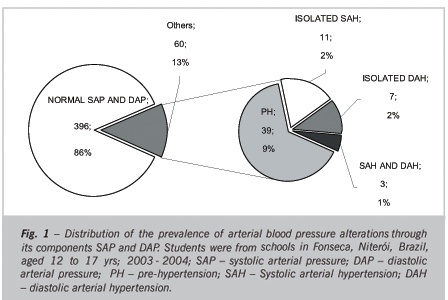
OBJECTIVE: To estimate the prevalence of prehypertension and elevated pulse pressure in adolescents and assess the association between those two conditions and sex, age, sexual development, obesity and physical activity. METHODS: Anthropometrical data and blood pressure were measured in and a questionnaire was applied to 456 adolescents (aged 12 to 17 years) recruited from public and private schools, in the Fonseca district, in the city of Niterói, state of Rio de Janeiro, Brazil, from 2003 to 2004. RESULTS: Thirty nine (8.6%) presented prehypertension (PH) and 13.4%, elevated pulse pressure (PP). At bivariate analysis, PH was significantly associated with sex, age and obesity, with more prevalent in boys aged between 15 and 17 years, and in the obese. Elevated PP was associated with gender only, as it was more prevalent in boys. Sexual maturation did not show an association with PH or elevated PP. Similar correlations were found at logistic regression. PH prevalence odds ratio was 7.7 for sex, 4.3 for age and 4.6 for obesity. Elevated PP prevalence odds ratio was 10.8 for sex. The correlation between PP and physical activity was positive and significant. The elevation of PP was attributable to systolic blood pressure. CONCLUSION: PH and the elevated PP were shown to be present in adolescents from a population with a low prevalence of hypertension, mostly in boys. Further prospective studies are necessary to assess the persistence and the impact of those conditions.

  • Adolescents
  • Hypertension
  • Obesity
  • Prevalence
  • pulse pressure
Read Full Article
Creative Commons Attribution (CC BY) Creative Commons license
28/07/2006 DOI: 10.1590/S0066-782X2006001400007 Views 2

How to cite this article

EndNote RIS

Electronic Document Format (Vancouver)

Quintão M, Chermont S, Marchese L, Brandão L, Bernardez SP, Mesquita ET, Rocha NN, et al. Acute Effects of Continuous Positive Air way Pressure on Pulse Pressure in Chronic Heart Failure. Arquivos Brasileiros de Cardiologia 2014;102(2):181-6.

Electronic Document Format (ABNT)

Quintão, Mônica; Chermont, Sérgio; Marchese, Luana; Brandão, Lúcia; Bernardez, Sabrina Pereira; Mesquita, Evandro Tinoco; Rocha, Nazareth de Novaes; Nóbrega, Antônio Claudio L.. Acute Effects of Continuous Positive Air way Pressure on Pulse Pressure in Chronic Heart Failure. Arquivos Brasileiros de Cardiologia, v. 102, n. 2, p. 181-186, Mar. 2014.

Electronic Document Format (APA)

Quintão, M., Chermont, S., Marchese, L., Brandão, L., Bernardez, S. P., Mesquita, E. T., Rocha, N. N., & Nóbrega, A. C. L. (2014). Acute Effects of Continuous Positive Air way Pressure on Pulse Pressure in Chronic Heart Failure. Arquivos Brasileiros de Cardiologia, 102(2), 181-186.

Electronic Document Format (ISO)

Quintão, Mônica and Chermont, Sérgio and Marchese, Luana and Brandão, Lúcia and Bernardez, Sabrina Pereira and Mesquita, Evandro Tinoco and Rocha, Nazareth de Novaes and Nóbrega, Antônio Claudio L.. Acute Effects of Continuous Positive Air way Pressure on Pulse Pressure in Chronic Heart Failure. Arquivos Brasileiros de Cardiologia [online]. 2014, vol. 102, n. 2, [cited 2026-10-14], pp. 181-186. Available from: <https://journals.cardiol.br/en/article/acute-effects-of-continuous-positive-air-way-pressure-on-pulse-pressure-in-chronic-heart-failure/>. ISSN 0066-782X

EndNote RIS

Electronic Document Format (Vancouver)

Marco AD, Feitosa AM, Gomes MM, Parente GB, Victor EG. Pulse pressure measured by home blood pressure monitoring and its correlation to left ventricular mass index. Arquivos Brasileiros de Cardiologia 2007;88(1):91-5.

Electronic Document Format (ABNT)

Marco, André De; Feitosa, Audes Magalhães; Gomes, Marco Mota; Parente, Giordano Bruno; Victor, Edgar Guimarães. Pulse pressure measured by home blood pressure monitoring and its correlation to left ventricular mass index. Arquivos Brasileiros de Cardiologia, v. 88, n. 1, p. 91-95, Mar. 2007.

Electronic Document Format (APA)

Marco, A. D., Feitosa, A. M., Gomes, M. M., Parente, G. B., & Victor, E. G. (2007). Pulse pressure measured by home blood pressure monitoring and its correlation to left ventricular mass index. Arquivos Brasileiros de Cardiologia, 88(1), 91-95.

Electronic Document Format (ISO)

Marco, André De and Feitosa, Audes Magalhães and Gomes, Marco Mota and Parente, Giordano Bruno and Victor, Edgar Guimarães. Pulse pressure measured by home blood pressure monitoring and its correlation to left ventricular mass index. Arquivos Brasileiros de Cardiologia [online]. 2007, vol. 88, n. 1, [cited 2026-10-14], pp. 91-95. Available from: <https://journals.cardiol.br/en/article/pulse-pressure-measured-by-home-blood-pressure-monitoring-and-its-correlation-to-left-ventricular-mass-index/>. ISSN 0066-782X

EndNote RIS

Electronic Document Format (Vancouver)

Rosa MLG, Fonseca VM, Oigman G, Mesquita ET. Arterial prehypertension and elevated pulse pressure in adolescents: prevalence and associated factors. Arquivos Brasileiros de Cardiologia 2006;87(1):46-53.

Electronic Document Format (ABNT)

Rosa, Maria Luiza Garcia; Fonseca, Vania Matos; Oigman, Gabriela; Mesquita, Evandro Tinoco. Arterial prehypertension and elevated pulse pressure in adolescents: prevalence and associated factors. Arquivos Brasileiros de Cardiologia, v. 87, n. 1, p. 46-53, Jul. 2006.

Electronic Document Format (APA)

Rosa, M. L. G., Fonseca, V. M., Oigman, G., & Mesquita, E. T. (2006). Arterial prehypertension and elevated pulse pressure in adolescents: prevalence and associated factors. Arquivos Brasileiros de Cardiologia, 87(1), 46-53.

Electronic Document Format (ISO)

Rosa, Maria Luiza Garcia and Fonseca, Vania Matos and Oigman, Gabriela and Mesquita, Evandro Tinoco. Arterial prehypertension and elevated pulse pressure in adolescents: prevalence and associated factors. Arquivos Brasileiros de Cardiologia [online]. 2006, vol. 87, n. 1, [cited 2026-10-14], pp. 46-53. Available from: <https://journals.cardiol.br/en/article/arterial-prehypertension-and-elevated-pulse-pressure-in-adolescents-prevalence-and-associated-factors/>. ISSN 0066-782X

  • About ABC Family
  • Internal Regulation
  • Editorial Board
  • Brazilian Society of Cardiology (SBC)

Issues

SBC Guidelines

  • Videos
  • Podcasts
  • News