Fabiana Pereira Vecchio Rebelo et al. Aline dos Santos Garcia Dalton Francisco de Andrade Cláudio Ribeiro Werner Tales de Carvalho
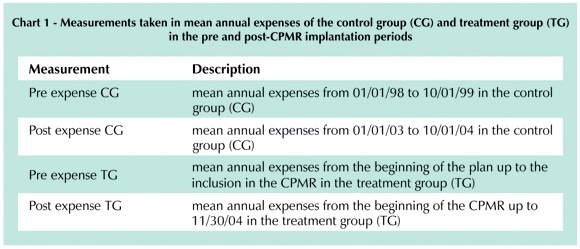
OBJECTIVE: To evaluate the clinical and economic outcome of a Cardiopulmonary and Metabolic Rehabilitation Program (CPMR) created by an HMO. METHODS: The sample was comprised of 96 clients, divided into two groups of 48 individuals (treatment group – TG, individuals who participated in the CPMR program, and control group – CG, individuals who did not participate in the program) of both genders, with age ranging between 54 and 79 years. Training time of the TG was 22 (±3) months. To assess the clinical outcome before and after CPMR, exercise tolerance, plasma lipoprotein profile (TC, LDL-C, HDL-C, TC/HDL-C and triglycerides), resting blood pressure (BP), and body composition (Body mass index – BMI and Waist-to-hip ratio – W/HR) were determined. RESULTS: The TG presented the following results in the pre and post CPMR assessment, respectively: TC (mg/dL) 242,5 (±48,32) and 189.47(±39.83); LDL-C (mg/dL) 162(±37.72) and 116,3(±33,28); HDL-C (mg/dL) 46,5(±8,59) and 57.8(±10.36); Tg (mg/dL) 165.15(±90.24) and 113.29(±54,92); TC/HDL-C 5.42 (±1.10) and 3.35 (±0.81); VO2 peak (mL/Kg/min) 26.92 ± 7 and 32.64 ± 5.92; BMI 29.35 (±3.93) and 28.12 (±3.55) for women and 29.17 (±5.14) and 27.88 (±4.83) for men; W/HR 0.93(±0.05) and 0.94(±0.04) for women and 0.93(±0.07) and 0.92(±0.06) for men; BP (mmHg) 151(±13.89) and 132(±9.56); DBP (mmHg) 83(±8.07) and 77(±5.92); monthly expenses CG (R$) 8,840.05 (±5,656.58) and 8,978.32 (±5,500.78); monthly expenses TG (R$) 2,016.98 (±2,861.69) and 1,470.73 (±1,333.25). CONCLUSION: In the group undergoing the CPMR Program, favorable clinical changes were observed in relation to the plasma lipoprotein profile, blood pressure, and exercise tolerance, with no relation to changes in medications.