Stella Bijkerk et al. Carlos I. Ponte-Negretti Ko Ko Maung Louisa Gnatiuc Friedrichs … Jesús Alegre-Díaz Simon G. Anderson Claudia Bambs Mauricio L. Barreto Antonio Bernabe-Ortiz Stefan Blankenberg Alfredo Cabrera-Villamizar Rodrigo M. Carrillo-Larco Luis F.S. Castro-de-Araujo William Checkley Sandra Cortés Jannick A.N. Dorresteijn Walter G. Espeche Catterina Ferreccio Patrícia Fortes C. de Macêdo Oscar H Franco Sergio Gimenez Gonzalo C. Grazioli Christina Howitt Vilma E. Irazola Stephen Kaptoge Pablo Kuri-Morales Fernando Lanas Bernardo Layerle José P. Lopez-Lopez Thiess Lorenz Paulo A. Lotufo Claudia Marco J. Jaime Miranda Carolina Nazzal José Ortellado Julia M. Pescarini Franco Peverelli Alejandro Pomi Luiz E. Ritt Carlos Daniel Rodríguez-Ariza Martín Salazar Carlos A. Sánchez-Vallejo Pamela Seron Itamar de Souza Santos Roberto Tapia-Conyer Pedro Zitko Emanuele Di Angelantonio Pedro M. Marques-Vidal Ana M. Abreu Frank L.J. Visseren Steven H.J. Hageman em nome da Cardiovascular Risk Collaboration da European Society of Cardiology e da European Association of Preventive Cardiology (ESC CRC) Interamerican Society of Cardiology (SIAC)
Abstract
Background and Aims
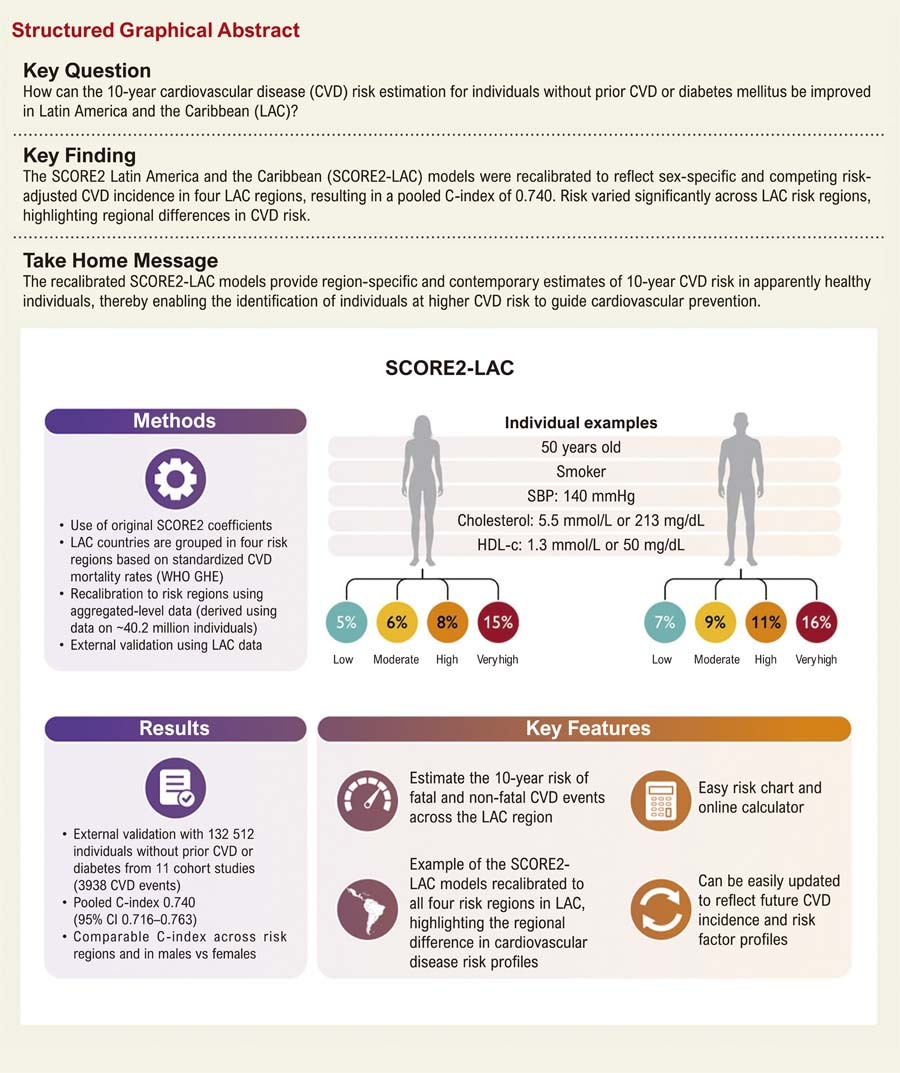
Despite the high burden of cardiovascular disease (CVD) in Latin America and the Caribbean (LAC), risk prediction models adapted for use in LAC populations remain limited. The aim of this study was to recalibrate the Systematic COronary Risk Evaluation 2 (SCORE2) risk models for estimating 10-year CVD risk in individuals without prior CVD or diabetes mellitus in LAC, resulting in the SCORE2 Latin America and the Caribbean (SCORE2-LAC) models.
Methods
Sex-specific, competing risk-adjusted SCORE2 models were recalibrated to contemporary CVD incidence across four risk regions, defined by country-level age- and sex-standardized CVD mortality rates, using region-specific risk factor distributions. Cardiovascular disease incidence was estimated from CVD mortality data and ratios of the total first-to-fatal CVD events, derived from 40 237 152 individuals (1 261 329 CVD events). External validation included 132 512 individuals without prior CVD or diabetes from 11 cohorts across seven countries (3938 CVD events). Discrimination was assessed using Harrell’s C-index.
Results
In the external validation datasets, the pooled C-index of SCORE2-LAC was .740 [95% confidence interval (CI) .716–.763], with cohort-specific C-indices ranging from .674 (95% CI .588–.761) to .789 (95% CI .747–.831). Estimated CVD risk varied several-fold across the four LAC risk regions. For a 50-year-old non-smoker with a systolic blood pressure of 140 mmHg, total cholesterol of 213 mg/dL (5.5 mmol/L), and HDL cholesterol of 50 mg/dL (1.3 mmol/L), the predicted risk ranged from 3% in low-risk countries to 10% in very-high-risk countries for women, and from 4% to 10% for men.
Conclusions
The SCORE2-LAC models provide region-specific contemporary estimates of 10-year CVD risk in apparently healthy individuals, enabling identification of individuals at high CVD risk across LAC. Structured Graphical Abstract.