ABC Family Arquivos Brasileiros de Cardiologia International Journal of Cardiovascular Sciences ABC Heart Failure & Cardiomyopathy ABC Imagem Cardiovascular
Português English
ABC Family
Português English
  • About
    • About ABC Family
    • Internal Regulation
    • Editorial Board
    • Brazilian Society of Cardiology (SBC)
  • Issues
  • SBC Guidelines
  • Content
    • Videos
    • Podcasts
    • News
  • About
    • About ABC Family
    • Internal Regulation
    • Editorial Board
    • Brazilian Society of Cardiology (SBC)
  • Issues
  • SBC Guidelines
  • Content
    • Videos
    • Podcasts
    • News

ABC Family

  • ABC Family
  • Arquivos Brasileiros de Cardiologia
  • International Journal of Cardiovascular Sciences
  • ABC Heart Failure & Cardiomyopathy
  • ABC Imagem Cardiovascular
Search in

No content found.

Journals
Ordering
Article types
Others

  1. Home
  2. Keyword: hospitals
Predictors of 30-Day Hospital Readmission Following CABG in a Multicenter Database: A Cross-Sectional Study
ABC
Original Article

Predictors of 30-Day Hospital Readmission Following CABG in a Multicenter Database: A Cross-Sectional Study

Rene Augusto Gonçalves e Silva et al. Gabrielle Barbosa Borgomoni Fabiane Letícia de Freitas Adnaldo da Silveira Maia … Cleóstones Farias do Vale Junior Eva da Silva Pereira Leonardy Guilherme Ibrahim Silvestre Luís Roberto Palma Dallan Luiz Augusto Lisboa Luís Alberto Oliveira Dallan Fabio Biscegli Jatene Omar Asdrúbal Vilca Mejia grupo de estudos REPLICCAR

Abstract

Background:

The analysis of indicators such as hospital readmission rates is crucial for improving the quality of services and management of hospital processes.

Objectives:

To identify the variables correlated with hospital readmission up to 30 days following coronary artery bypass grafting (CABG).

Methods:

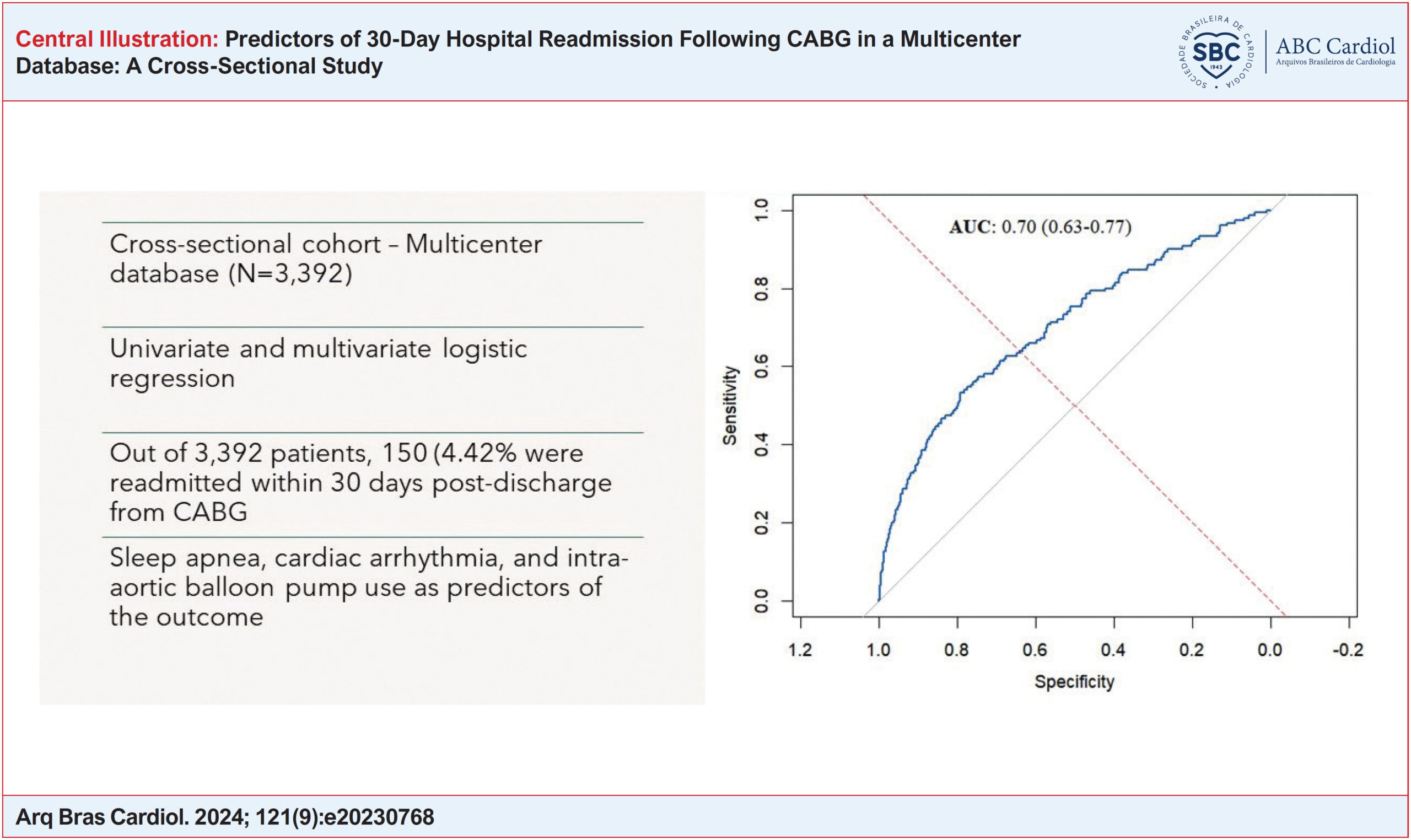
Cross-sectional cohort study by REPLICCAR II database (N=3,392) from June 2017 to June 2019. Retrospectively, 150 patients were analyzed to identify factors associated with hospital readmission within 30 days post-CABG using univariate and multivariate logistic regression. Analysis was conducted using software R, with a significance level of 0.05 and 95% confidence intervals.

Results:

Out of 3,392 patients, 150 (4,42%0 were readmitted within 30 days post-discharge from CABG primarily due to infections (mediastinitis, surgical wounds, and sepsis) accounting for 52 cases (34.66%). Other causes included surgical complications (14/150, 9.33%) and pneumonia (13/150, 8.66%). The multivariate regression model identified an intercept (OR: 1.098, p<0.00001), sleep apnea (OR: 1.117, p=0.0165), cardiac arrhythmia (OR: 1.040, p=0.0712), and intra-aortic balloon pump use (OR: 1.068, p=0.0021) as predictors of the outcome, with an AUC of 0.70.

Conclusion:

4.42% of patients were readmitted post-CABG, mainly due to infections. Factors such as sleep apnea (OR: 1.117, p=0.0165), cardiac arrhythmia (OR: 1.040, p=0.0712), and intra-aortic balloon pump use (OR: 1.068, p=0.0021) were predictors of readmission, with moderate risk discrimination (AUC: 0.70).
  • hospitals
  • Myocardium
  • Patient Readmission
Read Full Article
Creative Commons Attribution (CC BY) Creative Commons license
06/09/2024 DOI: 10.36660/abc.20230768i Views 2
ABC
Editorial

Evaluation of Clinical Competence for a Cardiology Residency Program

Sergio Timerman

In the past decades, medical education, especially in cardiology gratuate programs (CGP), has undergone profound changes, including restrictions on hours of service. In the reference article “To Err Is Human”, the Institute of Medicine suggests that nearly 100,000 patients die annually from preventable errors in hospitals, with another one million people with sequelae. This report turned the spotlight on the importance of patient safety with regard to healthcare. At about the same time, technological progress has outweighed curriculum innovations of EMPGs. As we were trained on the job, the method “see one, do one, and teach one” was common for all services, but as training progresses, procedures become extremely complex, with consequently higher risks. Most cardiology residents remember the first time they performed resuscitation maneuvers, placed transvenous pacemakers, and passed their first Swan-Ganz. Fortunately, most of these events were completed without complications. However, the level of concern and anxiety experienced regarding patient safety and their competence to perform these tasks is probably as vivid now as the day the procedure was performed. Despite the scarcity of evidence supporting the traditional training learning model,, most reviews discussing the potential of simulation-based education (SBE) for healthcare assess evidence that SBE is equivalent to or better than this traditional model.–

Nowadays, for the recent graduates and candidates for Medical Residency, assessment of clinical skills is an essential step and should be started in their education as a medical student, and should be done by the professor through direct observation of their performance in real situations. This formative and summative assessment takes different forms, as it assesses students’ clinical competences and quantifies the evolution of their performance based on real-life situations., The study published in this issue, entitled “Clinical Competence in ST-segment Elevation Myocardial Infarction Management by Recently Graduated Physicians Applying for a Medical Residency Program” aims to analyze the following: skills seen in the interview, physical examination skills, professionalism (ethics), clinical reasoning, orientation skills, efficiency and general clinical competence, pointing out their flaws and successes, making it a good weapon in formative assessment. Simulation training has also been widely adopted in other “high risk” industries. Although comparisons between medicine and aviation are frequent, it is important to recognize that the work performed by doctors differs a lot from that of pilots, so the nature of simulation must also be different. There is considerable focus on medical emergencies and practical procedural skills, but with scope to expand to other areas of care. The contribution of human cognitive performance to patient outcomes is well recognized; possessing the necessary knowledge and technical skills remains essential, but in addition to them, non-technical skills, such as situational awareness and the ability to synthesize information, making decisions and effectively communicating with team members during times of stress and distraction are also essential. And this study was important for this reason.

[…]

  • hospitals
  • Internship and Residence
  • Medical Competence
  • Programs
  • Simulation
  • ST Elevation Myocardial Infarction
Read Full Article
Creative Commons Attribution (CC BY) Creative Commons license
10/02/2020 DOI: 10.36660/abc.20190842 Views 2
Hospitalization and mortality rates for heart failure in public hospitals in São Paulo
ABC
Artigo Original

Hospitalization and mortality rates for heart failure in public hospitals in São Paulo

Henrique L. Godoy et al. José A. Silveira Eduardo Segalla Dirceu R. Almeida

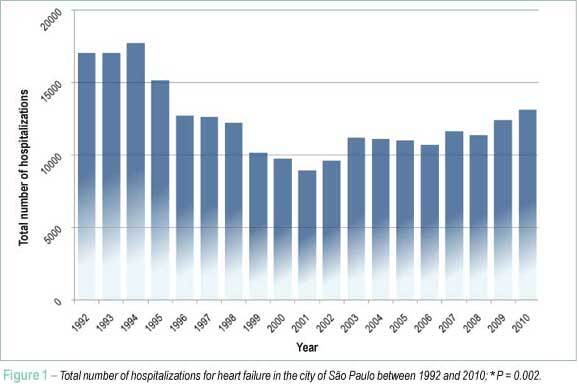
BACKGROUND: Advances in the treatment of heart failure (HF) have resulted in reduced mortality and hospitalization rates. On the other hand, when hospitalized, patients are at high risk of death. OBJECTIVE: As there are few studies in this group of patients in Brazil, we analyzed the numbers of hospitalization and deaths due to HF in the Brazilian Public Health System (SUS) in the city of São Paulo. METHODS: Historical prospective study carried out between 1992 and 2010. The data were obtained from DATASUS. We used Chi-square and t tests for comparison between the periods 1992-1993 and 2008-2009 and logistic regression models when appropriate. The level of significance was set at 5%. RESULTS: There was a 32% decrease in the number of hospitalizations for HF between 1992-1993 and 2008-2009 (p = 0.002). The in-hospital mortality rate for HF was 15%, with a 15% increase in the period (p = 0.004). Between 1992 and 1993, the mean time of hospitalization for HF was 8.8 days. Between 2008 and 2009, it was 11.3 days (p = 0.001). August was the month with the highest incidence of hospitalizations for HF, 20% higher than in February, the month with the lowest incidence (p = 0.041). CONCLUSION: This study showed changes in trends of hospitalization for HF and mortality over the last two decades. We emphasize important implications: 1: 32% decrease in the number of hospitalizations for HF in SUS hospitals in São Paulo; 2: 25% increase in hospitalization time, and 3: seasonal pattern of hospitalization for HF, with a peak in the third quarter.

  • Heart Failure
  • Hospitalization
  • hospitals
  • municipal
  • public
Read Full Article
Creative Commons Attribution (CC BY) Creative Commons license
07/10/2011 DOI: 10.1590/S0066-782X2011005000096

How to cite this article

EndNote RIS

Electronic Document Format (Vancouver)

Silva RAG, Borgomoni GB, Freitas FL, Maia AS, Vale Junior CF, Pereira ES, Silvestre LGI, et al. Predictors of 30-Day Hospital Readmission Following CABG in a Multicenter Database: A Cross-Sectional Study. Arquivos Brasileiros de Cardiologia 2024;121(9):e20230768.

Electronic Document Format (ABNT)

Silva, Rene Augusto Gonçalves e; Borgomoni, Gabrielle Barbosa; Freitas, Fabiane Letícia de; Maia, Adnaldo da Silveira; Vale Junior, Cleóstones Farias do; Pereira, Eva da Silva; Silvestre, Leonardy Guilherme Ibrahim; Dallan, Luís Roberto Palma; Lisboa, Luiz Augusto; Dallan, Luís Alberto Oliveira; Jatene, Fabio Biscegli; Mejia, Omar Asdrúbal Vilca; REPLICCAR, grupo de estudos. Predictors of 30-Day Hospital Readmission Following CABG in a Multicenter Database: A Cross-Sectional Study. Arquivos Brasileiros de Cardiologia, v. 121, n. 9, e20230768, Sep. 2024.

Electronic Document Format (APA)

Silva, R. A. G. , Borgomoni, G. B., Freitas, F. L. , Maia, A. S., Vale Junior, C. F. , Pereira, E. S., Silvestre, L. G. I., Dallan, L. R. P., Lisboa, L. A., Dallan, L. A. O., Jatene, F. B., Mejia, O. A. V., & REPLICCAR, (2024). Predictors of 30-Day Hospital Readmission Following CABG in a Multicenter Database: A Cross-Sectional Study. Arquivos Brasileiros de Cardiologia, 121(9), e20230768.

Electronic Document Format (ISO)

Silva, Rene Augusto Gonçalves e and Borgomoni, Gabrielle Barbosa and Freitas, Fabiane Letícia de and Maia, Adnaldo da Silveira and Vale Junior, Cleóstones Farias do and Pereira, Eva da Silva and Silvestre, Leonardy Guilherme Ibrahim and Dallan, Luís Roberto Palma and Lisboa, Luiz Augusto and Dallan, Luís Alberto Oliveira and Jatene, Fabio Biscegli and Mejia, Omar Asdrúbal Vilca and REPLICCAR, grupo de estudos. Predictors of 30-Day Hospital Readmission Following CABG in a Multicenter Database: A Cross-Sectional Study. Arquivos Brasileiros de Cardiologia [online]. 2024, vol. 121, n. 9, [cited 2026-10-14], e20230768. Available from: <https://journals.cardiol.br/en/article/predictors-of-30-day-hospital-readmission-following-cabg-in-a-multicenter-database-a-cross-sectional-study/>. ISSN 0066-782X

EndNote RIS

Electronic Document Format (Vancouver)

Timerman S. Evaluation of Clinical Competence for a Cardiology Residency Program. Arquivos Brasileiros de Cardiologia 2020;114(1):45-6.

Electronic Document Format (ABNT)

Timerman, Sergio. Evaluation of Clinical Competence for a Cardiology Residency Program. Arquivos Brasileiros de Cardiologia, v. 114, n. 1, p. 45-46, Feb. 2020.

Electronic Document Format (APA)

Timerman, S. (2020). Evaluation of Clinical Competence for a Cardiology Residency Program. Arquivos Brasileiros de Cardiologia, 114(1), 45-46.

Electronic Document Format (ISO)

Timerman, Sergio. Evaluation of Clinical Competence for a Cardiology Residency Program. Arquivos Brasileiros de Cardiologia [online]. 2020, vol. 114, n. 1, [cited 2026-10-14], pp. 45-46. Available from: <https://journals.cardiol.br/en/article/evaluation-of-clinical-competence-for-a-cardiology-residency-program/>. ISSN 0066-782X

EndNote RIS

Electronic Document Format (Vancouver)

Godoy HL, Silveira JA, Segalla E, Almeida DR. Hospitalization and mortality rates for heart failure in public hospitals in São Paulo. Arquivos Brasileiros de Cardiologia 2011;97(5):402-7.

Electronic Document Format (ABNT)

Godoy, Henrique L.; Silveira, José A.; Segalla, Eduardo; Almeida, Dirceu R.. Hospitalization and mortality rates for heart failure in public hospitals in São Paulo. Arquivos Brasileiros de Cardiologia, v. 97, n. 5, p. 402-407, Oct. 2011.

Electronic Document Format (APA)

Godoy, H. L., Silveira, J. A., Segalla, E., & Almeida, D. R. (2011). Hospitalization and mortality rates for heart failure in public hospitals in São Paulo. Arquivos Brasileiros de Cardiologia, 97(5), 402-407.

Electronic Document Format (ISO)

Godoy, Henrique L. and Silveira, José A. and Segalla, Eduardo and Almeida, Dirceu R.. Hospitalization and mortality rates for heart failure in public hospitals in São Paulo. Arquivos Brasileiros de Cardiologia [online]. 2011, vol. 97, n. 5, [cited 2026-10-14], pp. 402-407. Available from: <https://journals.cardiol.br/en/article/hospitalization-and-mortality-rates-for-heart-failure-in-public-hospitals-in-sao-paulo/>. ISSN 0066-782X

  • About ABC Family
  • Internal Regulation
  • Editorial Board
  • Brazilian Society of Cardiology (SBC)

Issues

SBC Guidelines

  • Videos
  • Podcasts
  • News