ABC Family Arquivos Brasileiros de Cardiologia International Journal of Cardiovascular Sciences ABC Heart Failure & Cardiomyopathy ABC Imagem Cardiovascular
Português English
ABC Family
Português English
  • About
    • About ABC Family
    • Internal Regulation
    • Editorial Board
    • Brazilian Society of Cardiology (SBC)
  • Issues
  • SBC Guidelines
  • Content
    • Videos
    • Podcasts
    • News
  • About
    • About ABC Family
    • Internal Regulation
    • Editorial Board
    • Brazilian Society of Cardiology (SBC)
  • Issues
  • SBC Guidelines
  • Content
    • Videos
    • Podcasts
    • News

ABC Family

  • ABC Family
  • Arquivos Brasileiros de Cardiologia
  • International Journal of Cardiovascular Sciences
  • ABC Heart Failure & Cardiomyopathy
  • ABC Imagem Cardiovascular
Search in

No content found.

Journals
Ordering
Article types
Others

  1. Home
  2. Keyword: Internship and Residence
Figure 1
ABC
Original Article

Clinical Competence in ST-segment Elevation Myocardial Infarction Management by Recently Graduated Physicians Applying for a Medical Residency Program

Ugo Stocco Aimoli et al. Carlos Henrique Miranda

Abstract

Background:

A significant reduction in the morbidity and mortality related to ST-segment elevation myocardial infarction (STEMI) has been achieved with the development of reperfusion therapies. Early diagnosis and correct initial management are important to ensure this benefit. In Brazil, recent graduates in medicine are responsible for a large part of the initial care provided for these patients.

Objective:

To assess the clinical competence in the diagnosis and initial treatment of STEMI by newly graduated physicians applying for a medical residency program.

Methods:

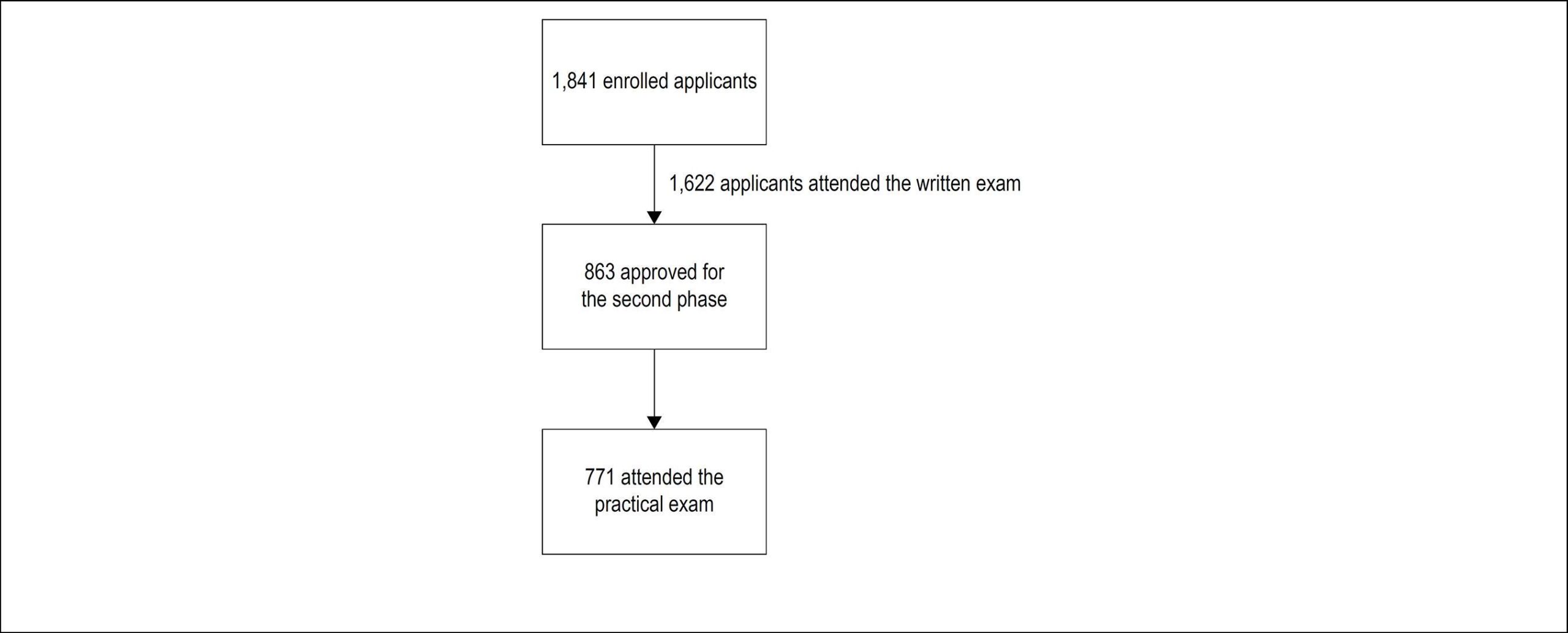
We assessed the performance of 771 applicants for the direct entry selection process of the FMRP-USP Clinical Hospital Medicine Residency Program, performed in a simulated setting of STEMI, with professional actors and medical evaluators, using a standardized checklist following the recommendations of the Brazilian Guidelines for the management of this disease.

Results:

The general performance score presented a median of 7 and an interquartile range of 5.5-8.0. In relation to the items assessed: 83% required ECG monitoring, 57% requested the insertion of a peripheral venous access catheter, 95% administered acetylsalicylic acid, 80% administered a second antiplatelet agent (p2y12 inhibitor), 66% administered nitrate, 71% administered morphine, 69% recognized the diagnosis of STEMI, 71% assessed the pain duration, 63% recognized the need for immediate transfer, 34% showed adequate communication skills and only 25% insisted on the transfer even in case of non-availability of beds.

Conclusions:

The initial diagnosis and management of STEMI need to be improved in medical undergraduate courses and inserted into the reality of the hierarchical network structure of the Brazilian Unified Health System (SUS).

  • Clinical Competence
  • Education, Medical
  • Internship and Residence
  • Medical Staff, Hospital
  • ST Elevation Myocardial Infarction
Read Full Article
Creative Commons Attribution (CC BY) Creative Commons license
10/02/2020 DOI: 10.36660/abc.20180309 Views 1
ABC
Editorial

Evaluation of Clinical Competence for a Cardiology Residency Program

Sergio Timerman

In the past decades, medical education, especially in cardiology gratuate programs (CGP), has undergone profound changes, including restrictions on hours of service. In the reference article “To Err Is Human”, the Institute of Medicine suggests that nearly 100,000 patients die annually from preventable errors in hospitals, with another one million people with sequelae. This report turned the spotlight on the importance of patient safety with regard to healthcare. At about the same time, technological progress has outweighed curriculum innovations of EMPGs. As we were trained on the job, the method “see one, do one, and teach one” was common for all services, but as training progresses, procedures become extremely complex, with consequently higher risks. Most cardiology residents remember the first time they performed resuscitation maneuvers, placed transvenous pacemakers, and passed their first Swan-Ganz. Fortunately, most of these events were completed without complications. However, the level of concern and anxiety experienced regarding patient safety and their competence to perform these tasks is probably as vivid now as the day the procedure was performed. Despite the scarcity of evidence supporting the traditional training learning model,, most reviews discussing the potential of simulation-based education (SBE) for healthcare assess evidence that SBE is equivalent to or better than this traditional model.–

Nowadays, for the recent graduates and candidates for Medical Residency, assessment of clinical skills is an essential step and should be started in their education as a medical student, and should be done by the professor through direct observation of their performance in real situations. This formative and summative assessment takes different forms, as it assesses students’ clinical competences and quantifies the evolution of their performance based on real-life situations., The study published in this issue, entitled “Clinical Competence in ST-segment Elevation Myocardial Infarction Management by Recently Graduated Physicians Applying for a Medical Residency Program” aims to analyze the following: skills seen in the interview, physical examination skills, professionalism (ethics), clinical reasoning, orientation skills, efficiency and general clinical competence, pointing out their flaws and successes, making it a good weapon in formative assessment. Simulation training has also been widely adopted in other “high risk” industries. Although comparisons between medicine and aviation are frequent, it is important to recognize that the work performed by doctors differs a lot from that of pilots, so the nature of simulation must also be different. There is considerable focus on medical emergencies and practical procedural skills, but with scope to expand to other areas of care. The contribution of human cognitive performance to patient outcomes is well recognized; possessing the necessary knowledge and technical skills remains essential, but in addition to them, non-technical skills, such as situational awareness and the ability to synthesize information, making decisions and effectively communicating with team members during times of stress and distraction are also essential. And this study was important for this reason.

[…]

  • hospitals
  • Internship and Residence
  • Medical Competence
  • Programs
  • Simulation
  • ST Elevation Myocardial Infarction
Read Full Article
Creative Commons Attribution (CC BY) Creative Commons license
10/02/2020 DOI: 10.36660/abc.20190842 Views 2

How to cite this article

EndNote RIS

Electronic Document Format (Vancouver)

Aimoli US, Miranda CH. Clinical Competence in ST-segment Elevation Myocardial Infarction Management by Recently Graduated Physicians Applying for a Medical Residency Program. Arquivos Brasileiros de Cardiologia 2020;114(1):35-44.

Electronic Document Format (ABNT)

Aimoli, Ugo Stocco; Miranda, Carlos Henrique. Clinical Competence in ST-segment Elevation Myocardial Infarction Management by Recently Graduated Physicians Applying for a Medical Residency Program. Arquivos Brasileiros de Cardiologia, v. 114, n. 1, p. 35-44, Feb. 2020.

Electronic Document Format (APA)

Aimoli, U. S., & Miranda, C. H. (2020). Clinical Competence in ST-segment Elevation Myocardial Infarction Management by Recently Graduated Physicians Applying for a Medical Residency Program. Arquivos Brasileiros de Cardiologia, 114(1), 35-44.

Electronic Document Format (ISO)

Aimoli, Ugo Stocco and Miranda, Carlos Henrique. Clinical Competence in ST-segment Elevation Myocardial Infarction Management by Recently Graduated Physicians Applying for a Medical Residency Program. Arquivos Brasileiros de Cardiologia [online]. 2020, vol. 114, n. 1, [cited 2026-10-14], pp. 35-44. Available from: <https://journals.cardiol.br/en/article/clinical-competence-in-st-segment-elevation-myocardial-infarction-management-by-recently-graduated-physicians-applying-for-a-medical-residency-program/>. ISSN 0066-782X

EndNote RIS

Electronic Document Format (Vancouver)

Timerman S. Evaluation of Clinical Competence for a Cardiology Residency Program. Arquivos Brasileiros de Cardiologia 2020;114(1):45-6.

Electronic Document Format (ABNT)

Timerman, Sergio. Evaluation of Clinical Competence for a Cardiology Residency Program. Arquivos Brasileiros de Cardiologia, v. 114, n. 1, p. 45-46, Feb. 2020.

Electronic Document Format (APA)

Timerman, S. (2020). Evaluation of Clinical Competence for a Cardiology Residency Program. Arquivos Brasileiros de Cardiologia, 114(1), 45-46.

Electronic Document Format (ISO)

Timerman, Sergio. Evaluation of Clinical Competence for a Cardiology Residency Program. Arquivos Brasileiros de Cardiologia [online]. 2020, vol. 114, n. 1, [cited 2026-10-14], pp. 45-46. Available from: <https://journals.cardiol.br/en/article/evaluation-of-clinical-competence-for-a-cardiology-residency-program/>. ISSN 0066-782X
  • About ABC Family
  • Internal Regulation
  • Editorial Board
  • Brazilian Society of Cardiology (SBC)

Issues

SBC Guidelines

  • Videos
  • Podcasts
  • News