ABC Family Arquivos Brasileiros de Cardiologia International Journal of Cardiovascular Sciences ABC Heart Failure & Cardiomyopathy ABC Imagem Cardiovascular
Português English
ABC Family
Português English
  • About
    • About ABC Family
    • Internal Regulation
    • Editorial Board
    • Brazilian Society of Cardiology (SBC)
  • Issues
  • SBC Guidelines
  • Content
    • Videos
    • Podcasts
    • News
  • About
    • About ABC Family
    • Internal Regulation
    • Editorial Board
    • Brazilian Society of Cardiology (SBC)
  • Issues
  • SBC Guidelines
  • Content
    • Videos
    • Podcasts
    • News

ABC Family

  • ABC Family
  • Arquivos Brasileiros de Cardiologia
  • International Journal of Cardiovascular Sciences
  • ABC Heart Failure & Cardiomyopathy
  • ABC Imagem Cardiovascular
Search in

No content found.

Journals
Ordering
Article types
Others

  1. Home
  2. Keyword: Hospital Emergency Service
Use of Diuretics in the Emergency Department Among Patients with Heart Failure: A Cohort Study
IJCS
Original Article

Use of Diuretics in the Emergency Department Among Patients with Heart Failure: A Cohort Study

Nichollas Costa Rosa et al. Camila Neumaier Alves Maria Antonieta Pereira de Moraes

Abstract

Introduction:

Evidence suggests that patients with decompensated heart failure who receive loop diuretics earlier experience reduced morbidity and mortality rates.

Objectives:

To determine the time from admission to administration of the first dose of diuretics in patients with heart failure and to evaluate the risk of readmission within 30 days after hospital discharge.

Methods:

A prospective and retrospective cohort study of patients with decompensated heart failure treated in a cardiac emergency department between December 2018 and June 2020 was conducted. The risk of readmission was classified using the LACE score. The statistical analysis included the Shapiro–Wilk test for normality, the chi-square test for associations, and the Mann–Whitney test for comparisons, adopting a significance level of 5%.

Results:

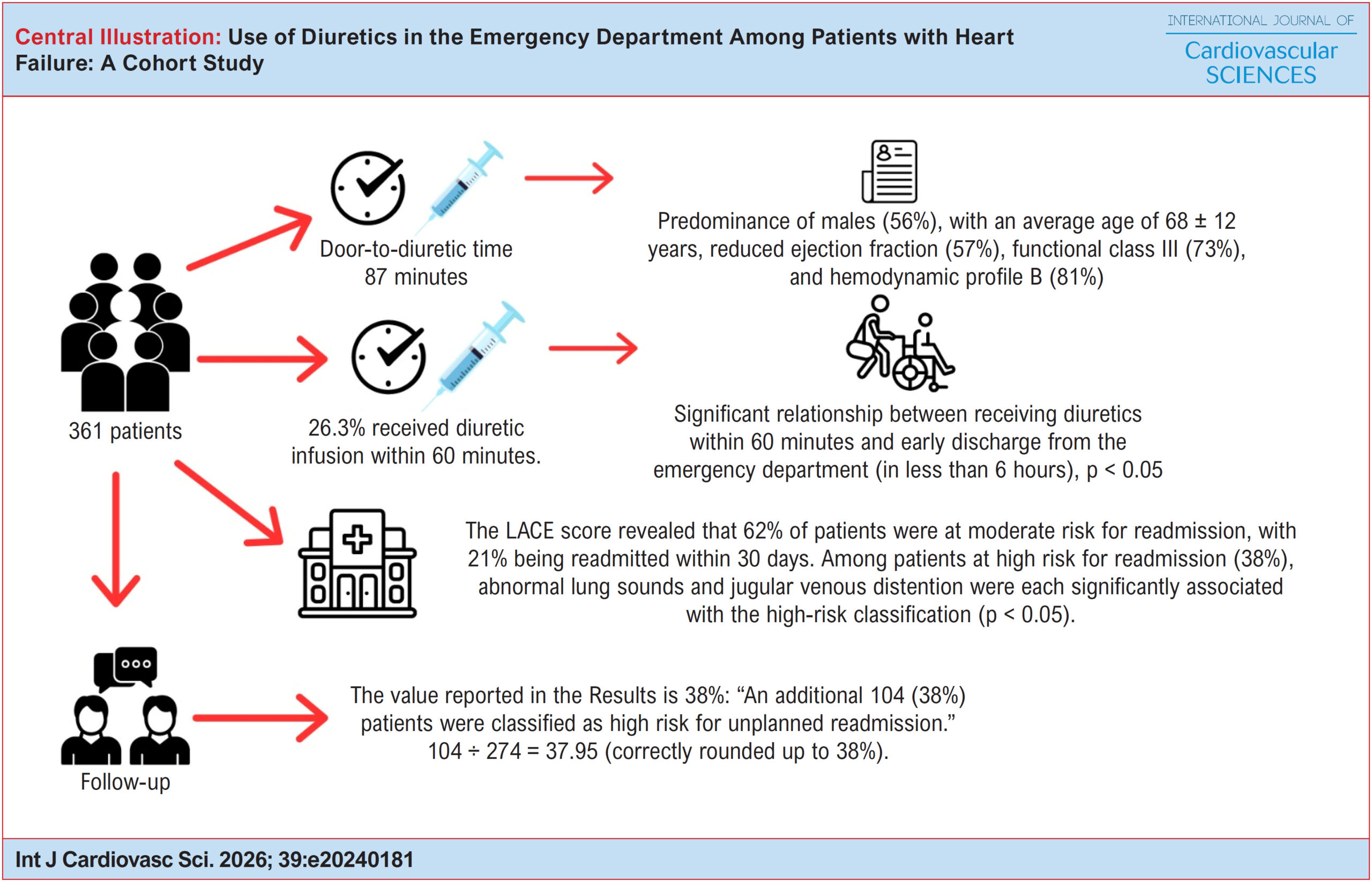
A total of 361 patients were included in the study, with a predominance of males (56%), an average age of 68 ± 12 years, reduced ejection fraction (57%), functional class III (73%), and hemodynamic profile B (81%). The average time from admission to diuretic infusion was 87 (60 to 128) minutes, with 26.3% of patients receiving the infusion within 60 minutes. A significant association was found between receiving diuretics within 60 minutes and a stay in the emergency department of less than 6 hours (early discharge) (p < 0.05). The LACE score indicated that 62% of patients were at moderate risk for readmission, with 21% readmitted within 30 days. Among patients at high risk for readmission (38%), abnormal lung sounds and jugular venous distention were each significantly associated with the high-risk classification (p < 0.05). For clinical follow-up, 274 patients were included; after 180 days, 15% had died, and 46% had been readmitted.

Conclusion:

In this population, patients who received the medication early (within 60 minutes) had shorter stays in the emergency department.
  • Heart Failure
  • Hospital Emergency Service
  • Patient Readmission
Read Full Article
Creative Commons Attribution (CC BY) Creative Commons license
01/06/2026 DOI: 10.36660/ijcs.20240181
Figure 1
ABC
Research Letter

Wide QRS Tachycardias Management in Emergency Departments: What Really Matters

José Nunes de Alencar et al. Guilherme Dagostin de Carvalho Renan Teixeira Campelo Sandro Pinelli Felicioni … Matheus Kiszka Scheffer Mariana Nogueira De Marchi

Introduction

Studies have shown that 80% of wide QRS tachycardias are ventricular tachycardias (VT). This number rises to 90% if there is underlying structural heart disease.– Criteria for differentiating between VT and supraventricular tachycardia (SVT) exist, and they are important in clinical practice, but not necessarily for the purpose of providing an exact diagnosis in acute settings.–

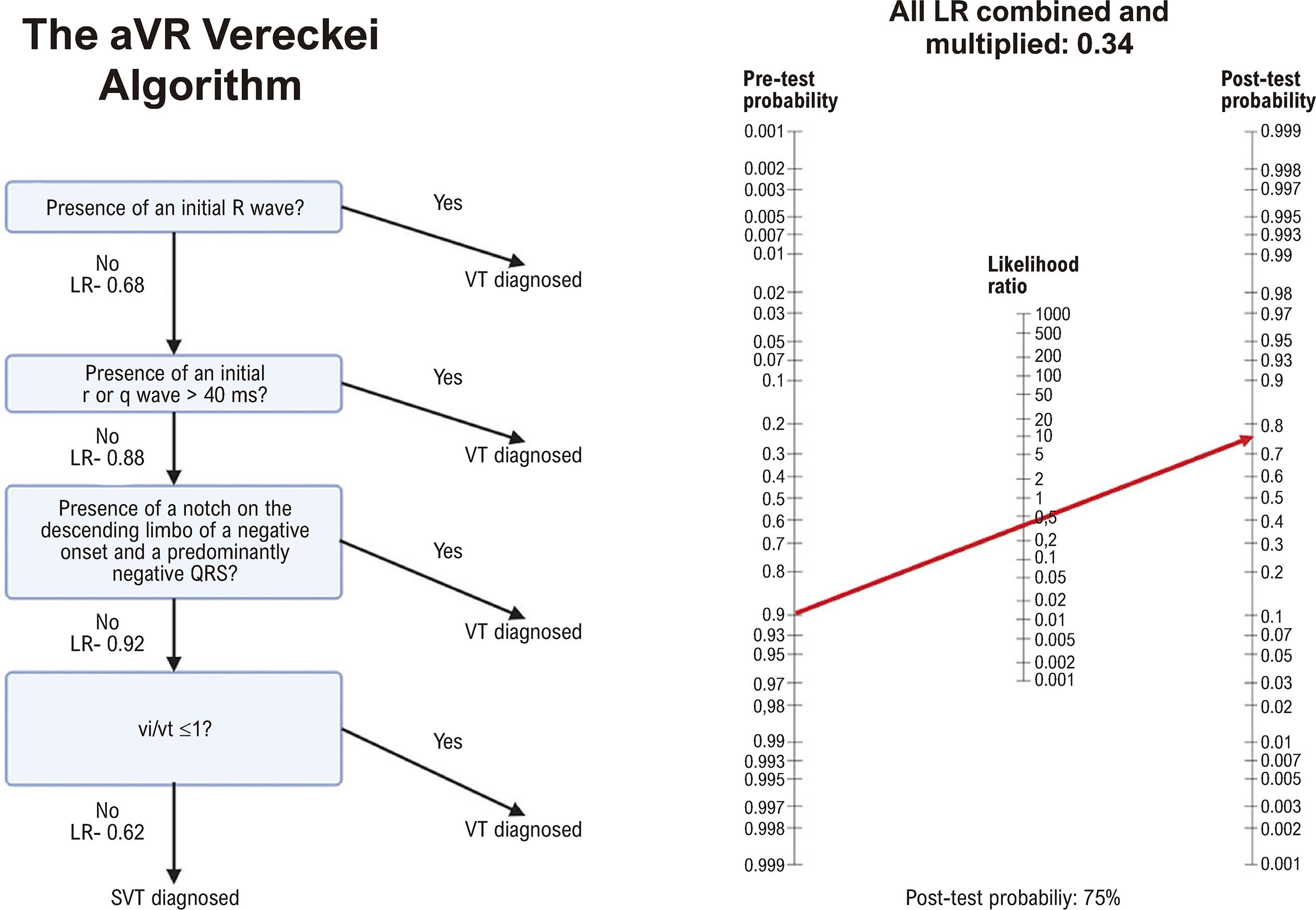
Although the criteria have been validated, they are not as effective at ruling out conditions as one might think. A real-world study showed that Vereckei’s criteria had a negative likelihood ratio of 0.34. This means that applying these criteria to a patient with a 90% pre-test probability would still result in a post-test probability of 75% for VT (). In that study, the Brugada criteria yielded a similar negative likelihood ratio of 0.24, resulting in a 68% probability for VT. Another reason not to rely solely on these criteria is the absence of baseline electrocardiogram (ECG) data. For instance, a patient with congenital heart disease may have a northwest axis and other unique findings. Similarly, a patient with Purkinje fiber blockage and electrically inactive zones may present with misleading ECG features., Adding to the complexity, idiopathic VT, such as fascicular VT, often present ECG patterns that mimic bundle branch or fascicular blocks, leading to misinterpretation. Another emblematic case is bundle-branch reentry VT, where the ECG during tachycardia will display morphological criteria of either left or right bundle branch block, further confounding the diagnosis.

[…]

  • Arrhythmias Cardiac
  • Electrocardiography
  • Hospital Emergency Service
  • Ventricular tachycardia
Read Full Article
Creative Commons Attribution (CC BY) Creative Commons license
15/07/2024 DOI: 10.36660/abc.20230829i Views 1

How to cite this article

EndNote RIS

Electronic Document Format (Vancouver)

Rosa NC, Alves CN, Moraes MAP. Use of Diuretics in the Emergency Department Among Patients with Heart Failure: A Cohort Study. International Journal of Cardiovascular Sciences 2026;39:e20240181.

Electronic Document Format (ABNT)

Rosa, Nichollas Costa; Alves, Camila Neumaier; Moraes, Maria Antonieta Pereira de. Use of Diuretics in the Emergency Department Among Patients with Heart Failure: A Cohort Study. International Journal of Cardiovascular Sciences, v. 39, e20240181, May. 2026.

Electronic Document Format (APA)

Rosa, N. C., Alves, C. N., & Moraes, M. A. P. (2026). Use of Diuretics in the Emergency Department Among Patients with Heart Failure: A Cohort Study. International Journal of Cardiovascular Sciences, 39, e20240181.

Electronic Document Format (ISO)

Rosa, Nichollas Costa and Alves, Camila Neumaier and Moraes, Maria Antonieta Pereira de. Use of Diuretics in the Emergency Department Among Patients with Heart Failure: A Cohort Study. International Journal of Cardiovascular Sciences [online]. 2026, vol. 39, [cited 2026-10-14], e20240181. Available from: <https://journals.cardiol.br/en/article/use-of-diuretics-in-the-emergency-department-among-patients-with-heart-failure-a-cohort-study/>. ISSN 2359-4802

EndNote RIS

Electronic Document Format (Vancouver)

Alencar JN, Carvalho GD, Campelo RT, Felicioni SP, Scheffer MK, Marchi MND. Wide QRS Tachycardias Management in Emergency Departments: What Really Matters. Arquivos Brasileiros de Cardiologia 2024;121(6):e20230829.

Electronic Document Format (ABNT)

Alencar, José Nunes de; Carvalho, Guilherme Dagostin de; Campelo, Renan Teixeira; Felicioni, Sandro Pinelli; Scheffer, Matheus Kiszka; Marchi, Mariana Nogueira De. Wide QRS Tachycardias Management in Emergency Departments: What Really Matters. Arquivos Brasileiros de Cardiologia, v. 121, n. 6, e20230829, Jul. 2024.

Electronic Document Format (APA)

Alencar, J. N. , Carvalho, G. D. , Campelo, R. T., Felicioni, S. P., Scheffer, M. K., & Marchi, M. N. D. (2024). Wide QRS Tachycardias Management in Emergency Departments: What Really Matters. Arquivos Brasileiros de Cardiologia, 121(6), e20230829.

Electronic Document Format (ISO)

Alencar, José Nunes de and Carvalho, Guilherme Dagostin de and Campelo, Renan Teixeira and Felicioni, Sandro Pinelli and Scheffer, Matheus Kiszka and Marchi, Mariana Nogueira De. Wide QRS Tachycardias Management in Emergency Departments: What Really Matters. Arquivos Brasileiros de Cardiologia [online]. 2024, vol. 121, n. 6, [cited 2026-10-14], e20230829. Available from: <https://journals.cardiol.br/en/article/wide-qrs-tachycardias-management-in-emergency-departments-what-really-matters/>. ISSN 0066-782X

  • About ABC Family
  • Internal Regulation
  • Editorial Board
  • Brazilian Society of Cardiology (SBC)

Issues

SBC Guidelines

  • Videos
  • Podcasts
  • News