ABC Family Arquivos Brasileiros de Cardiologia International Journal of Cardiovascular Sciences ABC Heart Failure & Cardiomyopathy ABC Imagem Cardiovascular
Português English
ABC Family
Português English
  • About
    • About ABC Family
    • Internal Regulation
    • Editorial Board
    • Brazilian Society of Cardiology (SBC)
  • Issues
  • SBC Guidelines
  • Content
    • Videos
    • Podcasts
    • News
  • About
    • About ABC Family
    • Internal Regulation
    • Editorial Board
    • Brazilian Society of Cardiology (SBC)
  • Issues
  • SBC Guidelines
  • Content
    • Videos
    • Podcasts
    • News

ABC Family

  • ABC Family
  • Arquivos Brasileiros de Cardiologia
  • International Journal of Cardiovascular Sciences
  • ABC Heart Failure & Cardiomyopathy
  • ABC Imagem Cardiovascular
Search in

No content found.

Journals
Ordering
Article types
Others

  1. Home
  2. Keyword: Genetic Polymorphism
Exploring the Link Between ITGB3 Gene Polymorphism and Diastolic Dysfunction in Arterial Hypertension Patients
IJCS
Original Article

Exploring the Link Between ITGB3 Gene Polymorphism and Diastolic Dysfunction in Arterial Hypertension Patients

Vafa Nazirova et al. Zumrud Ismibayli Ismail Gafarov Faig Guliyev Konstantinos Kyriazis

Abstract

Background:

Arterial hypertension (AH) is a significant risk factor for cardiovascular diseases (CVDs), including myocardial infarction and stroke. The ITGB3 gene polymorphism, particularly T1565C (rs5918), has been implicated in various cardiovascular conditions, suggesting a potential role in diastolic dysfunction (DD) among AH patients.

Objectives:

The clinical-genetic relationship was studied between ITGB3 gene polymorphisms and DD in Azerbaijani patients with AH, with or without ischemic heart disease (IHD) and type 2 diabetes (T2D) mellitus.

Methods:

The study included 100 Azerbaijani patients, divided into case (n = 76) and control (n = 24) groups. Echocardiography was used to assess left ventricular diastolic function. ITGB3 gene was identified using the MassArray system. Statistical analysis involved both parametric and non-parametric tests using the IBM SPSS Statistics 26.

Results:

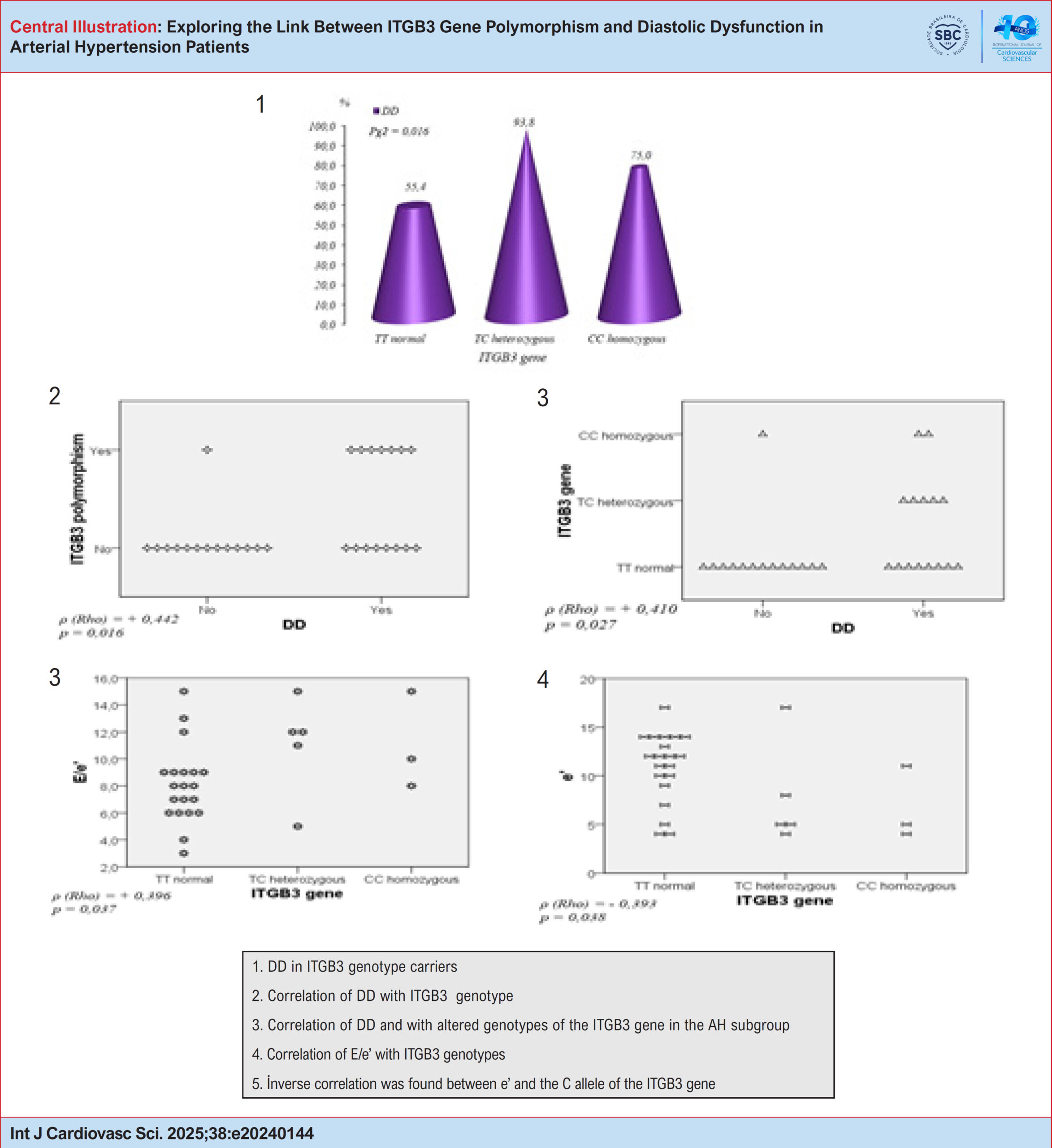
The study reported a significant association between ITGB3 gene polymorphisms and DD in AH patients. The T/C, C/C genotypes were particularly correlated with DD. The C/C variant, while more frequent in the AH group, did not reach statistical significance. A direct correlation was observed between DD and the C allele of the ITGB3 gene, with a higher E/e’ ratio and lower e’ velocity among carriers.

Conclusion:

This study highlights a significant association between ITGB3 gene polymorphisms and DD in Azerbaijani patients with AH. These findings suggest the potential for genetic screening to identify individuals at higher risk of DD among hypertensive patients, underscoring the importance of personalized approaches in managing hypertension and its complications. Further research with larger and more diverse cohorts is needed to validate these results and explore the underlying mechanisms.
  • Genetic Polymorphism
  • Hypertension
  • Ventricular Dysfunction
Read Full Article
Creative Commons Attribution (CC BY) Creative Commons license
02/06/2025 DOI: 10.36660/ijcs.20240144 Views 1
Influence of Insertion/Deletion Polymorphism of the Angiotensin Converting Enzyme Gene on Adiposity and Cardiac Function in Patients with Heart Failure
ABC
Original Article

Influence of Insertion/Deletion Polymorphism of the Angiotensin Converting Enzyme Gene on Adiposity and Cardiac Function in Patients with Heart Failure

Marla Darlene Machado Vale et al. Édina Caroline Ternus Ribeiro Ingrid da Silveira Knobloch Ida Vanessa Doederlein Schwartz … Fernanda Sperb-Ludwig Gabriela Corrêa Souza

Abstract

Background

The angiotensin-converting enzyme (ACE) insertion/deletion (I/D) polymorphism (rs4340) is associated with the pathogenesis of heart failure (HF). This polymorphism may contribute to a greater propensity for severe HF and excess weight.

Objective

To evaluate adiposity, cardiac function, and their association with ACE I/D polymorphism in HF patients.

Methods

Cross-sectional study with ambulatory individuals ≥18 years diagnosed with HF. Genetic analysis was performed using polymerase chain reaction followed by agarose gel electrophoresis. Left ventricular ejection fraction (LVEF) was determined by echocardiography. Nutritional status was assessed using body mass index, while adiposity was analyzed using bioelectrical impedance analysis (BIA), waist circumference, waist-to-hip ratio, and waist-to-height ratio. The adopted significance level was 5% (p < 0.05).

Results

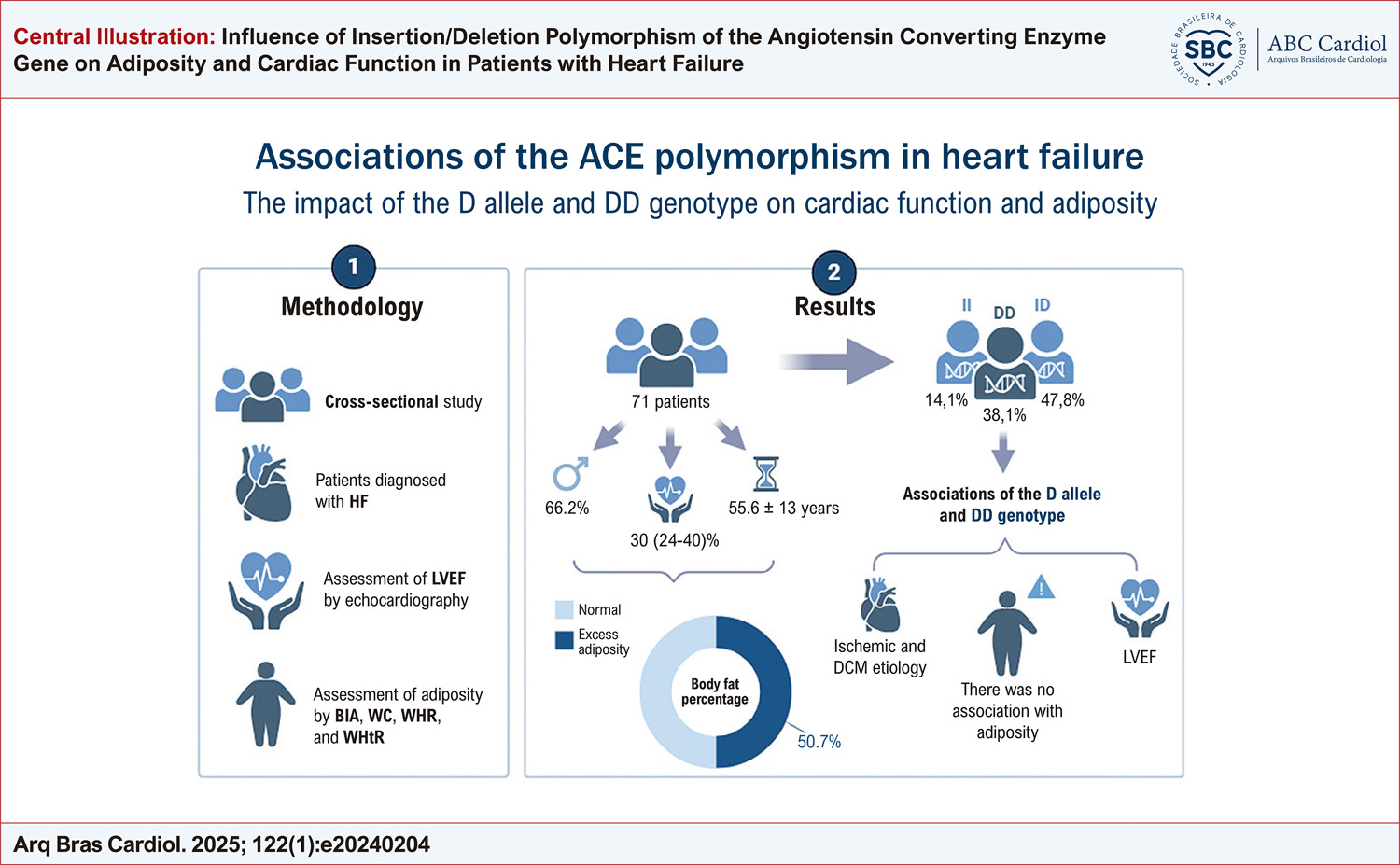
Seventy-one individuals were included, with a mean age of 55.8 ± 13.0 years, predominantly male (66.2%), with functional class I and II (90.9%), and a median LVEF of 30% (24-40). The prevalence of overweight was 38%, class I obesity was 23.9%, and class II and III obesity was 12.7%, with 50.7% exhibiting excess adiposity as assessed by BIA. A total of 88 D alleles and 54 I alleles of the ACE gene were identified. Regarding ACE genotypes, 38.1% were DD, 47.8% were ID, and 14.1% were II. In the multivariate analysis, the D allele (DD + ID genotypes versus II) was associated with LVEF (PR 0.995; 95% CI 0.991–1.000; p = 0.048) and with the etiology of HF (dilated cardiomyopathy: PR 1.283; 95% CI 1.039–1.583; p = 0.021). No independent association was found with adiposity.

Conclusion

The presence of the D allele of the ACE polymorphism is associated with LVEF and HF etiology. Despite overweight being prevalent in the sample, no independent associations were found.

  • Adiposity
  • Genetic Polymorphism
  • Heart Failure
Read Full Article
Creative Commons Attribution (CC BY) Creative Commons license
20/01/2025 DOI: 10.36660/abc.20240204i Views 1
Figure 1
ABC
Artigo Original

Angiotensin-converting enzyme genetic polymorphism: its impact on cardiac remodeling

Felipe Neves de Albuquerque et al. Andréa Araujo Brandão Dayse Aparecida da Silva Ricardo Mourilhe-Rocha … Gustavo Salgado Duque Alyne Freitas Pereira Gondar Luiza Maceira de Almeida Neves Marcelo Imbroinise Bittencourt Roberto Pozzan Denilson Campos de Albuquerque

Background:

The role of angiotensin-converting enzyme genetic polymorphisms as a predictor of echocardiographic outcomes on heart failure is yet to be established. The local profile should be identified so that the impact of those genotypes on the Brazilian population could be identified. This is the first study on exclusively non-ischemic heart failure over a follow-up longer than 5 years.

Objective:

To determine the distribution of angiotensin-converting enzyme genetic polymorphism variants and their relation with echocardiographic outcome of patients with non-ischemic heart failure.

Methods:

Secondary analysis of the medical records of 111 patients and identification of the angiotensin-converting enzyme genetic polymorphism variants, classified as DD (Deletion/Deletion), DI (Deletion/Insertion) or II (Insertion/Insertion).

Results:

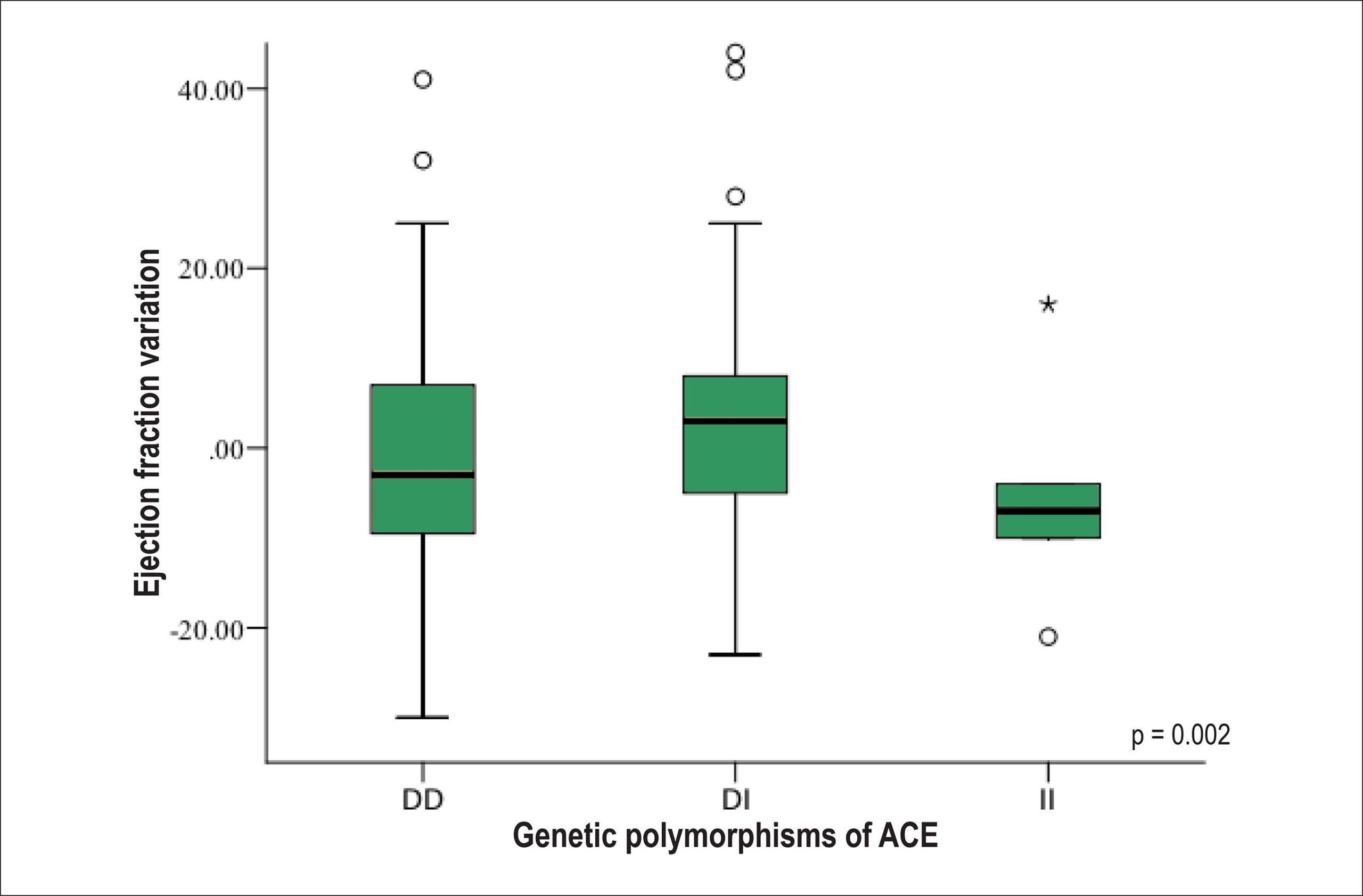
The cohort means were as follows: follow-up, 64.9 months; age, 59.5 years; male sex, 60.4%; white skin color, 51.4%; use of beta-blockers, 98.2%; and use of angiotensin-converting-enzyme inhibitors or angiotensin receptor blocker, 89.2%. The angiotensin-converting enzyme genetic polymorphism distribution was as follows: DD, 51.4%; DI, 44.1%; and II, 4.5%. No difference regarding the clinical characteristics or treatment was observed between the groups. The final left ventricular systolic diameter was the only isolated echocardiographic variable that significantly differed between the angiotensin-converting enzyme genetic polymorphisms: 59.2 ± 1.8 for DD versus 52.3 ± 1.9 for DI versus 59.2 ± 5.2 for II (p = 0.029). Considering the evolutionary behavior, all echocardiographic variables (difference between the left ventricular ejection fraction at the last and first consultation; difference between the left ventricular systolic diameter at the last and first consultation; and difference between the left ventricular diastolic diameter at the last and first consultation) differed between the genotypes (p = 0.024; p = 0.002; and p = 0.021, respectively).

Conclusion:

The distribution of the angiotensin-converting enzyme genetic polymorphisms differed from that of other studies with a very small number of II. The DD genotype was independently associated with worse echocardiographic outcome, while the DI genotype, with the best echocardiographic profile (increased left ventricular ejection fraction and decreased left ventricular diameters).

  • angiotensin-converting enzyme
  • Genetic Polymorphism
  • Heart Failure
Read Full Article
Creative Commons Attribution (CC BY) Creative Commons license
26/11/2013 DOI: 10.5935/abc.20130229 Views 1

How to cite this article

EndNote RIS

Electronic Document Format (Vancouver)

Nazirova V, Ismibayli Z, Gafarov I, Guliyev F, Kyriazis K. Exploring the Link Between ITGB3 Gene Polymorphism and Diastolic Dysfunction in Arterial Hypertension Patients. International Journal of Cardiovascular Sciences 2025;38:e20240144.

Electronic Document Format (ABNT)

Nazirova, Vafa; Ismibayli, Zumrud; Gafarov, Ismail; Guliyev, Faig; Kyriazis, Konstantinos. Exploring the Link Between ITGB3 Gene Polymorphism and Diastolic Dysfunction in Arterial Hypertension Patients. International Journal of Cardiovascular Sciences, v. 38, e20240144, Jun. 2025.

Electronic Document Format (APA)

Nazirova, V., Ismibayli, Z., Gafarov, I., Guliyev, F., & Kyriazis, K. (2025). Exploring the Link Between ITGB3 Gene Polymorphism and Diastolic Dysfunction in Arterial Hypertension Patients. International Journal of Cardiovascular Sciences, 38, e20240144.

Electronic Document Format (ISO)

Nazirova, Vafa and Ismibayli, Zumrud and Gafarov, Ismail and Guliyev, Faig and Kyriazis, Konstantinos. Exploring the Link Between ITGB3 Gene Polymorphism and Diastolic Dysfunction in Arterial Hypertension Patients. International Journal of Cardiovascular Sciences [online]. 2025, vol. 38, [cited 2026-10-15], e20240144. Available from: <https://journals.cardiol.br/en/article/exploring-the-link-between-itgb3-gene-polymorphism-and-diastolic-dysfunction-in-arterial-hypertension-patients/>. ISSN 2359-4802

EndNote RIS

Electronic Document Format (Vancouver)

Vale MDM, Ribeiro CT, Knobloch IS, Schwartz IVD, Sperb-Ludwig F, Souza GC. Influence of Insertion/Deletion Polymorphism of the Angiotensin Converting Enzyme Gene on Adiposity and Cardiac Function in Patients with Heart Failure. Arquivos Brasileiros de Cardiologia 2025;122(1):e20240204.

Electronic Document Format (ABNT)

Vale, Marla Darlene Machado; Ribeiro, Édina Caroline Ternus; Knobloch, Ingrid da Silveira; Schwartz, Ida Vanessa Doederlein; Sperb-Ludwig, Fernanda; Souza, Gabriela Corrêa. Influence of Insertion/Deletion Polymorphism of the Angiotensin Converting Enzyme Gene on Adiposity and Cardiac Function in Patients with Heart Failure. Arquivos Brasileiros de Cardiologia, v. 122, n. 1, e20240204, Jan. 2025.

Electronic Document Format (APA)

Vale, M. D. M., Ribeiro, C. T., Knobloch, I. S., Schwartz, I. V. D., Sperb-Ludwig, F., & Souza, G. C. (2025). Influence of Insertion/Deletion Polymorphism of the Angiotensin Converting Enzyme Gene on Adiposity and Cardiac Function in Patients with Heart Failure. Arquivos Brasileiros de Cardiologia, 122(1), e20240204.

Electronic Document Format (ISO)

Vale, Marla Darlene Machado and Ribeiro, Édina Caroline Ternus and Knobloch, Ingrid da Silveira and Schwartz, Ida Vanessa Doederlein and Sperb-Ludwig, Fernanda and Souza, Gabriela Corrêa. Influence of Insertion/Deletion Polymorphism of the Angiotensin Converting Enzyme Gene on Adiposity and Cardiac Function in Patients with Heart Failure. Arquivos Brasileiros de Cardiologia [online]. 2025, vol. 122, n. 1, [cited 2026-10-15], e20240204. Available from: <https://journals.cardiol.br/en/article/influence-of-insertion-deletion-polymorphism-of-the-angiotensin-converting-enzyme-gene-on-adiposity-and-cardiac-function-in-patients-with-heart-failure/>. ISSN 0066-782X

EndNote RIS

Electronic Document Format (Vancouver)

Albuquerque FN, Brandão AA, Silva DA, Mourilhe-Rocha R, Duque GS, Gondar AFP, Neves LMA, et al. Angiotensin-converting enzyme genetic polymorphism: its impact on cardiac remodeling. Arquivos Brasileiros de Cardiologia 2013;102(1):70-9.

Electronic Document Format (ABNT)

Albuquerque, Felipe Neves de; Brandão, Andréa Araujo; Silva, Dayse Aparecida da; Mourilhe-Rocha, Ricardo; Duque, Gustavo Salgado; Gondar, Alyne Freitas Pereira; Neves, Luiza Maceira de Almeida; Bittencourt, Marcelo Imbroinise; Pozzan, Roberto; Albuquerque, Denilson Campos de. Angiotensin-converting enzyme genetic polymorphism: its impact on cardiac remodeling. Arquivos Brasileiros de Cardiologia, v. 102, n. 1, p. 70-79, Nov. 2013.

Electronic Document Format (APA)

Albuquerque, F. N. , Brandão, A. A., Silva, D. A. , Mourilhe-Rocha, R., Duque, G. S., Gondar, A. F. P., Neves, L. M. A., Bittencourt, M. I., Pozzan, R., & Albuquerque, D. C. (2013). Angiotensin-converting enzyme genetic polymorphism: its impact on cardiac remodeling. Arquivos Brasileiros de Cardiologia, 102(1), 70-79.

Electronic Document Format (ISO)

Albuquerque, Felipe Neves de and Brandão, Andréa Araujo and Silva, Dayse Aparecida da and Mourilhe-Rocha, Ricardo and Duque, Gustavo Salgado and Gondar, Alyne Freitas Pereira and Neves, Luiza Maceira de Almeida and Bittencourt, Marcelo Imbroinise and Pozzan, Roberto and Albuquerque, Denilson Campos de. Angiotensin-converting enzyme genetic polymorphism: its impact on cardiac remodeling. Arquivos Brasileiros de Cardiologia [online]. 2013, vol. 102, n. 1, [cited 2026-10-15], pp. 70-79. Available from: <https://journals.cardiol.br/en/article/angiotensin-converting-enzyme-genetic-polymorphism-its-impact-on-cardiac-remodeling/>. ISSN 0066-782X

  • About ABC Family
  • Internal Regulation
  • Editorial Board
  • Brazilian Society of Cardiology (SBC)

Issues

SBC Guidelines

  • Videos
  • Podcasts
  • News