ABC Family Arquivos Brasileiros de Cardiologia International Journal of Cardiovascular Sciences ABC Heart Failure & Cardiomyopathy ABC Imagem Cardiovascular
Português English
ABC Family
Português English
  • About
    • About ABC Family
    • Internal Regulation
    • Editorial Board
    • Brazilian Society of Cardiology (SBC)
  • Issues
  • SBC Guidelines
  • Content
    • Videos
    • Podcasts
    • News
  • About
    • About ABC Family
    • Internal Regulation
    • Editorial Board
    • Brazilian Society of Cardiology (SBC)
  • Issues
  • SBC Guidelines
  • Content
    • Videos
    • Podcasts
    • News

ABC Family

  • ABC Family
  • Arquivos Brasileiros de Cardiologia
  • International Journal of Cardiovascular Sciences
  • ABC Heart Failure & Cardiomyopathy
  • ABC Imagem Cardiovascular
Search in

No content found.

Journals
Ordering
Article types
Others

  1. Home
  2. Keyword: angiotensin-converting enzyme
Figure 1
ABC
Artigo Original

Angiotensin-converting enzyme genetic polymorphism: its impact on cardiac remodeling

Felipe Neves de Albuquerque et al. Andréa Araujo Brandão Dayse Aparecida da Silva Ricardo Mourilhe-Rocha … Gustavo Salgado Duque Alyne Freitas Pereira Gondar Luiza Maceira de Almeida Neves Marcelo Imbroinise Bittencourt Roberto Pozzan Denilson Campos de Albuquerque

Background:

The role of angiotensin-converting enzyme genetic polymorphisms as a predictor of echocardiographic outcomes on heart failure is yet to be established. The local profile should be identified so that the impact of those genotypes on the Brazilian population could be identified. This is the first study on exclusively non-ischemic heart failure over a follow-up longer than 5 years.

Objective:

To determine the distribution of angiotensin-converting enzyme genetic polymorphism variants and their relation with echocardiographic outcome of patients with non-ischemic heart failure.

Methods:

Secondary analysis of the medical records of 111 patients and identification of the angiotensin-converting enzyme genetic polymorphism variants, classified as DD (Deletion/Deletion), DI (Deletion/Insertion) or II (Insertion/Insertion).

Results:

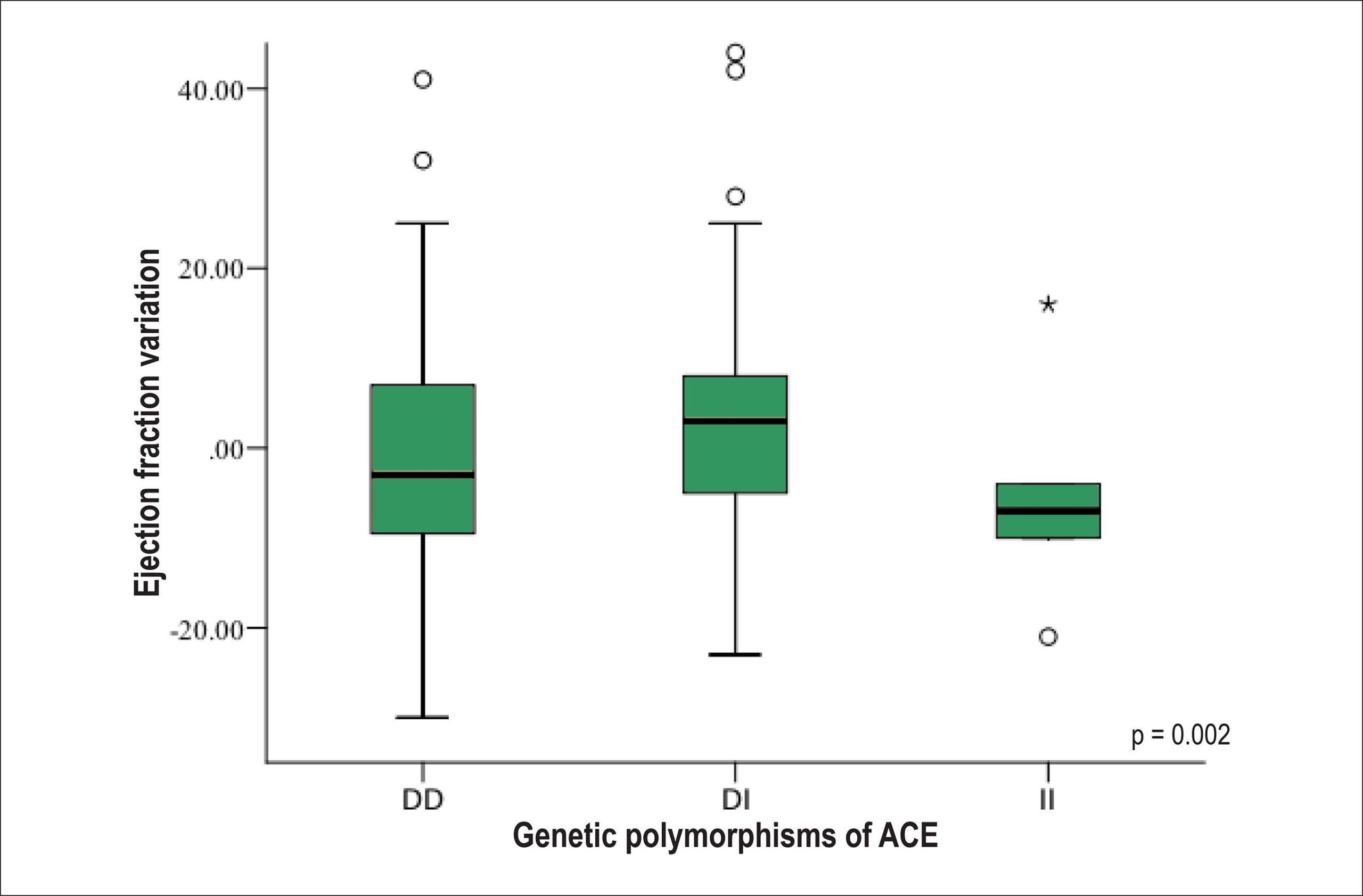
The cohort means were as follows: follow-up, 64.9 months; age, 59.5 years; male sex, 60.4%; white skin color, 51.4%; use of beta-blockers, 98.2%; and use of angiotensin-converting-enzyme inhibitors or angiotensin receptor blocker, 89.2%. The angiotensin-converting enzyme genetic polymorphism distribution was as follows: DD, 51.4%; DI, 44.1%; and II, 4.5%. No difference regarding the clinical characteristics or treatment was observed between the groups. The final left ventricular systolic diameter was the only isolated echocardiographic variable that significantly differed between the angiotensin-converting enzyme genetic polymorphisms: 59.2 ± 1.8 for DD versus 52.3 ± 1.9 for DI versus 59.2 ± 5.2 for II (p = 0.029). Considering the evolutionary behavior, all echocardiographic variables (difference between the left ventricular ejection fraction at the last and first consultation; difference between the left ventricular systolic diameter at the last and first consultation; and difference between the left ventricular diastolic diameter at the last and first consultation) differed between the genotypes (p = 0.024; p = 0.002; and p = 0.021, respectively).

Conclusion:

The distribution of the angiotensin-converting enzyme genetic polymorphisms differed from that of other studies with a very small number of II. The DD genotype was independently associated with worse echocardiographic outcome, while the DI genotype, with the best echocardiographic profile (increased left ventricular ejection fraction and decreased left ventricular diameters).
  • angiotensin-converting enzyme
  • Genetic Polymorphism
  • Heart Failure
Read Full Article
Creative Commons Attribution (CC BY) Creative Commons license
26/11/2013 DOI: 10.5935/abc.20130229 Views 1
The influence of ACE genotype on cardiovascular fitness of moderately active young men
ABC
Artigo Original

The influence of ACE genotype on cardiovascular fitness of moderately active young men

Jeeser Alves Almeida et al. Daniel Alexandre Boullosa Emerson Pardono Ricardo Moreno Lima … Pâmella Karoline Morais Benedito Sérgio Denadai Vinícius Carolino Souza Otávio Toledo Nóbrega Carmem Silvia Grubert Campbell Herbert Gustavo Simões

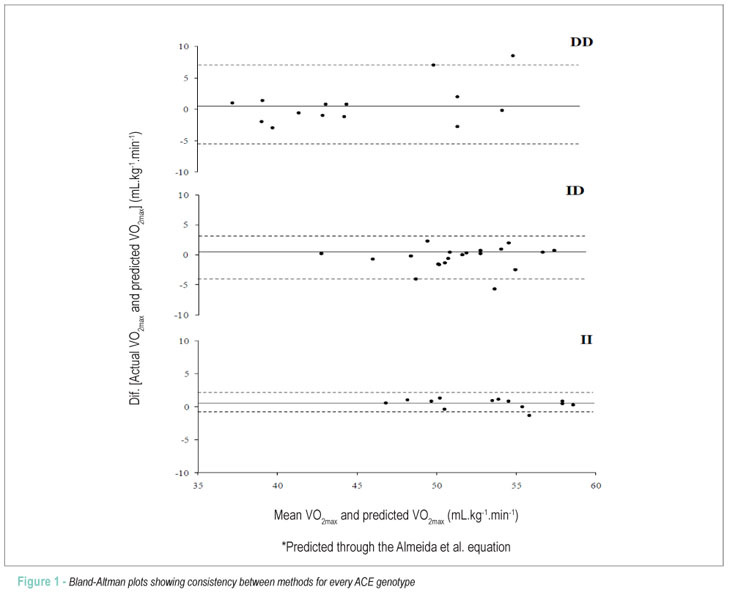
BACKGROUND: The angiotensin I-converting enzyme gene (ACE gene) has been broadly studied as for cardiorespiratory fitness phenotypes, but the association of the ACE genotype to middle-distance running has been poorly investigated. OBJECTIVE: This study investigated the possible influence of Angiotensin-Converting Enzyme (ACE) genotype (I/D) on cardiovascular fitness and middle-distance running performance of Brazilian young males. The validity of VO2max to predict the ACE genotype was also analyzed. METHODS: A homogeneous group of moderately active young males were evaluated in a 1,600 m running track test (V1600m; m.min-1) and in an incremental treadmill test for VO2max determination. Subsequently, the actual and the predicted [(0.177*V1600m) + 8.101] VO2max were compared to ACE genotypes. RESULTS: The VO2max and V1600m recorded for DD, ID and II genotypes were 45.6 (1.8); 51.9 (0.8) and 54.4 (1.0) mL.kg-1.min-1 and 211.2 (8.3); 249.1 (4.3) and 258.6 (5.4) m.min-1 respectively, and were significantly lower for DD carriers (p< 0.05). The actual and predicted VO2max did not differ from each other despite ACE genotype, but the agreement between actual and estimated VO2max methods was lower for the DD genotype. CONCLUSION: It was concluded that there is a possible association between ACE genotype, cardiovascular fitness and middle-distance running performance of moderately active young males and that the accuracy of VO2max prediction may also depend on the ACE genotype of the participants.

  • angiotensin-converting enzyme
  • I
  • middle-distance running
  • VO2max
Read Full Article
Creative Commons Attribution (CC BY) Creative Commons license
27/03/2012 DOI: 10.1590/S0066-782X2012005000029
Reduction in left ventricular hypertrophy in hypertensive patients treated with enalapril, losartan or the combination of enalapril and losartan
ABC
Original Article

Reduction in left ventricular hypertrophy in hypertensive patients treated with enalapril, losartan or the combination of enalapril and losartan

Antônio Carlos Avanza Jr et al. Lilian Mameri El Aouar José Geraldo Mill

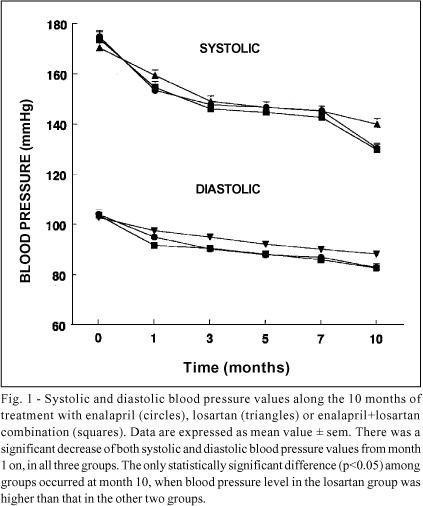
OBJECTIVE: To compare the regression of left ventricular hypertrophy in patients with moderate hypertension treated with enalapril, losartan or a combination of the two drugs at lower doses. METHODS: Patients of both sexes with moderate hypertension confirmed by ambulatory monitoring of arte-rial blood pressure and with left ventricular hypertrophy on echocardiogram were assigned to three groups: enalapril (35 mg/day, n=15), losartan (175 mg/day, n=15) and enalapril+losartan (15 mg+100 mg/day, n=16). The patients received the drugs for 10 months. RESULTS: The three therapeutic regimens were equally effective in reducing blood pressure and left ventricular mass index (LVMI, g/m²): 141±3.9 to 123±3.6 in the enalapril group (p<0.05), from 147±3.8 to 133±2.8 in the losartan group (p<0.05), and from 146±3.0 to 116±4.0 in the enalapril+losartan group (p<0.05). However, the percent reduction of LVMI was significantly greater (p<0.01) in the enalapril+losartan group (20.5±5.0%) than in enalapril (12.4±3.2%) and the losartan (9.1±2.1%) groups. Normalization of LVMI was obtained in 10 out of the 16 patients who received enalapril+ losartan, in 6 out of the 15 patients who received only enalapril and in 4 out of the 15 patients treated with losartan. CONCLUSION: The combination of an angiotensin-converting enzyme inhibitor and an angiotensin II receptor antagonist (AT1 receptor antagonist) in patients produced an additional effect on the reduction of left ventricular hypertrophy. This finding may depend on a more complete inhibition of the cardiac renin-angiotensin.

  • angiotensin-converting enzyme
  • Cardiac Hypertrophy
  • Hypertension
  • losartan
  • Renin-Angiotensin System
Read Full Article
Creative Commons Attribution (CC BY) Creative Commons license
05/09/2000 DOI: 10.1590/S0066-782X2000000200001

How to cite this article

EndNote RIS

Electronic Document Format (Vancouver)

Albuquerque FN, Brandão AA, Silva DA, Mourilhe-Rocha R, Duque GS, Gondar AFP, Neves LMA, et al. Angiotensin-converting enzyme genetic polymorphism: its impact on cardiac remodeling. Arquivos Brasileiros de Cardiologia 2013;102(1):70-9.

Electronic Document Format (ABNT)

Albuquerque, Felipe Neves de; Brandão, Andréa Araujo; Silva, Dayse Aparecida da; Mourilhe-Rocha, Ricardo; Duque, Gustavo Salgado; Gondar, Alyne Freitas Pereira; Neves, Luiza Maceira de Almeida; Bittencourt, Marcelo Imbroinise; Pozzan, Roberto; Albuquerque, Denilson Campos de. Angiotensin-converting enzyme genetic polymorphism: its impact on cardiac remodeling. Arquivos Brasileiros de Cardiologia, v. 102, n. 1, p. 70-79, Nov. 2013.

Electronic Document Format (APA)

Albuquerque, F. N. , Brandão, A. A., Silva, D. A. , Mourilhe-Rocha, R., Duque, G. S., Gondar, A. F. P., Neves, L. M. A., Bittencourt, M. I., Pozzan, R., & Albuquerque, D. C. (2013). Angiotensin-converting enzyme genetic polymorphism: its impact on cardiac remodeling. Arquivos Brasileiros de Cardiologia, 102(1), 70-79.

Electronic Document Format (ISO)

Albuquerque, Felipe Neves de and Brandão, Andréa Araujo and Silva, Dayse Aparecida da and Mourilhe-Rocha, Ricardo and Duque, Gustavo Salgado and Gondar, Alyne Freitas Pereira and Neves, Luiza Maceira de Almeida and Bittencourt, Marcelo Imbroinise and Pozzan, Roberto and Albuquerque, Denilson Campos de. Angiotensin-converting enzyme genetic polymorphism: its impact on cardiac remodeling. Arquivos Brasileiros de Cardiologia [online]. 2013, vol. 102, n. 1, [cited 2026-10-14], pp. 70-79. Available from: <https://journals.cardiol.br/en/article/angiotensin-converting-enzyme-genetic-polymorphism-its-impact-on-cardiac-remodeling/>. ISSN 0066-782X

EndNote RIS

Electronic Document Format (Vancouver)

Almeida JA, Boullosa DA, Pardono E, Lima RM, Morais PK, Denadai BS, Souza VC, et al. The influence of ACE genotype on cardiovascular fitness of moderately active young men. Arquivos Brasileiros de Cardiologia 2012;98(4):315-20.

Electronic Document Format (ABNT)

Almeida, Jeeser Alves; Boullosa, Daniel Alexandre; Pardono, Emerson; Lima, Ricardo Moreno; Morais, Pâmella Karoline; Denadai, Benedito Sérgio; Souza, Vinícius Carolino; Nóbrega, Otávio Toledo; Campbell, Carmem Silvia Grubert; Simões, Herbert Gustavo. The influence of ACE genotype on cardiovascular fitness of moderately active young men. Arquivos Brasileiros de Cardiologia, v. 98, n. 4, p. 315-320, Mar. 2012.

Electronic Document Format (APA)

Almeida, J. A., Boullosa, D. A., Pardono, E., Lima, R. M., Morais, P. K., Denadai, B. S., Souza, V. C., Nóbrega, O. T., Campbell, C. S. G., & Simões, H. G. (2012). The influence of ACE genotype on cardiovascular fitness of moderately active young men. Arquivos Brasileiros de Cardiologia, 98(4), 315-320.

Electronic Document Format (ISO)

Almeida, Jeeser Alves and Boullosa, Daniel Alexandre and Pardono, Emerson and Lima, Ricardo Moreno and Morais, Pâmella Karoline and Denadai, Benedito Sérgio and Souza, Vinícius Carolino and Nóbrega, Otávio Toledo and Campbell, Carmem Silvia Grubert and Simões, Herbert Gustavo. The influence of ACE genotype on cardiovascular fitness of moderately active young men. Arquivos Brasileiros de Cardiologia [online]. 2012, vol. 98, n. 4, [cited 2026-10-14], pp. 315-320. Available from: <https://journals.cardiol.br/en/article/the-influence-of-ace-genotype-on-cardiovascular-fitness-of-moderately-active-young-men/>. ISSN 0066-782X

EndNote RIS

Electronic Document Format (Vancouver)

Avanza Jr AC, Aouar LME, Mill JG. Reduction in left ventricular hypertrophy in hypertensive patients treated with enalapril, losartan or the combination of enalapril and losartan. Arquivos Brasileiros de Cardiologia 2000;74(2):111-7.

Electronic Document Format (ABNT)

Avanza Jr, Antônio Carlos; Aouar, Lilian Mameri El; Mill, José Geraldo. Reduction in left ventricular hypertrophy in hypertensive patients treated with enalapril, losartan or the combination of enalapril and losartan. Arquivos Brasileiros de Cardiologia, v. 74, n. 2, p. 111-117, Sep. 2000.

Electronic Document Format (APA)

Avanza Jr, A. C., Aouar, L. M. E., & Mill, J. G. (2000). Reduction in left ventricular hypertrophy in hypertensive patients treated with enalapril, losartan or the combination of enalapril and losartan. Arquivos Brasileiros de Cardiologia, 74(2), 111-117.

Electronic Document Format (ISO)

Avanza Jr, Antônio Carlos and Aouar, Lilian Mameri El and Mill, José Geraldo. Reduction in left ventricular hypertrophy in hypertensive patients treated with enalapril, losartan or the combination of enalapril and losartan. Arquivos Brasileiros de Cardiologia [online]. 2000, vol. 74, n. 2, [cited 2026-10-14], pp. 111-117. Available from: <https://journals.cardiol.br/en/article/reduction-in-left-ventricular-hypertrophy-in-hypertensive-patients-treated-with-enalapril-losartan-or-the-combination-of-enalapril-and-losartan/>. ISSN 0066-782X

  • About ABC Family
  • Internal Regulation
  • Editorial Board
  • Brazilian Society of Cardiology (SBC)

Issues

SBC Guidelines

  • Videos
  • Podcasts
  • News