ABC Family Arquivos Brasileiros de Cardiologia International Journal of Cardiovascular Sciences ABC Heart Failure & Cardiomyopathy ABC Imagem Cardiovascular
Português English
ABC Family
Português English
  • About
    • About ABC Family
    • Internal Regulation
    • Editorial Board
    • Brazilian Society of Cardiology (SBC)
  • Issues
  • SBC Guidelines
  • Content
    • Videos
    • Podcasts
    • News
  • About
    • About ABC Family
    • Internal Regulation
    • Editorial Board
    • Brazilian Society of Cardiology (SBC)
  • Issues
  • SBC Guidelines
  • Content
    • Videos
    • Podcasts
    • News

ABC Family

  • ABC Family
  • Arquivos Brasileiros de Cardiologia
  • International Journal of Cardiovascular Sciences
  • ABC Heart Failure & Cardiomyopathy
  • ABC Imagem Cardiovascular
Search in

No content found.

Journals
Ordering
Article types
Others

  1. Home
  2. Keyword: Gastrointestinal Microbiome
The Causal Relationship between Gut Microbiota and Atrial Fibrillation: A Two-Sample Mendelian Randomization Study
ABC
Original Article

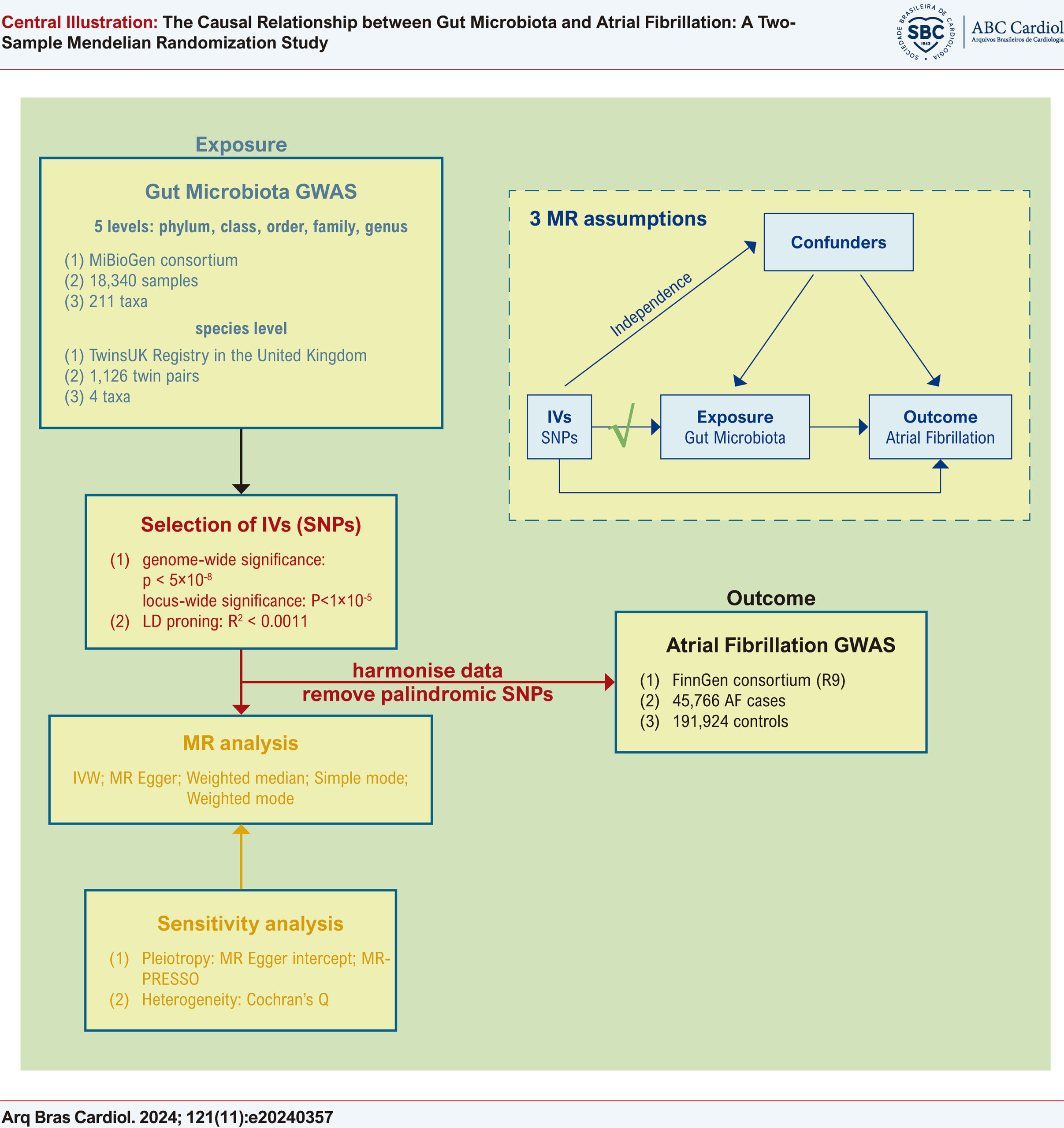
The Causal Relationship between Gut Microbiota and Atrial Fibrillation: A Two-Sample Mendelian Randomization Study

Yuan Zhou et al. Xuan Wang Jiongchao Guo Lei Zhang Huangsheng Zheng

Abstract

Background

Previous studies have adequately characterized the gut microbiota (GM) in atrial fibrillation (AF). Nevertheless, the precise causality between GM and AF remains elusive.

Objectives

This study utilized public data from genome-wide association studies to explore the causality between GM and AF.

Methods

In the first of two rounds of Mendelian randomization (MR) analysis, the instrumental variables (IVs) comprised single nucleotide polymorphisms (SNPs) that fell below the genome-wide statistical significance threshold (5 × 10⁻⁸). To attain a more comprehensive and inclusive conclusion, we further selected SNPs falling below the locus-wide significance level (1 × 10⁻⁵) as IVs for the second group. The MR analysis considered the statistically significant causal effect between the specific GM and AF when p 0.05 indicated no heterogeneity and pleiotropy.

Results

At the locus-wide significance threshold, the findings demonstrated a causal impact of GM on AF risk. The inverse variance weighting method indicated that Actinobacteria, Firmicutes, Alloprevotella, Bifidobacterium, Blautia, Eggerthella, Howardella, Ruminococcaceae UCG004, and Ruminococcus1 were negatively correlated with AF, while Pasteurellales, Pasteurellaceae, Oxalobacter, Ruminiclostridium5, and Turicibacter were positively correlated. Furthermore, at the genome-wide significance threshold, Actinobacteria, Bifidobacteriaceae, and Bifidobacterium were protective factors for the risk of developing AF, whereas Oxalobacteraceae and Erysipelatoclostridium were risk factors for AF. However, sensitivity analyses showed heterogeneity or horizontal pleiotropy within the outcomes for Actinobacteria, Howardella, Oxalobacter, and Firmicutes.

Conclusions

This study provides evidence for the existence of both favorable and unfavorable causality of GM on AF risk.
  • Atrial Fibrillation
  • Cardiovascular Diseases
  • Gastrointestinal Microbiome
  • Mendelian Randomization Analysis
Read Full Article
Creative Commons Attribution (CC BY) Creative Commons license
06/12/2024 DOI: 10.36660/abc.20240357i Views 1
Figure 1
ABCHF
Research Letter

The Heart-Gut Microbiome Intersection in Heart Failure

Jefferson L. Vieira et al. Alessandra F.R.R. Sidrim Mandeep R. Mehra

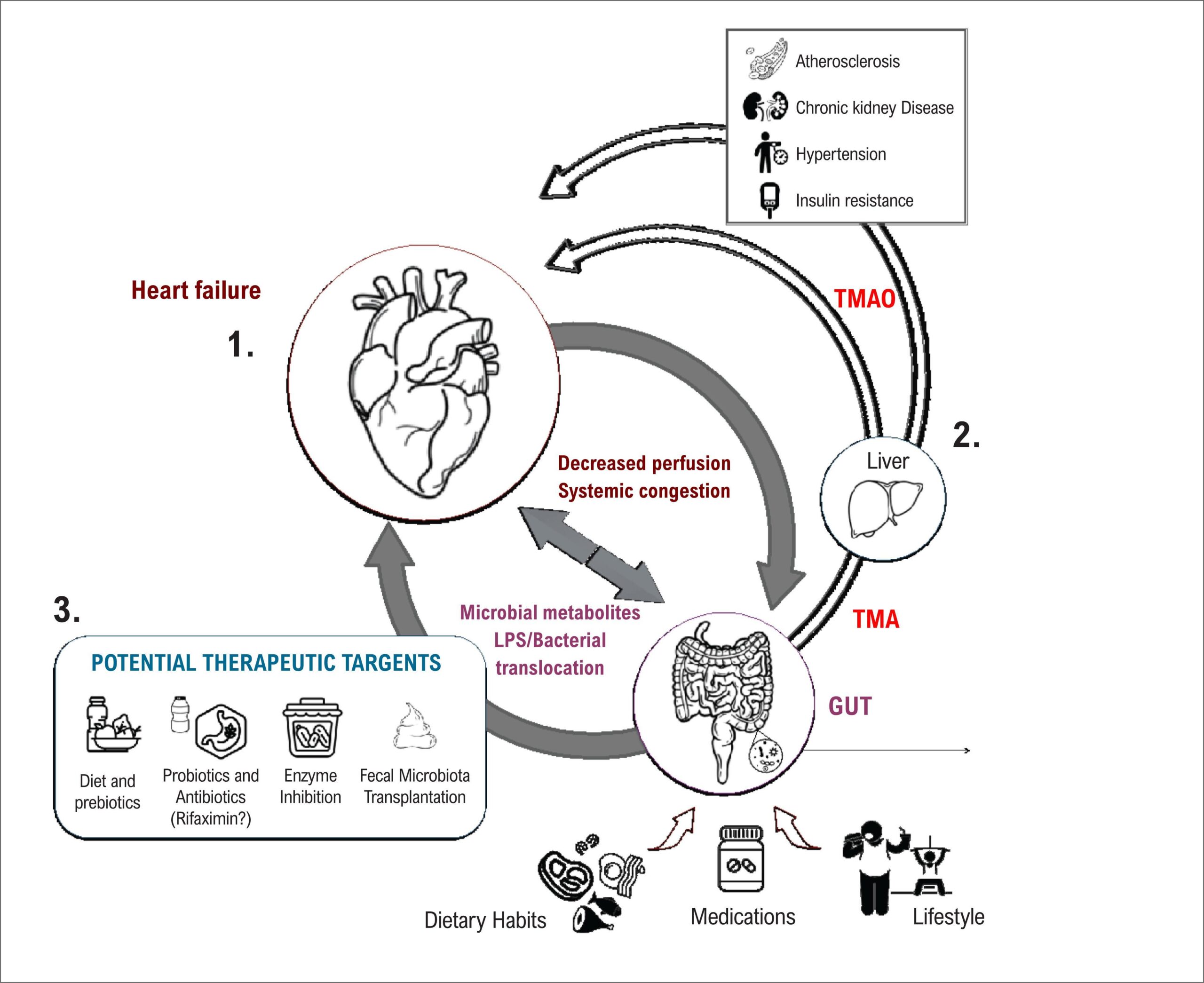
The human body is co-inhabited by over a trillion microorganisms, including > 2000 species of bacteria, archaea, viruses, and single-celled eukaryotes that live symbiotically with their hosts. The gut microbiota is a dynamic and complex ecological community in the gastrointestinal tract, an essentially anaerobic environment with abundant nutrients and ideal conditions for colonization; it acts as a virtual endocrine system that communicates with organs through metabolism-dependent pathways, releasing de novo products and transforming external nutrients and host metabolites into hormone-like signals.

In addition to metabolic benefits, the gut microbiota provides essential capacities for regulating the intestinal epithelial barrier, immune homeostasis, optimal immune responses, and protection against pathogen colonization.– One of the most important roles of gut microbiota is to act in digestion and nutrient absorption, producing short-chain fatty acids that serve as energy substrate for intestinal epithelial cells. After short-chain fatty acids bind to their receptor, the enteroendocrine hormone peptide YY is released, which regulates host appetite and contributes to dietary energy availability. Intestinal flora act to convert various dietary nutrients into trimethylamine, which is rapidly absorbed and oxidized in the liver to produce trimethylamine N-oxide (TMAO). Some foods, like red meat, eggs, and fish, are rich in nutritional precursors that can be converted into trimethylamine through specific microbial enzymes; therefore, a change in microbiota composition can alter circulating TMAO levels.

[…]

  • Dysbiosis
  • Gastrointestinal Microbiome
  • Heart Failure
Read Full Article
Creative Commons Attribution (CC BY) Creative Commons license
29/06/2022 DOI: 10.36660/abchf.20220039

How to cite this article

EndNote RIS

Electronic Document Format (Vancouver)

Zhou Y, Wang X, Guo J, Zhang L, Zheng H. The Causal Relationship between Gut Microbiota and Atrial Fibrillation: A Two-Sample Mendelian Randomization Study. Arquivos Brasileiros de Cardiologia 2024;121(11):e20240357.

Electronic Document Format (ABNT)

Zhou, Yuan; Wang, Xuan; Guo, Jiongchao; Zhang, Lei; Zheng, Huangsheng. The Causal Relationship between Gut Microbiota and Atrial Fibrillation: A Two-Sample Mendelian Randomization Study. Arquivos Brasileiros de Cardiologia, v. 121, n. 11, e20240357, Dec. 2024.

Electronic Document Format (APA)

Zhou, Y., Wang, X., Guo, J., Zhang, L., & Zheng, H. (2024). The Causal Relationship between Gut Microbiota and Atrial Fibrillation: A Two-Sample Mendelian Randomization Study. Arquivos Brasileiros de Cardiologia, 121(11), e20240357.

Electronic Document Format (ISO)

Zhou, Yuan and Wang, Xuan and Guo, Jiongchao and Zhang, Lei and Zheng, Huangsheng. The Causal Relationship between Gut Microbiota and Atrial Fibrillation: A Two-Sample Mendelian Randomization Study. Arquivos Brasileiros de Cardiologia [online]. 2024, vol. 121, n. 11, [cited 2026-10-14], e20240357. Available from: <https://journals.cardiol.br/en/article/the-causal-relationship-between-gut-microbiota-and-atrial-fibrillation-a-two-sample-mendelian-randomization-study/>. ISSN 0066-782X

EndNote RIS

Electronic Document Format (Vancouver)

Vieira JL, Sidrim AF, Mehra MR. The Heart-Gut Microbiome Intersection in Heart Failure. ABC: Heart Failure & Cardiomyopathy 2022;2(2):222-5.

Electronic Document Format (ABNT)

Vieira, Jefferson L.; Sidrim, Alessandra F.R.R.; Mehra, Mandeep R.. The Heart-Gut Microbiome Intersection in Heart Failure. ABC: Heart Failure & Cardiomyopathy, v. 2, n. 2, p. 222-225, Jun. 2022.

Electronic Document Format (APA)

Vieira, J. L., Sidrim, A. F., & Mehra, M. R. (2022). The Heart-Gut Microbiome Intersection in Heart Failure. ABC: Heart Failure & Cardiomyopathy, 2(2), 222-225.

Electronic Document Format (ISO)

Vieira, Jefferson L. and Sidrim, Alessandra F.R.R. and Mehra, Mandeep R.. The Heart-Gut Microbiome Intersection in Heart Failure. ABC: Heart Failure & Cardiomyopathy [online]. 2022, vol. 2, n. 2, [cited 2026-10-14], pp. 222-225. Available from: <https://journals.cardiol.br/en/article/the-heart-gut-microbiome-intersection-in-heart-failure/>

  • About ABC Family
  • Internal Regulation
  • Editorial Board
  • Brazilian Society of Cardiology (SBC)

Issues

SBC Guidelines

  • Videos
  • Podcasts
  • News