ABC Family Arquivos Brasileiros de Cardiologia International Journal of Cardiovascular Sciences ABC Heart Failure & Cardiomyopathy ABC Imagem Cardiovascular
Português English
ABC Family
Português English
  • About
    • About ABC Family
    • Internal Regulation
    • Editorial Board
    • Brazilian Society of Cardiology (SBC)
  • Issues
  • SBC Guidelines
  • Content
    • Videos
    • Podcasts
    • News
  • About
    • About ABC Family
    • Internal Regulation
    • Editorial Board
    • Brazilian Society of Cardiology (SBC)
  • Issues
  • SBC Guidelines
  • Content
    • Videos
    • Podcasts
    • News

ABC Family

  • ABC Family
  • Arquivos Brasileiros de Cardiologia
  • International Journal of Cardiovascular Sciences
  • ABC Heart Failure & Cardiomyopathy
  • ABC Imagem Cardiovascular
Search in

No content found.

Journals
Ordering
Article types
Others

  1. Home
  2. Keyword: Fondaparinux
ABC
Editorial

Radial Access and Fondaparinux: A Synergistic Interaction

Pedro Beraldo de Andrade et al. Leonardo Maróstica Alves Silva

The consolidation of antithrombotic treatment based on dual antiplatelet therapy with aspirin and P2Y12 receptor inhibitors, the routine adoption of invasive risk stratification, the technical refinement of percutaneous coronary intervention (PCI), with greater use of intravascular imaging as an adjunctive tool to guide procedures, as well as the technological evolution of coronary stents, culminated in a temporal decline over the last two decades in the occurrence of ischemic complications in patients admitted with non-ST-segment elevation acute coronary syndrome (NSTEMI). In this context, the risk of bleeding is no longer tolerated as an inherent complication of anti-ischemic treatment. Still, it has come to play a central role in the search for a balance between efficacy and safety in the clinical management of this patient profile. The importance of bleeding risk was achieved through publications demonstrating that major bleeding, whether related to PCI arterial access or bleeding in the central nervous system, digestive tract, or genitourinary system, was associated with a worse prognosis, with morbidity and mortality similar to or exceeding recurrent ischemic events.,

In 2010, the concept of “Bleeding Avoidance Strategies” emerged, consisting of a set of measures associated with high-quality, cost-effective clinical practice, whose metrics demonstrate its ability to mitigate major bleeding rates in patients undergoing invasive risk stratification ()..,

[…]

  • Fondaparinux
  • Non-ST Elevated Myocardial Infarction
  • Radial Artery
Read Full Article
Creative Commons Attribution (CC BY) Creative Commons license
01/12/2025 DOI: 10.36660/abc.20250556i Views 2
Fondaparinux versus Enoxaparin in the Treatment of Obese Patients with Acute Coronary Syndrome
ABC
Original Article

Fondaparinux versus Enoxaparin in the Treatment of Obese Patients with Acute Coronary Syndrome

Beatriz Rocha Darzé et al. Carolina Costa da Silva Souza Queila Borges de Oliveira João Victor Santos Pereira Ramos … Mateus S. Viana Eduardo Sahade Darzé Luiz Eduardo Fonteles Ritt

Abstract

Background:

Fondaparinux is an effective and safe anticoagulant in the treatment of acute coronary syndromes (ACS). However, due to the low representation of obese individuals in clinical trials, the effects of applying the results of this drug to this population remain uncertain.

Objectives:

To compare Fondaparinux to Enoxaparin in the treatment of obese patients with ACS.

Methods:

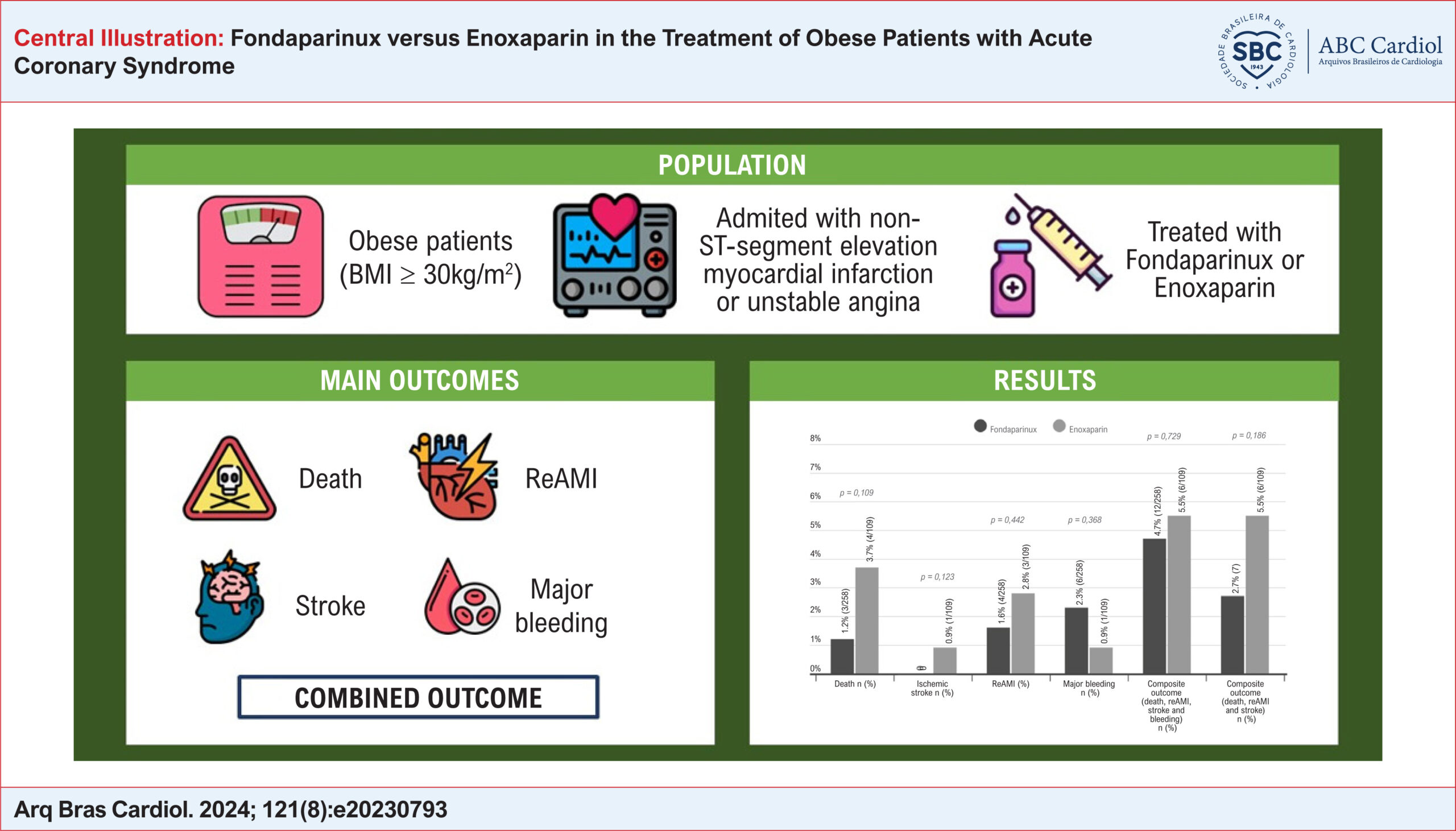
This is a retrospective cohort study, including obese individuals (BMI ≥ 30 Kg/m2) admitted with non-ST-segment elevation myocardial infarction (NSTEMI) or unstable angina (UA) and treated with Fondaparinux or Enoxaparin between 2010 and 2020. The Fondaparinux and Enoxaparin groups were compared for their clinical and laboratory characteristics using chi-square and Mann-Whitney tests, as appropriate. The incidence of primary outcomes (death, reinfarction, stroke, major bleeding) was compared between groups. P-value < 0.05 was considered significant for all analyses.

Results:

A total of 367 obese patients with NSTEMI or UA were included, of whom 258 used Fondaparinux and 109 used Enoxaparin. Mean age was 64 ± 12 years, and 52.9% were male. The prevalence of diabetes, hypertension, dyslipidemia, prior coronary artery disease, prior stroke, and implementation of invasive strategy was similar between groups. The incidence of the primary outcome was 4.7% in the Fondaparinux group and 5.5% in the Enoxaparin group (p = 0.729). There was no difference between groups when analyzing the components of the primary outcome separately.

Conclusion:

In a sample of obese patients with NSTEMI or UA, there was no difference in the occurrence of the composite outcome (death, stroke, reinfarction, major bleeding) between patients who used Fondaparinux or Enoxaparin.

  • Acute coronary syndrome
  • Anticoagulants
  • Enoxaparin
  • Fondaparinux
  • Obesity
Read Full Article
Creative Commons Attribution (CC BY) Creative Commons license
23/09/2024 DOI: 10.36660/abc.20230793i Views 2
ABC
Editorial

Use of Anticoagulant Therapy in Obese People: What is the Evidence for the Ideal Dose?

Marcia M. Noya-Rabelo et al. Eduardo Novaes Renata Moll-Bernardes Olga Souza

Data from the World Health Organization indicate that more than 1 billion people in the world, one in eight, are obese. In Brazil, according to research by the Chronic Disease Risk Factor Surveillance by Telephone Survey (VIGITEC), one in every four people in the adult population is obese. Obesity is defined by a body mass index (BMI) greater than or equal to 30 kg/m2, while morbid obesity is considered for those with a BMI above 40 kg/m2. Epidemiological data also points to a high prevalence of coronary disease in the Brazilian population, estimated at 5 to 8%.

Although obesity rates have reached epidemic proportions worldwide, the medical literature lacks precise data on changes in the pharmacokinetics and pharmacodynamics of different medications in patients with obesity. Possible physiological differences between obese and non-obese individuals may result in differences in the distribution and elimination of drugs, important factors to be considered when determining the appropriate dosage for pharmacological treatment. The ideal dose of most anticoagulants for obese people has not been established, including low molecular weight heparin and pentasaccharides. In this way, the therapeutic management of patients with acute coronary syndrome (ACS) and obesity is challenging and, consequently, can influence the efficacy and safety of anticoagulants.

[…]

  • Acute coronary syndrome
  • Anticoagulants
  • Enoxaparin
  • Fondaparinux
  • Obesity
Read Full Article
Creative Commons Attribution (CC BY) Creative Commons license
23/09/2024 DOI: 10.36660/abc.20240496i Views 1

How to cite this article

EndNote RIS

Electronic Document Format (Vancouver)

Andrade PB, Silva LMA. Radial Access and Fondaparinux: A Synergistic Interaction. Arquivos Brasileiros de Cardiologia 2025;122(9):e20250556.

Electronic Document Format (ABNT)

Andrade, Pedro Beraldo de; Silva, Leonardo Maróstica Alves. Radial Access and Fondaparinux: A Synergistic Interaction. Arquivos Brasileiros de Cardiologia, v. 122, n. 9, e20250556, Nov. 2025.

Electronic Document Format (APA)

Andrade, P. B. , & Silva, L. M. A. (2025). Radial Access and Fondaparinux: A Synergistic Interaction. Arquivos Brasileiros de Cardiologia, 122(9), e20250556.

Electronic Document Format (ISO)

Andrade, Pedro Beraldo de and Silva, Leonardo Maróstica Alves. Radial Access and Fondaparinux: A Synergistic Interaction. Arquivos Brasileiros de Cardiologia [online]. 2025, vol. 122, n. 9, [cited 2026-10-14], e20250556. Available from: <https://journals.cardiol.br/en/article/radial-access-and-fondaparinux-a-synergistic-interaction/>. ISSN 0066-782X

EndNote RIS

Electronic Document Format (Vancouver)

Darzé BR, Souza CCS, Oliveira QB, Ramos JVSP, Viana MS, Darzé ES, Ritt LEF, et al. Fondaparinux versus Enoxaparin in the Treatment of Obese Patients with Acute Coronary Syndrome. Arquivos Brasileiros de Cardiologia 2024;121(8):e20230793.

Electronic Document Format (ABNT)

Darzé, Beatriz Rocha; Souza, Carolina Costa da Silva; Oliveira, Queila Borges de; Ramos, João Victor Santos Pereira; Viana, Mateus S.; Darzé, Eduardo Sahade; Ritt, Luiz Eduardo Fonteles. Fondaparinux versus Enoxaparin in the Treatment of Obese Patients with Acute Coronary Syndrome. Arquivos Brasileiros de Cardiologia, v. 121, n. 8, e20230793, Sep. 2024.

Electronic Document Format (APA)

Darzé, B. R., Souza, C. C. S., Oliveira, Q. B. , Ramos, J. V. S. P., Viana, M. S., Darzé, E. S., & Ritt, L. E. F. (2024). Fondaparinux versus Enoxaparin in the Treatment of Obese Patients with Acute Coronary Syndrome. Arquivos Brasileiros de Cardiologia, 121(8), e20230793.

Electronic Document Format (ISO)

Darzé, Beatriz Rocha and Souza, Carolina Costa da Silva and Oliveira, Queila Borges de and Ramos, João Victor Santos Pereira and Viana, Mateus S. and Darzé, Eduardo Sahade and Ritt, Luiz Eduardo Fonteles. Fondaparinux versus Enoxaparin in the Treatment of Obese Patients with Acute Coronary Syndrome. Arquivos Brasileiros de Cardiologia [online]. 2024, vol. 121, n. 8, [cited 2026-10-14], e20230793. Available from: <https://journals.cardiol.br/en/article/fondaparinux-versus-enoxaparin-in-the-treatment-of-obese-patients-with-acute-coronary-syndrome/>. ISSN 0066-782X

EndNote RIS

Electronic Document Format (Vancouver)

Noya-Rabelo MM, Novaes E, Moll-Bernardes R, Souza O. Use of Anticoagulant Therapy in Obese People: What is the Evidence for the Ideal Dose?. Arquivos Brasileiros de Cardiologia 2024;121(8):e20240496.

Electronic Document Format (ABNT)

Noya-Rabelo, Marcia M.; Novaes, Eduardo; Moll-Bernardes, Renata; Souza, Olga. Use of Anticoagulant Therapy in Obese People: What is the Evidence for the Ideal Dose?. Arquivos Brasileiros de Cardiologia, v. 121, n. 8, e20240496, Sep. 2024.

Electronic Document Format (APA)

Noya-Rabelo, M. M., Novaes, E., Moll-Bernardes, R., & Souza, O. (2024). Use of Anticoagulant Therapy in Obese People: What is the Evidence for the Ideal Dose?. Arquivos Brasileiros de Cardiologia, 121(8), e20240496.

Electronic Document Format (ISO)

Noya-Rabelo, Marcia M. and Novaes, Eduardo and Moll-Bernardes, Renata and Souza, Olga. Use of Anticoagulant Therapy in Obese People: What is the Evidence for the Ideal Dose?. Arquivos Brasileiros de Cardiologia [online]. 2024, vol. 121, n. 8, [cited 2026-10-14], e20240496. Available from: <https://journals.cardiol.br/en/article/use-of-anticoagulant-therapy-in-obese-people-what-is-the-evidence-for-the-ideal-dose/>. ISSN 0066-782X

  • About ABC Family
  • Internal Regulation
  • Editorial Board
  • Brazilian Society of Cardiology (SBC)

Issues

SBC Guidelines

  • Videos
  • Podcasts
  • News