ABC Family Arquivos Brasileiros de Cardiologia International Journal of Cardiovascular Sciences ABC Heart Failure & Cardiomyopathy ABC Imagem Cardiovascular
Português English
ABC Family
Português English
  • About
    • About ABC Family
    • Internal Regulation
    • Editorial Board
    • Brazilian Society of Cardiology (SBC)
  • Issues
  • SBC Guidelines
  • Content
    • Videos
    • Podcasts
    • News
  • About
    • About ABC Family
    • Internal Regulation
    • Editorial Board
    • Brazilian Society of Cardiology (SBC)
  • Issues
  • SBC Guidelines
  • Content
    • Videos
    • Podcasts
    • News

ABC Family

  • ABC Family
  • Arquivos Brasileiros de Cardiologia
  • International Journal of Cardiovascular Sciences
  • ABC Heart Failure & Cardiomyopathy
  • ABC Imagem Cardiovascular
Search in

No content found.

Journals
Ordering
Article types
Others

  1. Home
  2. Keyword: Emergency Services
ABC
Editorial

Is There a Role for Telemonitoring in Heart Failure?

Mônica Samuel Avila et al. Deborah de Sá Pereira Belfort

Heart failure (HF) is the leading cause of cardiovascular hospitalization in the world. Mortality rate ranges from 5% to 15%, and up to 50% of patients are readmitted in the emergency department in 90 days after discharge. Different strategies have been implemented in recent years to avoid readmission, and telemedicine is a growing field in this scenario. The use of telecommunication technologies brings potential advantages when compared to in-person care, overcoming organizational and geographic barriers. However, divergent results in randomized trials evaluating the efficacy of telemedicine in reducing heart failure hospitalizations and mortality discouraged the routine use of digital resources in clinical practice until the COVID-19 pandemic.

In this issue of Arquivos Brasileiros de Cardiologia, retrospective observational research evaluated the impact of an advanced telemonitoring program in a heart failure population. Thirty-nine patients were included, and the researchers compared the number of hospitalizations one year before the program, with hospitalizations during the program. The program used vital signs and variables such as heart rate, blood pressure, weight variation, peripheral blood oxygenation, temperature, and a seminal 3-derivation electrocardiogram. Thirty-four patients were included in the final analysis. The authors reported a 66% reduction in emergency department admissions and a reduction of 68% in heart failure hospitalizations, considering the patients themselves as controls.

[…]

  • Emergency Services
  • Heart Failure/physiopathology
  • Hospitalization
  • Telemonitoring
Read Full Article
Creative Commons Attribution (CC BY) Creative Commons license
18/03/2022 DOI: 10.36660/abc.20220034
ABC
Original Article

Telemonitoring in Heart Failure – A Single Center Experience

Isabel O. Cruz et al. Susana Costa Rogério Teixeira Fátima Franco Lino Gonçalves

Abstract

Background

The natural history of heart failure is a progressive decline and recurrent hospital admissions. New strategies to timely detect decompensations are needed. The use of telemonitoring in heart failure is inconsistent.

Objectives

This study aimed to evaluate the impact of this telemonitoring program (TMP) in hospitalizations and emergency department admissions.

Methods

This is a retrospective observational study, that analyzed data of all the patients who enrolled in the TMP program from January 2018 to December 2019. Demographic, clinical, and TMP-related data were collected. The number of hospitalizations and emergency department admissions from the year before and after enrollment were compared, using the Wilcoxon test. A two-sided p<0.05 was considered significant.

Results

A total of 39 patients were enrolled, with a mean age of 62.1 ± 14 years and a male predominance (90%). The most common causes of heart failure were ischemic and dilated cardiomyopathy. The mean ejection fraction was 30% and the median time of disease duration was 84 months (IQR 33-144). Patients who were enrolled for less than one month were excluded, with a total of 34 patients analyzed. Patients were followed in the TMP for a median of 320 days. The number of emergency department admissions was reduced by 66% (p<0.001), and the number of hospitalizations for heart failure was reduced by 68% (p<0.001). The TMP had no impact on the number of hospitalizations for other causes.

Conclusions

This trial suggests that a TMP could reduce health service use in patients with heart failure.

  • Emergency Services
  • Heart Failure/physiopathology
  • Hospitalization
  • Telemonitoring
Read Full Article
Creative Commons Attribution (CC BY) Creative Commons license
07/02/2022 DOI: 10.36660/abc.20201264
Figure 1
ABC
Original Article

Training Non-Cardiologists Could Improve the Treatment Results of ST Elevation Myocardial Infarction

Luiz Antonio Machado Cesar et al. Antonio Padua Mansur Rui Fernando Ramos Carlos Magalhães … João Fernando Monteiro Ferreira Bruno Mahler Mioto Naide Aparecida de Oliveira Pedro Silvio Farsky Amaury Zatorre Amaral Antonio Célio Camargo Moreno

Abstract

Background

According to the World Health Organization, emerging countries will have an enormous growth in the number of heart attacks and related deaths. The main medical issue in Brazil is mortality caused by acute ST elevation myocardial infarction (STEMI). The Society of Cardiology in the State of São Paulo has never trained non-cardiologists as emergency personnel. Patients usually seek help from emergency departments instead of calling for an ambulance.

Objectives

We aimed at reducing in-hospital death rates from acute myocardial infarction by training emergency personnel in the city of Sao Paulo.

Methods

We used a training program for the personnel of five hospitals with >100 patients admitted with STEMI per year, and at least 15% in-hospital STEMI-associated mortality rate. We performed internet training, biannual-quarterly symposia for up to 400 participants, informative folders and handouts. Statistical analysis used the two proportion comparison test with p <0.05.

Results

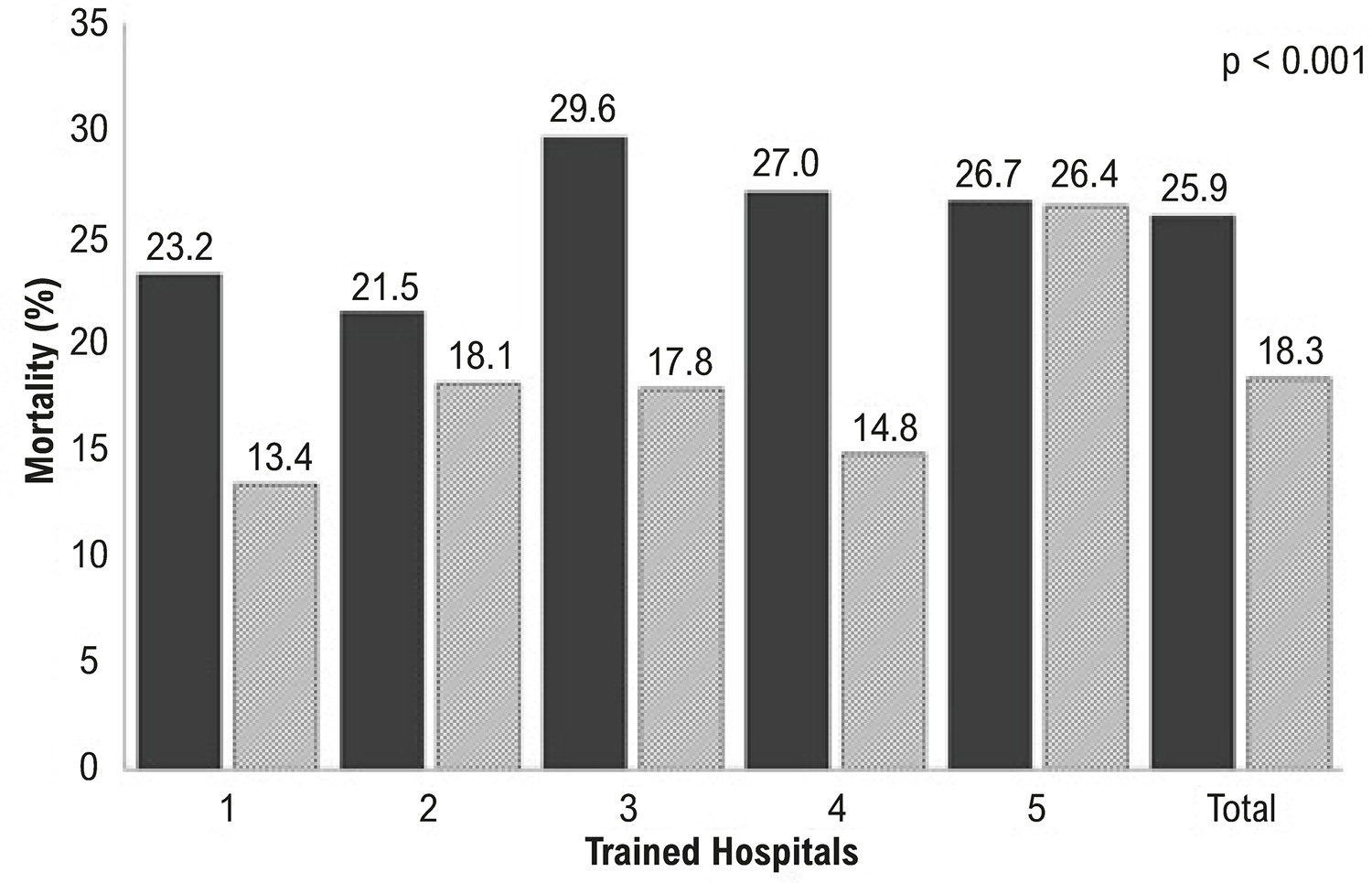
Nearly 200 physicians and 350 nurses attended at least one training from May 2010 to December 2013. Initially, many emergency physicians could not recognize an acute myocardial infarction on the electrocardiogram, but tele-electrocardiography is used in some emergency departments to determine the diagnosis. The death rate in the five hospitals decreased from 25.6%, in 2009, to 18.2%, in 2010 (p=0.005). After the entire period of training, the STEMI-associated death rate in all public hospitals of São Paulo decreased from 14.31%, in 2009, to 11.25%, in 2014 (p<0.0001).

Conclusion

Even simple training programs for emergency personnel can greatly reduce acute myocardial infarction death rates in undeveloped countries.

  • Acute Coronary,Syndrome
  • Emergency Services
  • Epidemiology
  • Mortality
  • Myocardial Infarction/drug therapy
  • Training
Read Full Article
Creative Commons Attribution (CC BY) Creative Commons license
13/08/2021 DOI: 10.36660/abc.20200180 Views 2

How to cite this article

EndNote RIS

Electronic Document Format (Vancouver)

Avila MS, Belfort DSP. Is There a Role for Telemonitoring in Heart Failure?. Arquivos Brasileiros de Cardiologia 2022;118(3):605-6.

Electronic Document Format (ABNT)

Avila, Mônica Samuel; Belfort, Deborah de Sá Pereira. Is There a Role for Telemonitoring in Heart Failure?. Arquivos Brasileiros de Cardiologia, v. 118, n. 3, p. 605-606, Mar. 2022.

Electronic Document Format (APA)

Avila, M. S., & Belfort, D. S. P. (2022). Is There a Role for Telemonitoring in Heart Failure?. Arquivos Brasileiros de Cardiologia, 118(3), 605-606.

Electronic Document Format (ISO)

Avila, Mônica Samuel and Belfort, Deborah de Sá Pereira. Is There a Role for Telemonitoring in Heart Failure?. Arquivos Brasileiros de Cardiologia [online]. 2022, vol. 118, n. 3, [cited 2026-10-14], pp. 605-606. Available from: <https://journals.cardiol.br/en/article/is-there-a-role-for-telemonitoring-in-heart-failure/>. ISSN 0066-782X

EndNote RIS

Electronic Document Format (Vancouver)

Cruz IO, Costa S, Teixeira R, Franco F, Gonçalves L. Telemonitoring in Heart Failure – A Single Center Experience. Arquivos Brasileiros de Cardiologia 2022;118(3):599-604.

Electronic Document Format (ABNT)

Cruz, Isabel O.; Costa, Susana; Teixeira, Rogério; Franco, Fátima; Gonçalves, Lino. Telemonitoring in Heart Failure – A Single Center Experience. Arquivos Brasileiros de Cardiologia, v. 118, n. 3, p. 599-604, Feb. 2022.

Electronic Document Format (APA)

Cruz, I. O., Costa, S., Teixeira, R., Franco, F., & Gonçalves, L. (2022). Telemonitoring in Heart Failure – A Single Center Experience. Arquivos Brasileiros de Cardiologia, 118(3), 599-604.

Electronic Document Format (ISO)

Cruz, Isabel O. and Costa, Susana and Teixeira, Rogério and Franco, Fátima and Gonçalves, Lino. Telemonitoring in Heart Failure – A Single Center Experience. Arquivos Brasileiros de Cardiologia [online]. 2022, vol. 118, n. 3, [cited 2026-10-14], pp. 599-604. Available from: <https://journals.cardiol.br/en/article/telemonitoring-in-heart-failure-a-single-center-experience/>. ISSN 0066-782X

EndNote RIS

Electronic Document Format (Vancouver)

Cesar LAM, Mansur AP, Ramos RF, Magalhães C, Ferreira JFM, Mioto BM, Oliveira NA, et al. Training Non-Cardiologists Could Improve the Treatment Results of ST Elevation Myocardial Infarction. Arquivos Brasileiros de Cardiologia 2021;117(6):1073-8.

Electronic Document Format (ABNT)

Cesar, Luiz Antonio Machado; Mansur, Antonio Padua; Ramos, Rui Fernando; Magalhães, Carlos; Ferreira, João Fernando Monteiro; Mioto, Bruno Mahler; Oliveira, Naide Aparecida de; Farsky, Pedro Silvio; Amaral, Amaury Zatorre; Moreno, Antonio Célio Camargo. Training Non-Cardiologists Could Improve the Treatment Results of ST Elevation Myocardial Infarction. Arquivos Brasileiros de Cardiologia, v. 117, n. 6, p. 1073-1078, Aug. 2021.

Electronic Document Format (APA)

Cesar, L. A. M., Mansur, A. P., Ramos, R. F., Magalhães, C., Ferreira, J. F. M., Mioto, B. M., Oliveira, N. A. , Farsky, P. S., Amaral, A. Z., & Moreno, A. C. C. (2021). Training Non-Cardiologists Could Improve the Treatment Results of ST Elevation Myocardial Infarction. Arquivos Brasileiros de Cardiologia, 117(6), 1073-1078.

Electronic Document Format (ISO)

Cesar, Luiz Antonio Machado and Mansur, Antonio Padua and Ramos, Rui Fernando and Magalhães, Carlos and Ferreira, João Fernando Monteiro and Mioto, Bruno Mahler and Oliveira, Naide Aparecida de and Farsky, Pedro Silvio and Amaral, Amaury Zatorre and Moreno, Antonio Célio Camargo. Training Non-Cardiologists Could Improve the Treatment Results of ST Elevation Myocardial Infarction. Arquivos Brasileiros de Cardiologia [online]. 2021, vol. 117, n. 6, [cited 2026-10-14], pp. 1073-1078. Available from: <https://journals.cardiol.br/en/article/training-non-cardiologists-could-improve-the-treatment-results-of-st-elevation-myocardial-infarction/>. ISSN 0066-782X

  • About ABC Family
  • Internal Regulation
  • Editorial Board
  • Brazilian Society of Cardiology (SBC)

Issues

SBC Guidelines

  • Videos
  • Podcasts
  • News