ABC Family Arquivos Brasileiros de Cardiologia International Journal of Cardiovascular Sciences ABC Heart Failure & Cardiomyopathy ABC Imagem Cardiovascular
Português English
ABC Family
Português English
  • About
    • About ABC Family
    • Internal Regulation
    • Editorial Board
    • Brazilian Society of Cardiology (SBC)
  • Issues
  • SBC Guidelines
  • Content
    • Videos
    • Podcasts
    • News
  • About
    • About ABC Family
    • Internal Regulation
    • Editorial Board
    • Brazilian Society of Cardiology (SBC)
  • Issues
  • SBC Guidelines
  • Content
    • Videos
    • Podcasts
    • News

ABC Family

  • ABC Family
  • Arquivos Brasileiros de Cardiologia
  • International Journal of Cardiovascular Sciences
  • ABC Heart Failure & Cardiomyopathy
  • ABC Imagem Cardiovascular
Search in

No content found.

Journals
Ordering
Article types
Others

  1. Home
  2. Keyword: Emergency room
ABCIC
Image

Suprasternal echocardiogram: an essential tool in emergency room

Inês Almeida et al. Hélder Santos Hugo Miranda Catarina Sousa

[…]

  • Chest Pain
  • Echocardiography
  • Emergency room
Read Full Article
Creative Commons Attribution (CC BY) Creative Commons license
14/01/2022 DOI: 10.5935/2318-8219.20200026 Views 1
Safety, feasibility, and results of exercise testing for stratifying patients with chest pain in the emergency room
ABC
Original Article

Safety, feasibility, and results of exercise testing for stratifying patients with chest pain in the emergency room

Renato Machado Macaciel et al. Evandro Tinoco Mesquita Ricardo Vivacqua Salvador Serra … Augusta Campos Marcelo Miranda Roberto Gamarski Hans Dohman Roberto Bassan

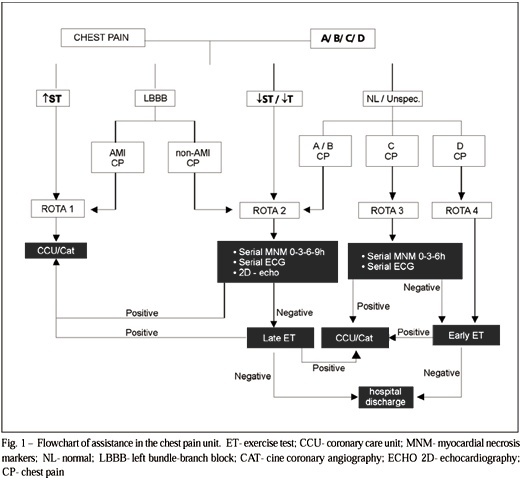
OBJECTIVE: To assess safety, feasibility, and the results of early exercise testing in patients with chest pain admitted to the emergency room of the chest pain unit, in whom acute myocardial infarction and high-risk unstable angina had been ruled out. METHODS: A study including 1060 consecutive patients with chest pain admitted to the emergency room of the chest pain unit was carried out. Of them, 677 (64%) patients were eligible for exercise testing, but only 268 (40%) underwent the test. RESULTS: The mean age of the patients studied was 51.7±12.1 years, and 188 (70%) were males. Twenty-eight (10%) patients had a previous history of coronary artery disease, 244 (91%) had a normal or unspecific electrocardiogram, and 150 (56%) underwent exercise testing within a 12-hour interval. The results of the exercise test in the latter group were as follows: 34 (13%) were positive, 191 (71%) were negative, and 43 (16%) were inconclusive. In the group of patients with a positive exercise test, 21 (62%) underwent coronary angiography, 11 underwent angioplasty, and 2 underwent myocardial revascularization. In a univariate analysis, type A/B chest pain (definitely/probably anginal) (p<0.0001), previous coronary artery disease (p<0.0001), and route 2 (patients at higher risk) correlated with a positive or inconclusive test (p<0.0001). CONCLUSION: In patients with chest pain and in whom acute myocardial infarction and high-risk unstable angina had been ruled out, the exercise test proved to be feasible, safe, and well tolerated.

  • Chest Pain
  • chest pain unit
  • Emergency room
  • Exercise Test
Read Full Article
Creative Commons Attribution (CC BY) Creative Commons license
16/09/2003 DOI: 10.1590/S0066-782X2003001000006 Views 1
Efficacy of a diagnostic strategy for patients with chest pain and no ST-segment elevation in the emergency room
ABC
Original Article

Efficacy of a diagnostic strategy for patients with chest pain and no ST-segment elevation in the emergency room

Roberto Bassan et al. Roberto Gamarski Lúcia Pimenta André Volschan … Marcelo Scofano Hans Fernando Dohmann Monica Araujo Cristina Clare Marcelo Fabrício Carlos Henrique Sanmartin Kalil Mohallem Renato Macaciel Sergio Gaspar

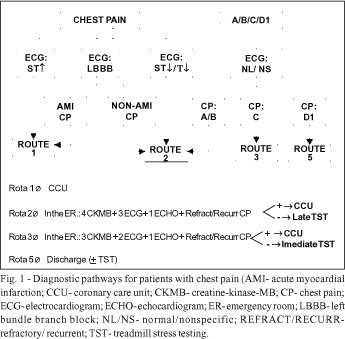
PURPOSE: To evaluate the efficacy of a systematic model of care for patients with chest pain and no ST segment elevation in the emergency room. METHODS: From 1003 patients submitted to an algorithm diagnostic investigation by probability of acute ischemic syndrome. We analyzed 600 ones with no elevation of ST segment, then enrolled to diagnostic routes of median (route 2) and low probability (route 3) to ischemic syndrome. RESULTS: In route 2 we found 17% acute myocardial infarction and 43% unstable angina, whereas in route 3 the rates were 2% and 7%, respectively. Patients with normal/non–specific ECG had 6% probability of AMI whereas in those with negative first CKMB it was 7%; the association of the 2 data only reduced it to 4%. In patients in route 2 the diagnosis of AMI could only be ruled out with serial CKMB measurement up to 9 hours, while in route 3 it could be done in up to 3 hours. Thus, sensitivity and negative predictive value of admission CKMB for AMI were 52% and 93%, respectively. About one-half of patients with unstable angina did not disclose objective ischemic changes on admission. CONCLUSION: The use of a systematic model of care in patients with chest pain offers the opportunity of hindering inappropriate release of patients with ACI and reduces unnecessary admissions. However some patients even with normal ECG should not be released based on a negative first CKMB. Serial measurement of CKMB up to 9 hours is necessary in patients with medium probability of AMI.

  • Acute Myocardial Infarction
  • Chest Pain
  • Emergency room
  • Unstable Angina
Read Full Article
Creative Commons Attribution (CC BY) Creative Commons license
08/01/2002 DOI: 10.1590/S0066-782X2000000500002 Views 1
Chest pain in the emergency room. Importance of a systematic approach
ABC
Original Article

Chest pain in the emergency room. Importance of a systematic approach

Roberto Bassan et al. Marcelo Scofano Roberto Gamarski Hans Fernando Dohmann … Lúcia Pimenta André Volschan Mônica Araujo Cristina Clare Marcelo Fabrício Carlos Henrique Sanmartin Kalil Mohallem Sergio Gaspar Renato Macaciel

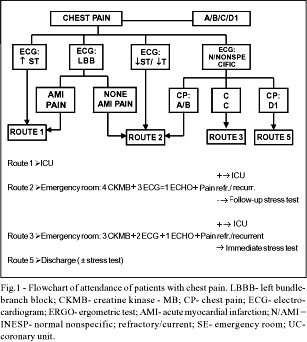
OBJECTIVE: To evaluate the efficiency of a systematic diagnostic approach in patients with chest pain in the emergency room in relation to the diagnosis of acute coronary syndrome (ACS) and the rate of hospitalization in high-cost units. METHODS: One thousand and three consecutive patients with chest pain were screened according to a pre-established process of diagnostic investigation based on the pre-test probability of ACS determinate by chest pain type and ECG changes. RESULTS: Of the 1003 patients, 224 were immediately discharged home because of no suspicion of ACS (route 5) and 119 were immediately transferred to the coronary care united because of ST elevation or left bundle-branch block (LBBB) (route 1) (74% of these had a final diagnosis of acute myocardial infarction [AMI]). Of the 660 patients that remained in the emergency room under observation, 77 (12%) had AMI without ST segment elevation and 202 (31%) had unstable angina (UA). In route 2 (high probability of ACS) 17% of patients had AMI and 43% had UA, whereas in route 3 (low probability) 2% had AMI and 7 % had UA. The admission ECG has been confirmed as a poor sensitivity test for the diagnosis of AMI ( 49%), with a positive predictive value considered only satisfactory (79%). CONCLUSION: A systematic diagnostic strategy, as used in this study, is essential in managing patients with chest pain in the emergency room in order to obtain high diagnostic accuracy, lower cost, and optimization of the use of coronary care unit beds.

  • Acute Myocardial Infarction
  • Chest Pain
  • Emergency room
  • Unstable Angina
Read Full Article
Creative Commons Attribution (CC BY) Creative Commons license
05/09/2000 DOI: 10.1590/S0066-782X2000000100003 Views 2

How to cite this article

EndNote RIS

Electronic Document Format (Vancouver)

Almeida I, Santos H, Miranda H, Sousa C. Suprasternal echocardiogram: an essential tool in emergency room. Arquivos Brasileiros de Cardiologia Imagem cardiovascular 2022;33(2):1.

Electronic Document Format (ABNT)

Almeida, Inês; Santos, Hélder; Miranda, Hugo; Sousa, Catarina. Suprasternal echocardiogram: an essential tool in emergency room. Arquivos Brasileiros de Cardiologia Imagem cardiovascular, v. 33, n. 2, p. 1-1, Jan. 2022.

Electronic Document Format (APA)

Almeida, I., Santos, H., Miranda, H., & Sousa, C. (2022). Suprasternal echocardiogram: an essential tool in emergency room. Arquivos Brasileiros de Cardiologia Imagem cardiovascular, 33(2), 1-1.

Electronic Document Format (ISO)

Almeida, Inês and Santos, Hélder and Miranda, Hugo and Sousa, Catarina. Suprasternal echocardiogram: an essential tool in emergency room. Arquivos Brasileiros de Cardiologia Imagem cardiovascular [online]. 2022, vol. 33, n. 2, [cited 2026-10-14], pp. 1-1. Available from: <https://journals.cardiol.br/en/article/suprasternal-echocardiogram-an-essential-tool-in-emergency-room/>. ISSN 2318-8219

EndNote RIS

Electronic Document Format (Vancouver)

Macaciel RM, Mesquita ET, Vivacqua R, Serra S, Campos A, Miranda M, Gamarski R, et al. Safety, feasibility, and results of exercise testing for stratifying patients with chest pain in the emergency room. Arquivos Brasileiros de Cardiologia 2003;81(2):174-81.

Electronic Document Format (ABNT)

Macaciel, Renato Machado; Mesquita, Evandro Tinoco; Vivacqua, Ricardo; Serra, Salvador; Campos, Augusta; Miranda, Marcelo; Gamarski, Roberto; Dohman, Hans; Bassan, Roberto. Safety, feasibility, and results of exercise testing for stratifying patients with chest pain in the emergency room. Arquivos Brasileiros de Cardiologia, v. 81, n. 2, p. 174-181, Sep. 2003.

Electronic Document Format (APA)

Macaciel, R. M., Mesquita, E. T., Vivacqua, R., Serra, S., Campos, A., Miranda, M., Gamarski, R., Dohman, H., & Bassan, R. (2003). Safety, feasibility, and results of exercise testing for stratifying patients with chest pain in the emergency room. Arquivos Brasileiros de Cardiologia, 81(2), 174-181.

Electronic Document Format (ISO)

Macaciel, Renato Machado and Mesquita, Evandro Tinoco and Vivacqua, Ricardo and Serra, Salvador and Campos, Augusta and Miranda, Marcelo and Gamarski, Roberto and Dohman, Hans and Bassan, Roberto. Safety, feasibility, and results of exercise testing for stratifying patients with chest pain in the emergency room. Arquivos Brasileiros de Cardiologia [online]. 2003, vol. 81, n. 2, [cited 2026-10-14], pp. 174-181. Available from: <https://journals.cardiol.br/en/article/safety-feasibility-and-results-of-exercise-testing-for-stratifying-patients-with-chest-pain-in-the-emergency-room/>. ISSN 0066-782X

EndNote RIS

Electronic Document Format (Vancouver)

Bassan R, Gamarski R, Pimenta L, Volschan A, Scofano M, Dohmann HF, Araujo M, et al. Efficacy of a diagnostic strategy for patients with chest pain and no ST-segment elevation in the emergency room. Arquivos Brasileiros de Cardiologia 2002;74(5):412-7.

Electronic Document Format (ABNT)

Bassan, Roberto; Gamarski, Roberto; Pimenta, Lúcia; Volschan, André; Scofano, Marcelo; Dohmann, Hans Fernando; Araujo, Monica; Clare, Cristina; Fabrício, Marcelo; Sanmartin, Carlos Henrique; Mohallem, Kalil; Macaciel, Renato; Gaspar, Sergio. Efficacy of a diagnostic strategy for patients with chest pain and no ST-segment elevation in the emergency room. Arquivos Brasileiros de Cardiologia, v. 74, n. 5, p. 412-417, Jan. 2002.

Electronic Document Format (APA)

Bassan, R., Gamarski, R., Pimenta, L., Volschan, A., Scofano, M., Dohmann, H. F., Araujo, M., Clare, C., Fabrício, M., Sanmartin, C. H., Mohallem, K., Macaciel, R., & Gaspar, S. (2002). Efficacy of a diagnostic strategy for patients with chest pain and no ST-segment elevation in the emergency room. Arquivos Brasileiros de Cardiologia, 74(5), 412-417.

Electronic Document Format (ISO)

Bassan, Roberto and Gamarski, Roberto and Pimenta, Lúcia and Volschan, André and Scofano, Marcelo and Dohmann, Hans Fernando and Araujo, Monica and Clare, Cristina and Fabrício, Marcelo and Sanmartin, Carlos Henrique and Mohallem, Kalil and Macaciel, Renato and Gaspar, Sergio. Efficacy of a diagnostic strategy for patients with chest pain and no ST-segment elevation in the emergency room. Arquivos Brasileiros de Cardiologia [online]. 2002, vol. 74, n. 5, [cited 2026-10-14], pp. 412-417. Available from: <https://journals.cardiol.br/en/article/efficacy-of-a-diagnostic-strategy-for-patients-with-chest-pain-and-no-st-segment-elevation-in-the-emergency-room/>. ISSN 0066-782X

EndNote RIS

Electronic Document Format (Vancouver)

Bassan R, Scofano M, Gamarski R, Dohmann HF, Pimenta L, Volschan A, Araujo M, et al. Chest pain in the emergency room. Importance of a systematic approach. Arquivos Brasileiros de Cardiologia 2000;74(1):22-9.

Electronic Document Format (ABNT)

Bassan, Roberto; Scofano, Marcelo; Gamarski, Roberto; Dohmann, Hans Fernando; Pimenta, Lúcia; Volschan, André; Araujo, Mônica; Clare, Cristina; Fabrício, Marcelo; Sanmartin, Carlos Henrique; Mohallem, Kalil; Gaspar, Sergio; Macaciel, Renato. Chest pain in the emergency room. Importance of a systematic approach. Arquivos Brasileiros de Cardiologia, v. 74, n. 1, p. 22-29, Sep. 2000.

Electronic Document Format (APA)

Bassan, R., Scofano, M., Gamarski, R., Dohmann, H. F., Pimenta, L., Volschan, A., Araujo, M., Clare, C., Fabrício, M., Sanmartin, C. H., Mohallem, K., Gaspar, S., & Macaciel, R. (2000). Chest pain in the emergency room. Importance of a systematic approach. Arquivos Brasileiros de Cardiologia, 74(1), 22-29.

Electronic Document Format (ISO)

Bassan, Roberto and Scofano, Marcelo and Gamarski, Roberto and Dohmann, Hans Fernando and Pimenta, Lúcia and Volschan, André and Araujo, Mônica and Clare, Cristina and Fabrício, Marcelo and Sanmartin, Carlos Henrique and Mohallem, Kalil and Gaspar, Sergio and Macaciel, Renato. Chest pain in the emergency room. Importance of a systematic approach. Arquivos Brasileiros de Cardiologia [online]. 2000, vol. 74, n. 1, [cited 2026-10-14], pp. 22-29. Available from: <https://journals.cardiol.br/en/article/chest-pain-in-the-emergency-room-importance-of-a-systematic-approach/>. ISSN 0066-782X

  • About ABC Family
  • Internal Regulation
  • Editorial Board
  • Brazilian Society of Cardiology (SBC)

Issues

SBC Guidelines

  • Videos
  • Podcasts
  • News