ABC Family Arquivos Brasileiros de Cardiologia International Journal of Cardiovascular Sciences ABC Heart Failure & Cardiomyopathy ABC Imagem Cardiovascular
Português English
ABC Family
Português English
  • About
    • About ABC Family
    • Internal Regulation
    • Editorial Board
    • Brazilian Society of Cardiology (SBC)
  • Issues
  • SBC Guidelines
  • Content
    • Videos
    • Podcasts
    • News
  • About
    • About ABC Family
    • Internal Regulation
    • Editorial Board
    • Brazilian Society of Cardiology (SBC)
  • Issues
  • SBC Guidelines
  • Content
    • Videos
    • Podcasts
    • News

ABC Family

  • ABC Family
  • Arquivos Brasileiros de Cardiologia
  • International Journal of Cardiovascular Sciences
  • ABC Heart Failure & Cardiomyopathy
  • ABC Imagem Cardiovascular
Search in

No content found.

Journals
Ordering
Article types
Others

  1. Home
  2. Keyword: Diet, Sodium-Restricted
Figure 1
IJCS
Original Article

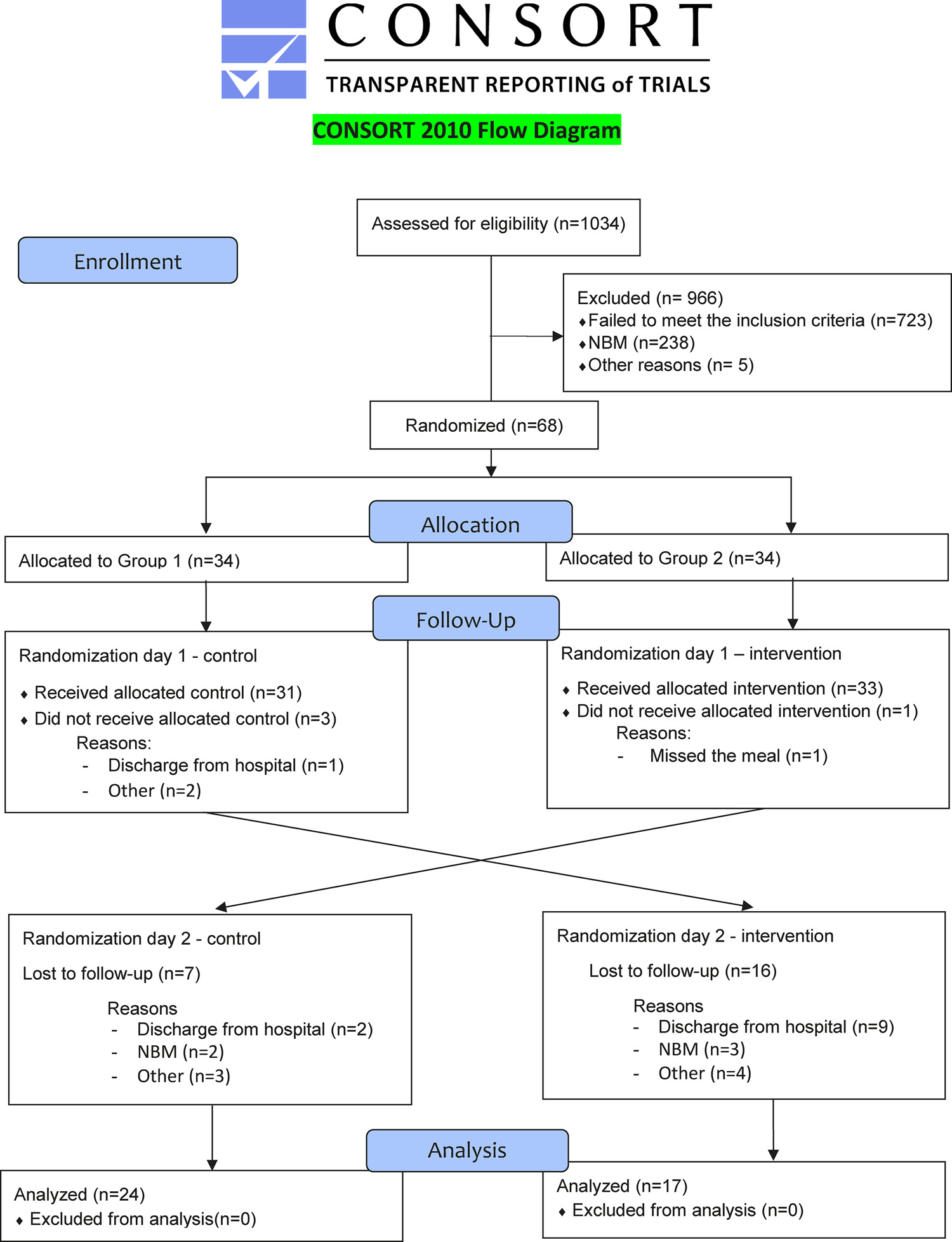
Acceptance of Low-Sodium Hospital Diet by Cardiac Patients: A Randomized Controlled Crossover Trial

Bruna Fraga dos Santos et al. Bruna Eibel Ana Lúcia Grasel Antunes Cláudia Monster Martins … Renata Della Giustina Melina Borba Duarte Izabele Vian da Silveira Corrêa

Abstract

Background

Cardiovascular diseases are the major cause of hospitalization. Dietary salt restriction is indicated as part of clinical treatment, however, it is not always well accepted by the patients, resulting in low food intake and malnutrition.

Objective

To compare acceptance of a low-sodium diet cooked with salt with a standard low-sodium diet in cardiac inpatients.

Methods

A randomized controlled crossover trial in patients with low-sodium diet prescriptions (Clinical Trials NCT03481322). Patients were given a control standard low sodium diet (cooked without salt; salt [2g per meal] added by the patient at the time of consumption) on one day and on the next day patients were given the intervention diet – a low sodium diet cooked with salt (2 grams of salt, divided between preparations). Dietary acceptance was evaluated by weighing leftover food and calculating intake. A questionnaire was used to verify reasons that influenced acceptance. For data analysis, parametric data are presented as mean and standard deviation, Student’s t test was used to compare means, with significance defined as p<0.05.

Results

Sixty-four patients were evaluated, with a mean age of 66 ± 11.3 years; 64% were male. There were no differences in percentage acceptance between the standard low-sodium diet and the low-sodium diet cooked with salt at lunch (p= 0.876) or at dinner (p= 0.255). Around 80% of what was offered at each meal was consumed by the patients, with no significant difference between groups.

Conclusions

The low-sodium diet cooked with salt was well accepted, but there was no difference when compared with the standard low-sodium diet, which also had adequate acceptance.
  • Cooking
  • Diet, Sodium-Restricted
  • Heart Diseases
  • Sodium Chloride
Read Full Article
Creative Commons Attribution (CC BY) Creative Commons license
22/06/2022 DOI: 10.36660/ijcs.20200345 Views 1
Figure 01
ABC
Original Article

Effects of added salt reduction on central and peripheral blood pressure

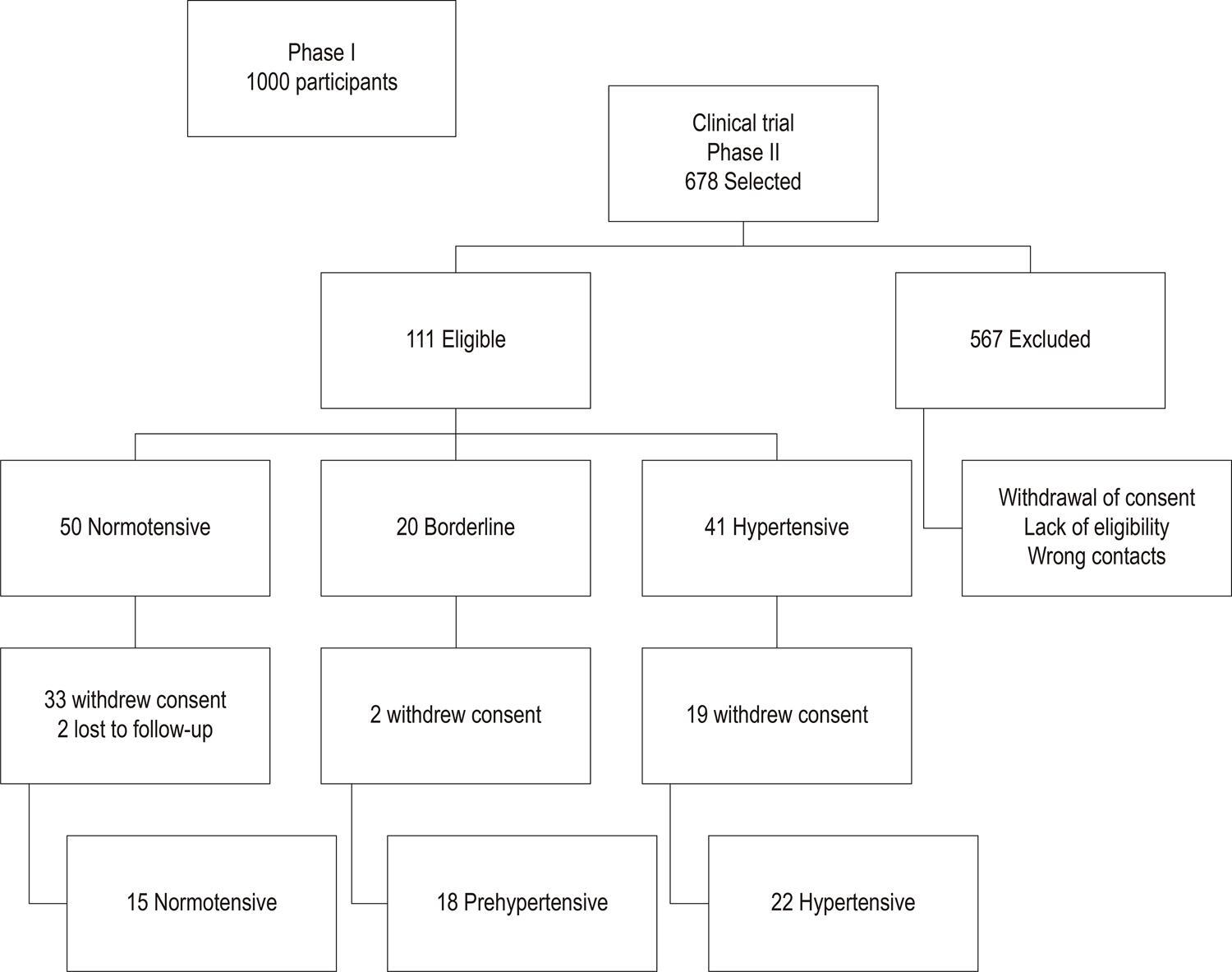
Ana Carolina Arantes et al. Ana Luiza Lima Sousa Priscila Valverde de O. Vitorino Paulo Cesar B. Veiga Jardim … Thiago de Souza Veiga Jardim Jeeziane Marcelino Rezende Ellen de Souza Lelis Rafaela Bernardes Rodrigues Antonio Coca Weimar Kunz Sebba Barroso

Abstract

Background

Although the effects of salt intake reduction on casual blood pressure have been extensively studied in hypertensive individuals, data on reductions of added salt on arterial stiffness in both normotensive and prehypertensive subjects are scarce.

Objective

To evaluate the effects of progressive reduction in added salt intake (from 6 grams to 4 grams per day) on peripheral and central blood pressure and arterial stiffness in normotensive, prehypertensive and hypertensive individuals.

Methods

This was a single-blinded clinical trial with 13 weeks of follow-up. Normotensive (≤ 130/85 mmHg), prehypertensive (≥ 130 e < 139/≥ 85 e < 90 mmHg) and stage 1 hypertensive individuals (< 139/≥ 85 and < 90 mmHg) were assessed. Casual blood pressure measurements and ambulatory blood pressure monitoring were performed using the automated OMRON 705CP device, and central blood pressure was measured using the Sphygmocor®. Twenty-four-hour urinary sodium excretion and the amounts of added salt consumed were measured. Statistically significance level was set at p < 0.05 for all analysis.

Results

A total of 55 participants (18 normotensive, 15 prehypertensive and 22 hypertensive), median age 48 years (IQR:39-54) were studied. The groups were not different in age or sex. No difference was observed in blood pressure or sodium excretion levels before and after the intervention. No significant changes in arterial stiffness parameters were observed.

Conclusion

The progressive reduction in added salt intake during a period of 13 weeks did not cause significant reductions in peripheral and central blood pressure. (Arq Bras Cardiol. 2020; 114(3):554-561)

  • Arterial Pressure
  • Cardiovascular Diseases
  • Diet, Sodium-Restricted
  • Health Policies
  • Hypertension
  • Prehypertension
  • Sodium Chloride
Read Full Article
Creative Commons Attribution (CC BY) Creative Commons license
06/04/2020 DOI: 10.36660/abc.20180426 Views 1
ABC
Artigo Original

Dietary variety is a protective factor for elevated systolic blood pressure

Erick Prado de Oliveira et al. Karina Fernandes de Camargo Gabriela Kaiser Fullin Castanho Marina Nicola … Kátia Cristina Portero-McLellan Roberto Carlos Burini

BACKGROUND: Diet directly influences systemic arterial hypertension (SAH), which is one of the main risk factors for cardiovascular disease. OBJECTIVE: To associate hypertension with dietary factors in adults clinically selected for a change-of-lifestyle program. METHODS: Cross-sectional study comprising 335 individuals, aged between 44 and 65 years, clinically selected for a change-of-lifestyle program. We evaluated anthropometric data (BMI, %body fat and waist circumference), biochemical components (plasma glucose, triglycerides, total cholesterol, HDL-C and LDL-c) and diet, through the 24-hour recall method. The quality of the diet was assessed by the Healthy Eating Index. Blood pressure was measured according to the V Brazilian Guidelines on Hypertension and classified according to NCEP-ATPIII. Logistic regression was performed to determine the likelihood of changes in SBP and DBP according to dietary intake. The level of significance was set at p <0.05. RESULTS: There was a positive correlation between diastolic blood pressure and sugar and cholesterol intake, and a negative one with intake of fiber, portions of oil and fats and diet quality. Dietary variety with ≥ 8 food items showed a protective effect for alterations in systolic blood pressure, OR = 0.361 (0.148 to 0.878). CONCLUSION: A greater dietary variety had a protective effect on the systolic blood pressure.

  • Blood Pressure
  • Diet, Sodium-Restricted
  • food quality
  • Hypertension
Read Full Article
Creative Commons Attribution (CC BY) Creative Commons license
15/03/2012 DOI: 10.1590/S0066-782X2012005000020 Views 1
Is the low-sodium diet actually indicated for all patients with stable heart failure?
ABC
Artigo Original

Is the low-sodium diet actually indicated for all patients with stable heart failure?

Miyoko Nakasato et al. Célia M. C. Strunk Guilherme Guimarães Marcos V. C. Rezende Edimar A. Bocchi

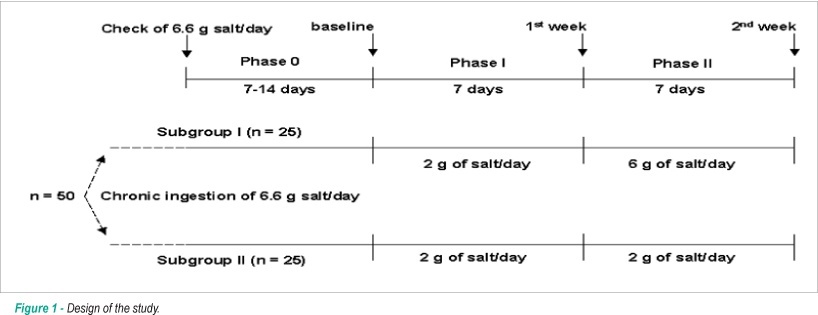
BACKGROUND: Although a low-sodium diet is indicated for heart failure HF, there is no evidence this dietary restriction is beneficial to all patients. OBJECTIVE: To prospectively study the acute effectsof a low-sodium diet in patients (pts) with heart failure (HF). METHODS: Fifty stable outpatients with mild to moderate HF who reported previously consuming 6.6 g table salt/day were studied. In Phase 1, all pts were submitted to a diet with 2 g of salt during 7 days, followed by randomization in 2 subgroups (Phase 2): one to receive 6 g of salt (subgroup 1) and the other, 2 g of salt/day for 7 days (subgroup II). RESULTS: Phase 1: the diet with 2 g of salt reduced the BMI, plasma and urinary sodium, protein consumption, iron, zinc, selenium and vitamin B12; it increased plasma levels of norepinephrine, nitrate, serum aldosterone and improved quality of life. Phase 2: for pts with low BMI, the use of 6 g salt/day acutely decreased the levels of norepinephrine, albumin and cholesterol in plasma. No difference was observed in pts with higher BMI. CONCLUSION: The diet with 2 g salt/day for pts with HF increased the neurohormonal activation associated to HF progression. The BMI can influence the response to the neurohormonal activation in a low-sodium diet in pts with HF. Further studies to test salt restriction for longer periods are recommended.

  • Diet, Sodium-Restricted
  • dietary
  • Heart Failure
  • neurohormonal activation
  • Sodium Chloride
Read Full Article
Creative Commons Attribution (CC BY) Creative Commons license
22/09/2010 DOI: 10.1590/S0066-782X2010000100015 Views 2

How to cite this article

EndNote RIS

Electronic Document Format (Vancouver)

Santos BF, Eibel B, Antunes ALG, Martins CM, Giustina RD, Duarte MB, Corrêa IVS, et al. Acceptance of Low-Sodium Hospital Diet by Cardiac Patients: A Randomized Controlled Crossover Trial. International Journal of Cardiovascular Sciences 2022;35(5):610-7.

Electronic Document Format (ABNT)

Santos, Bruna Fraga dos; Eibel, Bruna; Antunes, Ana Lúcia Grasel; Martins, Cláudia Monster; Giustina, Renata Della; Duarte, Melina Borba; Corrêa, Izabele Vian da Silveira. Acceptance of Low-Sodium Hospital Diet by Cardiac Patients: A Randomized Controlled Crossover Trial. International Journal of Cardiovascular Sciences, v. 35, n. 5, p. 610-617, Jun. 2022.

Electronic Document Format (APA)

Santos, B. F. , Eibel, B., Antunes, A. L. G., Martins, C. M., Giustina, R. D., Duarte, M. B., & Corrêa, I. V. S. (2022). Acceptance of Low-Sodium Hospital Diet by Cardiac Patients: A Randomized Controlled Crossover Trial. International Journal of Cardiovascular Sciences, 35(5), 610-617.

Electronic Document Format (ISO)

Santos, Bruna Fraga dos and Eibel, Bruna and Antunes, Ana Lúcia Grasel and Martins, Cláudia Monster and Giustina, Renata Della and Duarte, Melina Borba and Corrêa, Izabele Vian da Silveira. Acceptance of Low-Sodium Hospital Diet by Cardiac Patients: A Randomized Controlled Crossover Trial. International Journal of Cardiovascular Sciences [online]. 2022, vol. 35, n. 5, [cited 2026-10-14], pp. 610-617. Available from: <https://journals.cardiol.br/en/article/acceptance-of-low-sodium-hospital-diet-by-cardiac-patients-a-randomized-controlled-crossover-trial/>. ISSN 2359-4802

EndNote RIS

Electronic Document Format (Vancouver)

Arantes AC, Sousa ALL, Vitorino PVO, Jardim PCBV, Jardim TSV, Rezende JM, Lelis ES, et al. Effects of added salt reduction on central and peripheral blood pressure. Arquivos Brasileiros de Cardiologia 2020;114(3):554-61.

Electronic Document Format (ABNT)

Arantes, Ana Carolina; Sousa, Ana Luiza Lima; Vitorino, Priscila Valverde de O.; Jardim, Paulo Cesar B. Veiga; Jardim, Thiago de Souza Veiga; Rezende, Jeeziane Marcelino; Lelis, Ellen de Souza; Rodrigues, Rafaela Bernardes; Coca, Antonio; Barroso, Weimar Kunz Sebba. Effects of added salt reduction on central and peripheral blood pressure. Arquivos Brasileiros de Cardiologia, v. 114, n. 3, p. 554-561, Apr. 2020.

Electronic Document Format (APA)

Arantes, A. C., Sousa, A. L. L., Vitorino, P. V. O., Jardim, P. C. B. V., Jardim, T. S. V., Rezende, J. M., Lelis, E. S., Rodrigues, R. B., Coca, A., & Barroso, W. K. S. (2020). Effects of added salt reduction on central and peripheral blood pressure. Arquivos Brasileiros de Cardiologia, 114(3), 554-561.

Electronic Document Format (ISO)

Arantes, Ana Carolina and Sousa, Ana Luiza Lima and Vitorino, Priscila Valverde de O. and Jardim, Paulo Cesar B. Veiga and Jardim, Thiago de Souza Veiga and Rezende, Jeeziane Marcelino and Lelis, Ellen de Souza and Rodrigues, Rafaela Bernardes and Coca, Antonio and Barroso, Weimar Kunz Sebba. Effects of added salt reduction on central and peripheral blood pressure. Arquivos Brasileiros de Cardiologia [online]. 2020, vol. 114, n. 3, [cited 2026-10-14], pp. 554-561. Available from: <https://journals.cardiol.br/en/article/effects-of-added-salt-reduction-on-central-and-peripheral-blood-pressure/>. ISSN 0066-782X

EndNote RIS

Electronic Document Format (Vancouver)

Oliveira EP, Camargo KF, Castanho GKF, Nicola M, Portero-McLellan KC, Burini RC. Dietary variety is a protective factor for elevated systolic blood pressure. Arquivos Brasileiros de Cardiologia 2012;98(4):338-43.

Electronic Document Format (ABNT)

Oliveira, Erick Prado de; Camargo, Karina Fernandes de; Castanho, Gabriela Kaiser Fullin; Nicola, Marina; Portero-McLellan, Kátia Cristina; Burini, Roberto Carlos. Dietary variety is a protective factor for elevated systolic blood pressure. Arquivos Brasileiros de Cardiologia, v. 98, n. 4, p. 338-343, Mar. 2012.

Electronic Document Format (APA)

Oliveira, E. P. , Camargo, K. F. , Castanho, G. K. F., Nicola, M., Portero-McLellan, K. C., & Burini, R. C. (2012). Dietary variety is a protective factor for elevated systolic blood pressure. Arquivos Brasileiros de Cardiologia, 98(4), 338-343.

Electronic Document Format (ISO)

Oliveira, Erick Prado de and Camargo, Karina Fernandes de and Castanho, Gabriela Kaiser Fullin and Nicola, Marina and Portero-McLellan, Kátia Cristina and Burini, Roberto Carlos. Dietary variety is a protective factor for elevated systolic blood pressure. Arquivos Brasileiros de Cardiologia [online]. 2012, vol. 98, n. 4, [cited 2026-10-14], pp. 338-343. Available from: <https://journals.cardiol.br/en/article/dietary-variety-is-a-protective-factor-for-elevated-systolic-blood-pressure/>. ISSN 0066-782X

EndNote RIS

Electronic Document Format (Vancouver)

Nakasato M, Strunk CMC, Guimarães G, Rezende MVC, Bocchi EA. Is the low-sodium diet actually indicated for all patients with stable heart failure?. Arquivos Brasileiros de Cardiologia 2010;94(1):92-101.

Electronic Document Format (ABNT)

Nakasato, Miyoko; Strunk, Célia M. C.; Guimarães, Guilherme; Rezende, Marcos V. C.; Bocchi, Edimar A.. Is the low-sodium diet actually indicated for all patients with stable heart failure?. Arquivos Brasileiros de Cardiologia, v. 94, n. 1, p. 92-101, Sep. 2010.

Electronic Document Format (APA)

Nakasato, M., Strunk, C. M. C., Guimarães, G., Rezende, M. V. C., & Bocchi, E. A. (2010). Is the low-sodium diet actually indicated for all patients with stable heart failure?. Arquivos Brasileiros de Cardiologia, 94(1), 92-101.

Electronic Document Format (ISO)

Nakasato, Miyoko and Strunk, Célia M. C. and Guimarães, Guilherme and Rezende, Marcos V. C. and Bocchi, Edimar A.. Is the low-sodium diet actually indicated for all patients with stable heart failure?. Arquivos Brasileiros de Cardiologia [online]. 2010, vol. 94, n. 1, [cited 2026-10-14], pp. 92-101. Available from: <https://journals.cardiol.br/en/article/is-the-low-sodium-diet-actually-indicated-for-all-patients-with-stable-heart-failure/>. ISSN 0066-782X

  • About ABC Family
  • Internal Regulation
  • Editorial Board
  • Brazilian Society of Cardiology (SBC)

Issues

SBC Guidelines

  • Videos
  • Podcasts
  • News