ABC Family Arquivos Brasileiros de Cardiologia International Journal of Cardiovascular Sciences ABC Heart Failure & Cardiomyopathy ABC Imagem Cardiovascular
Português English
  • ABC Family
  • Arquivos Brasileiros de Cardiologia
  • International Journal of Cardiovascular Sciences
  • ABC Heart Failure & Cardiomyopathy
  • ABC Imagem Cardiovascular
Português English
  • About
    • About ABC Family
    • Internal Regulation
    • Editorial Board
    • Brazilian Society of Cardiology (SBC)
  • Issues
  • SBC Guidelines
  • Content
    • Videos
    • Podcasts
    • News
  • About
    • About ABC Family
    • Internal Regulation
    • Editorial Board
    • Brazilian Society of Cardiology (SBC)
  • Issues
  • SBC Guidelines
  • Content
    • Videos
    • Podcasts
    • News
Search in

No content found.

Journals
Ordering
Article types
Others

  1. Home
  2. Cognition
Figure 1
ABCHF
Viewpoint

From Recognition to Clinical Practice: Advances and Challenges in the Multidimensional Assessment of Frailty in Heart Failure

France Matos de Oliveira et al. Sandrigo Mangini Fabiana Goulart Marcondes-Braga

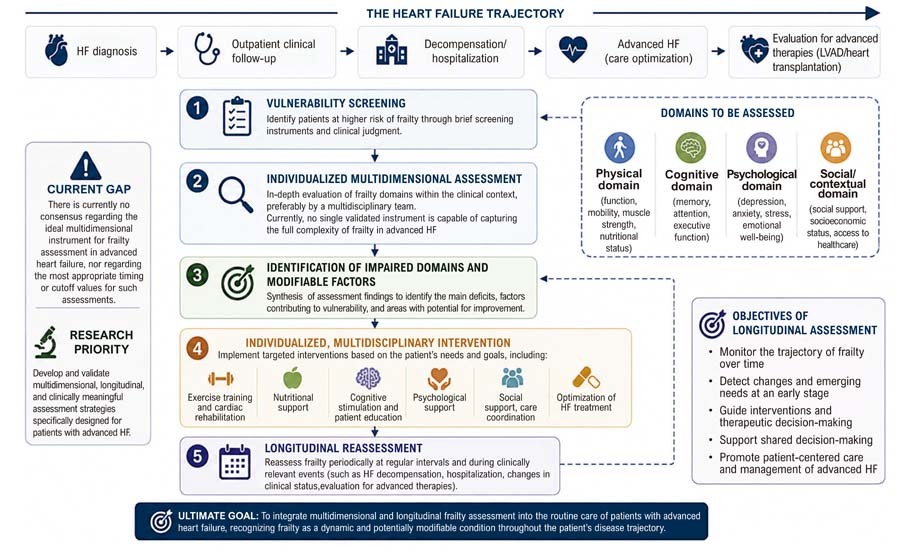
The concept of frailty has gained increasing relevance in recent years due to its association with worse clinical outcomes and prognosis across different health conditions. There is broad recognition of its role as a determinant of morbidity and mortality in patients with heart failure (HF); however, there is still no consensus regarding an optimal assessment model.– In addition to the absence of a universally accepted instrument, this scenario reflects a conceptual issue: can frailty in advanced HF be adequately represented by a single-point and predominantly physical assessment?

In this article, we argue that it cannot. Frailty in advanced HF should not be reduced to a physical marker of vulnerability. Rather, it is a multidimensional condition influenced by cognitive, psychosocial, and contextual factors, whose interpretation requires clinical integration and sensitivity from the healthcare team.

[…]

  • Cognition
  • Frailty
  • Heart Failure
  • Heart Transplantation
Read Full Article
Creative Commons Attribution (CC BY) Creative Commons license
29/10/2026 DOI: 10.36660/abchf.20260038i Views 13
Figure 1
ABC
Viewpoint

Cognitive Deficit in Heart Failure and the Benefits of Aerobic Physical Activity

Maria Luíza de Medeiros Rêgo et al. Daniel Aranha Rego Cabral Eduardo Bodnariuc Fontes

Abstract

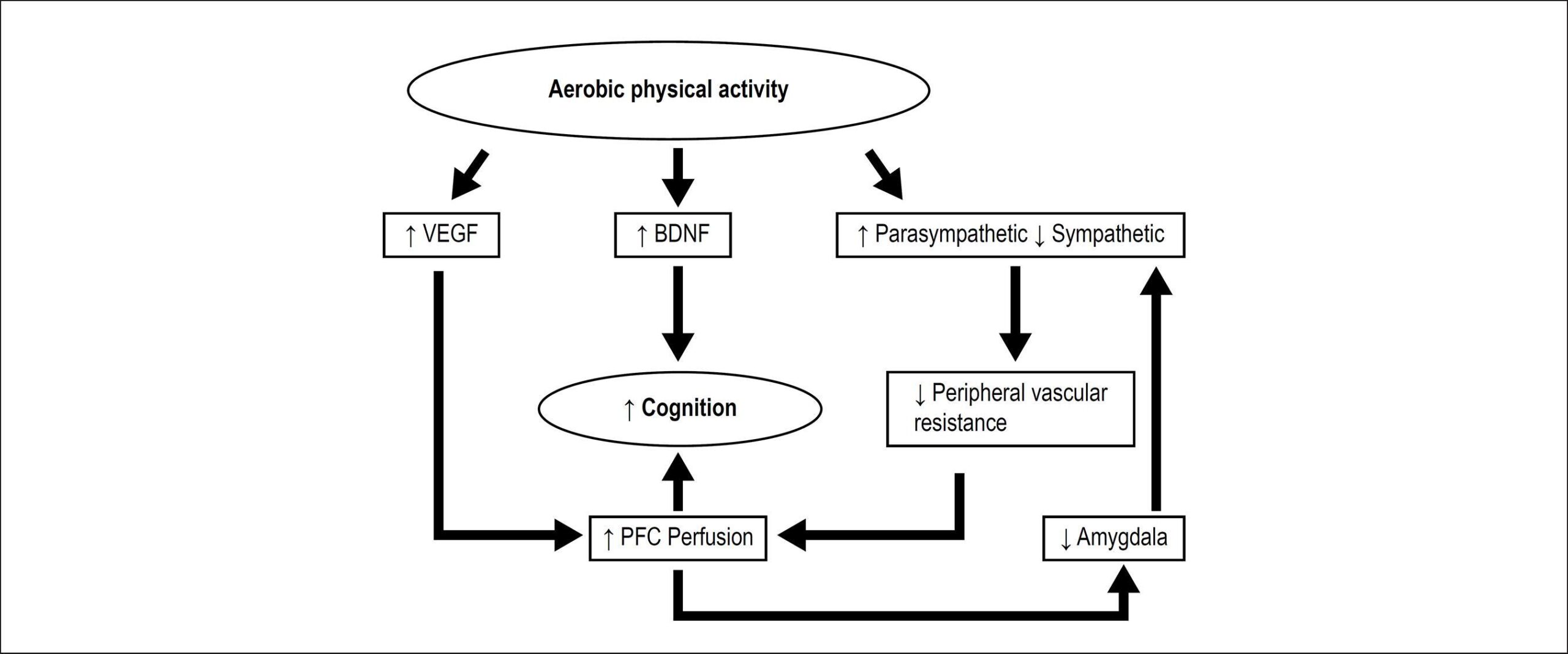
Heart Failure is a clinical syndrome prevalent throughout the world and a major contribution to mortality of cardiac patients in Brazil. In addition, this pathology is strongly related to cerebral dysfunction, with a high prevalence of cognitive impairment. Many mechanisms may be related to cognitive loss, such as cerebral hypoperfusion, atrophy and loss of gray matter of the brain, and dysfunction of the autonomic nervous system. The literature is clear regarding the benefits of aerobic physical activity in healthy populations in the modulation of the autonomic nervous system and in brain functions. Studies have shown that in the population of patients with heart failure, exercise is associated with an improvement in cognitive function, as well as in cardiac autonomic regulation. However, little emphasis has been given to the mechanisms by which aerobic physical activity can benefit brain functioning, the autonomic nervous system and result in better cognitive performance, particularly in patients with heart failure. Therefore, the present work presents the ways in which brain areas responsible for cognition also act in the modulation of the autonomic nervous system, and emphasizes its importance for the understanding of cognitive impairment in relation to the pathophysiology of heart failure. It is also described the way in which aerobic physical activity can promote benefits when it is integrated into the therapy, associated to a better prognosis of the clinical picture of these patients.

  • Cognition
  • Exercise
  • Heart Failure
  • Indicators of Morbidity and Mortality
Read Full Article
Creative Commons Attribution (CC BY) Creative Commons license
01/01/2018 DOI: 10.5935/abc.20180002 Views 11
ABC
Artigo Original

Elderly hypertensives show decreased cognitive performance compared with elderly normotensives

Juliana Magalhães Duarte Matoso et al. Wellington Bruno Santos Irene de Freitas Henriques Moreira Roberto Alves Lourenço Marcelo Lima de Gusmão Correia

BACKGROUND: Essential hypertension has been associated with decreased cognitive performance; however, the literature is conflicting. OBJECTIVE: This study aims at comparing cognitive performance between elderly normotensives (“N”; n = 17; age 68 ± 1; blood pressure = 133 ± 3/74 ±2 mmHg) and hypertensives (“H”; n = 28; age 69 ± 1, blood pressure = 148 ± 4/80 ± 1mmHg) with at least 5 years of education. METHODS: The comprehensive neuropsychological assessment was comprised of the Cambridge Cognition-Revised (CAMCOG-R), the Trail Making Test A and B (TMT A and B) and the Rey Auditory Verbal Learning Test (RAVLT). RESULTS: Elderly hypertensives presented lower CAMCOG-R global scores (N = 87.6 ± 1.8; H = 78.6 ± 1.4; p = 0.002). The hypertensive’s performance was slower in the TMT A and B (TMT A: N = 39 ± 3s; H = 57 ± 3s; p = 0.001; TMT B: N = 93 ± 7s; H = 124 ± 7s; p = 0.006), which was also reflected in smaller percentiles achieved by hypertensives in these tests. Hypertensive subjects exhibited a significantly lower RAVLT summation score (N = 51.8 ± 1.7; H = 40.7 ± 1.5; p < 0.0001). Even when adjusted for age, sex, education and depression symptoms, hypertension was an independent predictor of cognitive performance as measured by CAMCOG-R global score, TMT A and RAVLT summation score. CONCLUSION: Cognitive performance is lower in elderly hypertensives as compared with elderly normotensives.

  • Aged
  • Cognition
  • Hypertension
Read Full Article
Creative Commons Attribution (CC BY) Creative Commons license
12/04/2013 DOI: 10.5935/abc.20130080 Views 16

How to cite this article

EndNote RIS

Electronic Document Format (Vancouver)

Oliveira FM, Mangini S, Marcondes-Braga FG. From Recognition to Clinical Practice: Advances and Challenges in the Multidimensional Assessment of Frailty in Heart Failure. ABC Heart Fail Cardiomyop 2026;6:e20260038.

Electronic Document Format (ABNT)

Oliveira, France Matos de; Mangini, Sandrigo; Marcondes-Braga, Fabiana Goulart. From Recognition to Clinical Practice: Advances and Challenges in the Multidimensional Assessment of Frailty in Heart Failure. ABC Heart Fail Cardiomyop, v. 6, e20260038, Oct. 2026.

Electronic Document Format (APA)

Oliveira, F. M. , Mangini, S., & Marcondes-Braga, F. G. (2026). From Recognition to Clinical Practice: Advances and Challenges in the Multidimensional Assessment of Frailty in Heart Failure. ABC Heart Fail Cardiomyop, 6, e20260038.

Electronic Document Format (ISO)

Oliveira, France Matos de and Mangini, Sandrigo and Marcondes-Braga, Fabiana Goulart. From Recognition to Clinical Practice: Advances and Challenges in the Multidimensional Assessment of Frailty in Heart Failure. ABC Heart Fail Cardiomyop [online]. 2026, vol. 6, [cited 2026-11-28], e20260038. Available from: <https://journals.cardiol.br/en/article/from-recognition-to-clinical-practice-advances-and-challenges-in-the-multidimensional-assessment-of-frailty-in-heart-failure/>

EndNote RIS

Electronic Document Format (Vancouver)

Rêgo MLM, Cabral DAR, Fontes EB. Cognitive Deficit in Heart Failure and the Benefits of Aerobic Physical Activity. Arquivos Brasileiros de Cardiologia 2018;110(1):91-4.

Electronic Document Format (ABNT)

Rêgo, Maria Luíza de Medeiros; Cabral, Daniel Aranha Rego; Fontes, Eduardo Bodnariuc. Cognitive Deficit in Heart Failure and the Benefits of Aerobic Physical Activity. Arquivos Brasileiros de Cardiologia, v. 110, n. 1, p. 91-94, Dec. 2017.

Electronic Document Format (APA)

Rêgo, M. L. M., Cabral, D. A. R., & Fontes, E. B. (2018). Cognitive Deficit in Heart Failure and the Benefits of Aerobic Physical Activity. Arquivos Brasileiros de Cardiologia, 110(1), 91-94.

Electronic Document Format (ISO)

Rêgo, Maria Luíza de Medeiros and Cabral, Daniel Aranha Rego and Fontes, Eduardo Bodnariuc. Cognitive Deficit in Heart Failure and the Benefits of Aerobic Physical Activity. Arquivos Brasileiros de Cardiologia [online]. 2018, vol. 110, n. 1, [cited 2026-11-28], pp. 91-94. Available from: <https://journals.cardiol.br/en/article/cognitive-deficit-in-heart-failure-and-the-benefits-of-aerobic-physical-activity/>. ISSN 0066-782X

EndNote RIS

Electronic Document Format (Vancouver)

Matoso JMD, Santos WB, Moreira IFH, Lourenço RA, Correia MLG. Elderly hypertensives show decreased cognitive performance compared with elderly normotensives. Arquivos Brasileiros de Cardiologia 2013;100(5):444-51.

Electronic Document Format (ABNT)

Matoso, Juliana Magalhães Duarte; Santos, Wellington Bruno; Moreira, Irene de Freitas Henriques; Lourenço, Roberto Alves; Correia, Marcelo Lima de Gusmão. Elderly hypertensives show decreased cognitive performance compared with elderly normotensives. Arquivos Brasileiros de Cardiologia, v. 100, n. 5, p. 444-451, Apr. 2013.

Electronic Document Format (APA)

Matoso, J. M. D., Santos, W. B., Moreira, I. F. H., Lourenço, R. A., & Correia, M. L. G. (2013). Elderly hypertensives show decreased cognitive performance compared with elderly normotensives. Arquivos Brasileiros de Cardiologia, 100(5), 444-451.

Electronic Document Format (ISO)

Matoso, Juliana Magalhães Duarte and Santos, Wellington Bruno and Moreira, Irene de Freitas Henriques and Lourenço, Roberto Alves and Correia, Marcelo Lima de Gusmão. Elderly hypertensives show decreased cognitive performance compared with elderly normotensives. Arquivos Brasileiros de Cardiologia [online]. 2013, vol. 100, n. 5, [cited 2026-11-28], pp. 444-451. Available from: <https://journals.cardiol.br/en/article/elderly-hypertensives-show-decreased-cognitive-performance-compared-with-elderly-normotensives/>. ISSN 0066-782X

  • About ABC Family
  • Internal Regulation
  • Editorial Board
  • Brazilian Society of Cardiology (SBC)

Issues

SBC Guidelines

  • Videos
  • Podcasts
  • News
Accessibility Adjustments

Powered by OneTap

How long do you want to hide the toolbar?
Hide Toolbar Duration
Select your accessibility profile
Vision Impaired Mode
Enhances website's visuals
Seizure Safe Profile
Clear flashes & reduces color
ADHD Friendly Mode
Focused browsing, distraction-free
Blindness Mode
Reduces distractions, improves focus
Epilepsy Safe Mode
Dims colors and stops blinking
Content Modules
Font Size

Default

Line Height

Default

Color Modules
Orientation Modules