ABC Family Arquivos Brasileiros de Cardiologia International Journal of Cardiovascular Sciences ABC Heart Failure & Cardiomyopathy ABC Imagem Cardiovascular
Português English
ABC Family
Português English
  • About
    • About ABC Family
    • Internal Regulation
    • Editorial Board
    • Brazilian Society of Cardiology (SBC)
  • Issues
  • SBC Guidelines
  • Content
    • Videos
    • Podcasts
    • News
  • About
    • About ABC Family
    • Internal Regulation
    • Editorial Board
    • Brazilian Society of Cardiology (SBC)
  • Issues
  • SBC Guidelines
  • Content
    • Videos
    • Podcasts
    • News

ABC Family

  • ABC Family
  • Arquivos Brasileiros de Cardiologia
  • International Journal of Cardiovascular Sciences
  • ABC Heart Failure & Cardiomyopathy
  • ABC Imagem Cardiovascular
Search in

No content found.

Journals
Ordering
Article types
Others

  1. Home
  2. Keyword: Carotid sinus
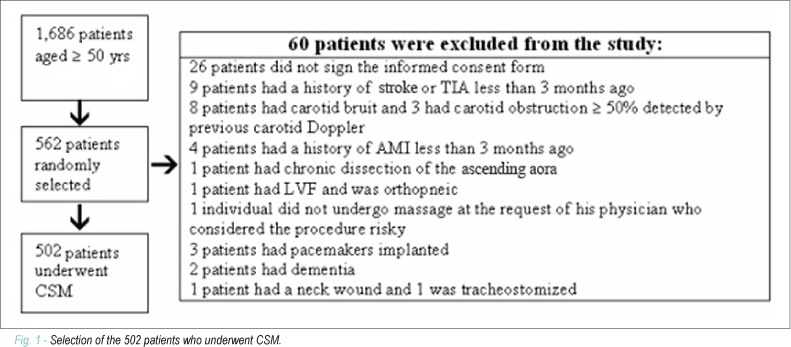
Figure 1
ABC
Research Letter

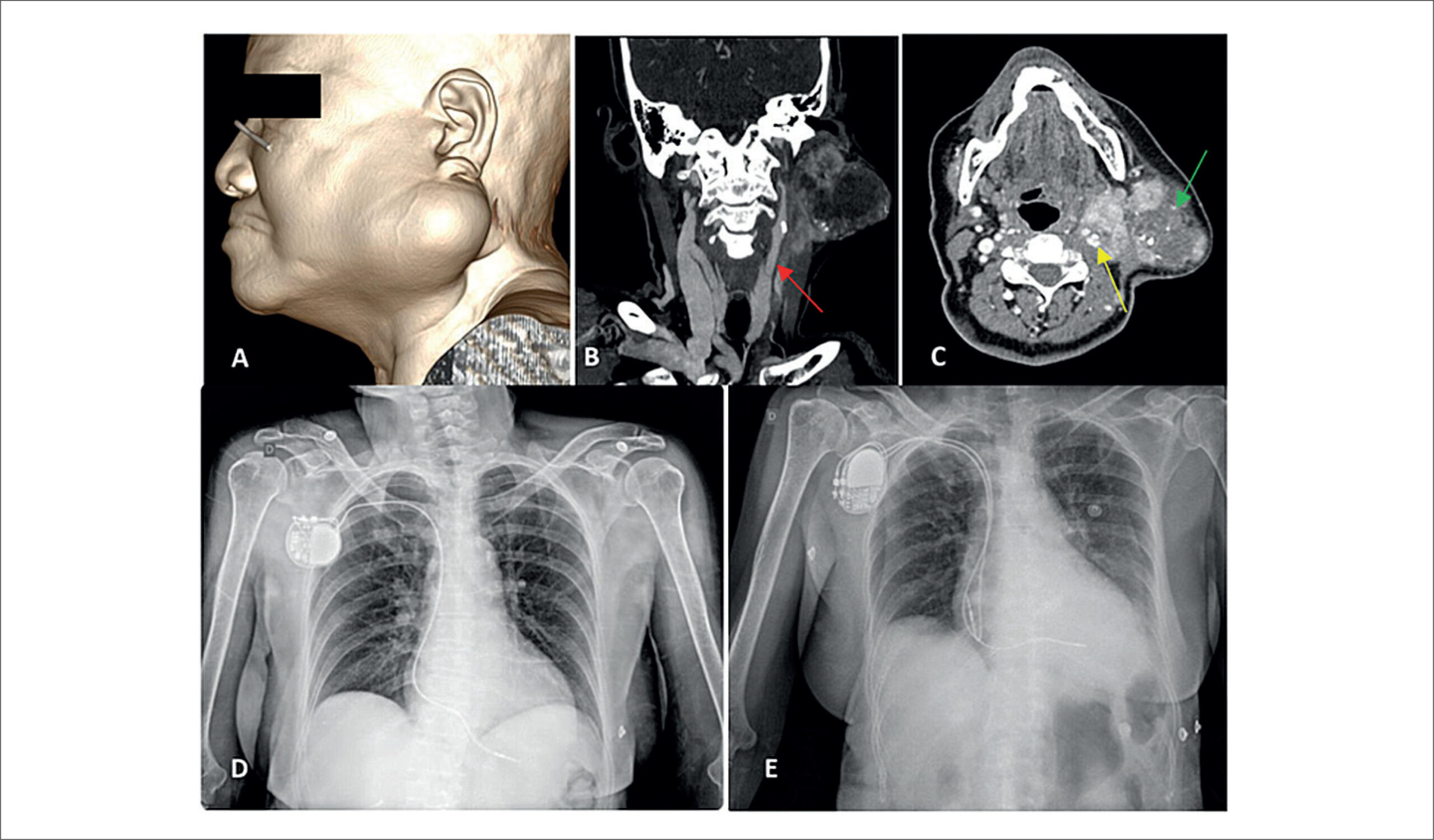
Carotid Sinus Syndrome Associated with Carcinoma Ex-Pleomorphic Adenoma: What Is the Role of Artificial Cardiac Stimulation?

Vanessa Sanson Lani et al. Jorge Elias Neto Márcio Augusto Silva Helena Alves de Andrade … Elisama Pimentel Zamian Cotias Fernando Luiz Torres Gomes

Introduction

Carotid sinus syndrome (CSS) is defined as syncope or pre-syncope associated with at least 3 seconds of asystole (cardioinhibitory response) and/or a drop of at least 50 mmHg in arterial systolic blood pressure (vasodepressor response) in response to stimulation of the carotid sinus. First recognized by Weiss and Baker in 1933, there have been since then reports of the association between neck masses and the occurrence of syncope. Among its causes is carcinoma ex-pleomorphic adenoma (CXAP), a rare malignant neoplasm that develops from a primary or recurrent pleomorphic adenoma. It represents 3.6% of all salivary gland neoplasms and 11.6% of all malignant neoplasms of these glands. CSS caused by neck masses is due to compression and invasion of the carotid sinus and nerve branches. This syndrome has 3 subtypes: cardioinhibitory, vasodepressor, and the mixed type. A fourth type of “cerebral response” has been previously described in the literature, in which direct compression of the carotid artery causes ipsilateral cerebral ischemia leading to seizures.

[…]
  • Adenoma Pleomorphic
  • Cardiac Pacing, Artificial
  • Carotid sinus
  • Head and Neck Neoplasms
  • Syncope
Read Full Article
Creative Commons Attribution (CC BY) Creative Commons license
12/08/2024 DOI: 10.36660/abc.20240026i Views 1
Complications related to carotid sinus massage in 502 ambulatory patients
ABC
Artigo Original

Complications related to carotid sinus massage in 502 ambulatory patients

Gustavo de Castro Lacerda et al. Roberto Coury Pedrosa Renato Côrtes de Lacerda Marcela Cedenilla dos Santos … Alfredo Teixeira Brasil Aristarco Gonçalves de Siqueira-Filho

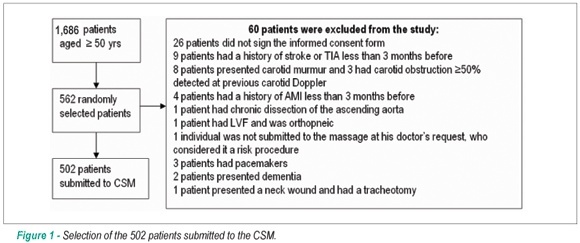
BACKGROUND: The carotid sinus massage (CSM) is a simple and low-cost technique with many indications. OBJECTIVE: To determine the safety of CSM in outpatients with high prevalence of atherosclerotic disease and cardiopathy. METHODS: A transversal study. Inclusion criteria: Outpatients aged >50 years, referred for ECG. Exclusion criteria: Individuals that refused to participate in a study on the prevalence of the cardioinhibitory response to CSM, patients with dementia, patients with pacemakers, individuals with carotid murmur or history of stroke or AMI in the last three months. The CSM was carried out in the supine position during 10 seconds. The occurrence of sustained arrhythmias or the occurence of neurological deficit during the CSM or in the first 24 hours after its end were considered complications of the CSM. RESULTS: 562 patients were randomly selected from a total of 1,686 individuals that met the inclusion criteria. Sixty individuals met the exclusion criteria. The remaining 502 patients (52% males, 69% with cardiopathies and 50% with atherosclerotic disease) were submitted to 1,053 CSM. Two patients presented complications (0.4%; 95%CI:0%-0.9%). A 71-yr-old man developed left arm monoparesis with complete regression within 30 minutes. Another 56-yr-old man presented left homonymous hemianopsia, with regression after 7 days. CONCLUSION: The incidence of CSM-related complications was small, particularly when considering that the population submitted to the maneuver was elderly, with high incidence of structural heart disease and atherosclerotic disease.

  • Arrhythmias Cardiac
  • Carotid sinus
  • Syncope
Read Full Article
Creative Commons Attribution (CC BY) Creative Commons license
06/04/2009 DOI: 10.1590/S0066-782X2009000200002
ABC
Artigo Original

Diagnostic relevance of the carotid sinus massage during a head up tilt table test (HUTT)

Marcos Benchimol et al. Ricardo Oliveira-Souza

BACKGROUND: Syncope due to carotid sinus hypersensitivity (CSH) may be underdiagnosed due to a low level of diagnostic suspicion and fear of complications caused by massage of the carotid sinus. OBJECTIVE: To investigate the relevance of carotid sinus massage in the diagnosis of non-convulsive faints and unexplained falls. METHODS: Two-hundred and fifty-nine patients with a mean age of 50±24 years referred for the investigation of non-convulsive faints or unexplained falls were evaluated with a head up tilt table test (HUTT) without (“passive”) and with pharmacological stimulation. Clinical and laboratory work-up did not reveal an obvious cause for the complaints. Fifty-five volunteers with a mean age of 57±21 years with no history of seizures, faints or falls were used as controls. All participants underwent a HUTT preceded by digital stimulation of each carotid sinus both at zero and 60º. RESULTS: Carotid sinus massage was positive in 4 controls. The relevance of CSH in the evaluation of syncope was supported by a positive response to carotid sinus massage at 60º in 28 patients, most of whom were elderly men. Carotid sinus massage was positive at 0º in only three of such patients. The results of the HUTT did not show statistical difference between patients with and without CSH. CONCLUSION: Carotid sinus massage at 60º under controlled conditions should be included in the assessment of patients with non-convulsive faints or unexplained falls. Routine cardiovascular exams, including the HUTT, are not useful for the diagnosis in such cases. Further studies in normal individuals are needed to establish the significance of a positive response to carotid sinus massage in the absence of a history of fainting or falling.

  • Carotid sinus
  • hypersensitivity
  • Syncope
  • Tilt Table Test
Read Full Article
Creative Commons Attribution (CC BY) Creative Commons license
29/05/2008 DOI: 10.1590/S0066-782X2008000400009
Cardioinhibitory carotid sinus hypersensitivity: prevalence and predictors in 502 outpatients
ABC
Artigo Original

Cardioinhibitory carotid sinus hypersensitivity: prevalence and predictors in 502 outpatients

Gustavo de Castro Lacerda et al. Roberto Coury Pedrosa Renato Côrtes de Lacerda Marcela Cedenilla dos Santos … Maurício de Andrade Perez Alfredo Brasil Teixeira Aristarco Gonçalves de Siqueira-Filho

BACKGROUND: Cardioinhibitory response (CIR) is defined as asystole >3 seconds in response to 5-10 seconds of carotid sinus massage (CSM). Pacemaker implantation is indicated for patients with unexplained syncope episodes and CIR. OBJECTIVE: To determine the prevalence and predictors of CIR in patients with a high prevalence of cardiovascular disease, and assess the clinical significance of CIR in patients with a history of unexplained syncope or falls. METHODS: Cross-section design study. Outpatients, aged >50 years, referred to the electrocardiography sector of a tertiary hospital. Those with dementia, carotid bruit, and history of myocardial infarction, stroke or transient ischemic attack in the preceding 3 months were excluded. CSM was performed by a single investigator, with the patients in the supine position. CSM was applied on the right side and then on the left side during 10 seconds each time. RESULTS: 502 patients underwent CSM. CIR was present in 52 patients (10.4%; 95% CI: 7.7%-13%). Independent predictors of CIR were male gender (OR: 2.61%; CI 95%: 1.3%-5.1%), structural heart disease (OR: 3.28%; CI 95%: 1.3%-7.9%) and baseline heart rate (P 50 years. In males and in patients with structural heart disease CIR was more common. In women and patients with no apparent structural heart disease, the presence of CIR was a highly specific finding in the evaluation of syncope or falls.

  • Arrhythmia
  • Carotid sinus
  • outpatients
  • Syncope
Read Full Article
Creative Commons Attribution (CC BY) Creative Commons license
04/04/2008 DOI: 10.1590/S0066-782X2008000300002

How to cite this article

EndNote RIS

Electronic Document Format (Vancouver)

Lani VS, Elias Neto J, Silva MA, Andrade HA, Cotias EPZ, Gomes FLT. Carotid Sinus Syndrome Associated with Carcinoma Ex-Pleomorphic Adenoma: What Is the Role of Artificial Cardiac Stimulation?. Arquivos Brasileiros de Cardiologia 2024;121(7):e20240026.

Electronic Document Format (ABNT)

Lani, Vanessa Sanson; Elias Neto, Jorge; Silva, Márcio Augusto; Andrade, Helena Alves de; Cotias, Elisama Pimentel Zamian; Gomes, Fernando Luiz Torres. Carotid Sinus Syndrome Associated with Carcinoma Ex-Pleomorphic Adenoma: What Is the Role of Artificial Cardiac Stimulation?. Arquivos Brasileiros de Cardiologia, v. 121, n. 7, e20240026, Aug. 2024.

Electronic Document Format (APA)

Lani, V. S., Elias Neto, J., Silva, M. A., Andrade, H. A. , Cotias, E. P. Z., & Gomes, F. L. T. (2024). Carotid Sinus Syndrome Associated with Carcinoma Ex-Pleomorphic Adenoma: What Is the Role of Artificial Cardiac Stimulation?. Arquivos Brasileiros de Cardiologia, 121(7), e20240026.

Electronic Document Format (ISO)

Lani, Vanessa Sanson and Elias Neto, Jorge and Silva, Márcio Augusto and Andrade, Helena Alves de and Cotias, Elisama Pimentel Zamian and Gomes, Fernando Luiz Torres. Carotid Sinus Syndrome Associated with Carcinoma Ex-Pleomorphic Adenoma: What Is the Role of Artificial Cardiac Stimulation?. Arquivos Brasileiros de Cardiologia [online]. 2024, vol. 121, n. 7, [cited 2026-10-14], e20240026. Available from: <https://journals.cardiol.br/en/article/carotid-sinus-syndrome-associated-with-carcinoma-ex-pleomorphic-adenoma-what-is-the-role-of-artificial-cardiac-stimulation/>. ISSN 0066-782X

EndNote RIS

Electronic Document Format (Vancouver)

Lacerda GC, Pedrosa RC, Lacerda RC, Santos MC, Brasil AT, Siqueira-Filho AG. Complications related to carotid sinus massage in 502 ambulatory patients. Arquivos Brasileiros de Cardiologia 2009;92(2):82-7.

Electronic Document Format (ABNT)

Lacerda, Gustavo de Castro; Pedrosa, Roberto Coury; Lacerda, Renato Côrtes de; Santos, Marcela Cedenilla dos; Brasil, Alfredo Teixeira; Siqueira-Filho, Aristarco Gonçalves de. Complications related to carotid sinus massage in 502 ambulatory patients. Arquivos Brasileiros de Cardiologia, v. 92, n. 2, p. 82-87, Apr. 2009.

Electronic Document Format (APA)

Lacerda, G. C., Pedrosa, R. C., Lacerda, R. C. , Santos, M. C. , Brasil, A. T., & Siqueira-Filho, A. G. (2009). Complications related to carotid sinus massage in 502 ambulatory patients. Arquivos Brasileiros de Cardiologia, 92(2), 82-87.

Electronic Document Format (ISO)

Lacerda, Gustavo de Castro and Pedrosa, Roberto Coury and Lacerda, Renato Côrtes de and Santos, Marcela Cedenilla dos and Brasil, Alfredo Teixeira and Siqueira-Filho, Aristarco Gonçalves de. Complications related to carotid sinus massage in 502 ambulatory patients. Arquivos Brasileiros de Cardiologia [online]. 2009, vol. 92, n. 2, [cited 2026-10-14], pp. 82-87. Available from: <https://journals.cardiol.br/en/article/complications-related-to-carotid-sinus-massage-in-502-ambulatory-patients/>. ISSN 0066-782X

EndNote RIS

Electronic Document Format (Vancouver)

Benchimol M, Oliveira-Souza R. Diagnostic relevance of the carotid sinus massage during a head up tilt table test (HUTT). Arquivos Brasileiros de Cardiologia 2008;90(4):288-92.

Electronic Document Format (ABNT)

Benchimol, Marcos; Oliveira-Souza, Ricardo. Diagnostic relevance of the carotid sinus massage during a head up tilt table test (HUTT). Arquivos Brasileiros de Cardiologia, v. 90, n. 4, p. 288-292, May. 2008.

Electronic Document Format (APA)

Benchimol, M., & Oliveira-Souza, R. (2008). Diagnostic relevance of the carotid sinus massage during a head up tilt table test (HUTT). Arquivos Brasileiros de Cardiologia, 90(4), 288-292.

Electronic Document Format (ISO)

Benchimol, Marcos and Oliveira-Souza, Ricardo. Diagnostic relevance of the carotid sinus massage during a head up tilt table test (HUTT). Arquivos Brasileiros de Cardiologia [online]. 2008, vol. 90, n. 4, [cited 2026-10-14], pp. 288-292. Available from: <https://journals.cardiol.br/en/article/diagnostic-relevance-of-the-carotid-sinus-massage-during-a-head-up-tilt-table-test-hutt/>. ISSN 0066-782X

EndNote RIS

Electronic Document Format (Vancouver)

Lacerda GC, Pedrosa RC, Lacerda RC, Santos MC, Perez MA, Teixeira AB, Siqueira-Filho AG, et al. Cardioinhibitory carotid sinus hypersensitivity: prevalence and predictors in 502 outpatients. Arquivos Brasileiros de Cardiologia 2008;90(3):163-71.

Electronic Document Format (ABNT)

Lacerda, Gustavo de Castro; Pedrosa, Roberto Coury; Lacerda, Renato Côrtes de; Santos, Marcela Cedenilla dos; Perez, Maurício de Andrade; Teixeira, Alfredo Brasil; Siqueira-Filho, Aristarco Gonçalves de. Cardioinhibitory carotid sinus hypersensitivity: prevalence and predictors in 502 outpatients. Arquivos Brasileiros de Cardiologia, v. 90, n. 3, p. 163-171, Apr. 2008.

Electronic Document Format (APA)

Lacerda, G. C., Pedrosa, R. C., Lacerda, R. C. , Santos, M. C. , Perez, M. A., Teixeira, A. B., & Siqueira-Filho, A. G. (2008). Cardioinhibitory carotid sinus hypersensitivity: prevalence and predictors in 502 outpatients. Arquivos Brasileiros de Cardiologia, 90(3), 163-171.

Electronic Document Format (ISO)

Lacerda, Gustavo de Castro and Pedrosa, Roberto Coury and Lacerda, Renato Côrtes de and Santos, Marcela Cedenilla dos and Perez, Maurício de Andrade and Teixeira, Alfredo Brasil and Siqueira-Filho, Aristarco Gonçalves de. Cardioinhibitory carotid sinus hypersensitivity: prevalence and predictors in 502 outpatients. Arquivos Brasileiros de Cardiologia [online]. 2008, vol. 90, n. 3, [cited 2026-10-14], pp. 163-171. Available from: <https://journals.cardiol.br/en/article/cardioinhibitory-carotid-sinus-hypersensitivity-prevalence-and-predictors-in-502-outpatients/>. ISSN 0066-782X

  • About ABC Family
  • Internal Regulation
  • Editorial Board
  • Brazilian Society of Cardiology (SBC)

Issues

SBC Guidelines

  • Videos
  • Podcasts
  • News