ABC Family Arquivos Brasileiros de Cardiologia International Journal of Cardiovascular Sciences ABC Heart Failure & Cardiomyopathy ABC Imagem Cardiovascular
Português English
ABC Family
Português English
  • About
    • About ABC Family
    • Internal Regulation
    • Editorial Board
    • Brazilian Society of Cardiology (SBC)
  • Issues
  • SBC Guidelines
  • Content
    • Videos
    • Podcasts
    • News
  • About
    • About ABC Family
    • Internal Regulation
    • Editorial Board
    • Brazilian Society of Cardiology (SBC)
  • Issues
  • SBC Guidelines
  • Content
    • Videos
    • Podcasts
    • News

ABC Family

  • ABC Family
  • Arquivos Brasileiros de Cardiologia
  • International Journal of Cardiovascular Sciences
  • ABC Heart Failure & Cardiomyopathy
  • ABC Imagem Cardiovascular
Search in

No content found.

Journals
Ordering
Article types
Others

  1. Home
  2. Keyword: APACHE
Applicability of SAPS 3 and APACHE II Scores in a Cardiac Intensive Care Unit: A Prospective Study
IJCS
Original Article

Applicability of SAPS 3 and APACHE II Scores in a Cardiac Intensive Care Unit: A Prospective Study

Rafael Petri Pinheiro et al. Leonardo Castro Luna Vanessa dos Reis von Doellinger Marcelo Goulart Correia … Bernardo Tura Stephan Lachtermacher

Abstract

Background

Prognostic scores such as the Simplified Acute Physiology Score (SAPS) and the Acute Physiology and Chronic Health Evaluation (APACHE) are essential for assessing performance and predicting mortality in Intensive Care Units (ICUs).

Objectives

To evaluate the performance of SAPS 3 (including the Latin America [LA] and Brazil [BR] versions) and APACHE II in predicting mortality in a cardiac intensive care unit (CICU).

Methods

Prospective cohort of patients admitted between June 2022 and May 2024, followed until discharge or death. Data were extracted from electronic medical records. The relationship between observed and predicted mortality was calculated using the Standardized Mortality Ratio (SMR), and discrimination was assessed by the Receiver Operating Characteristic (ROC) curve.

Results

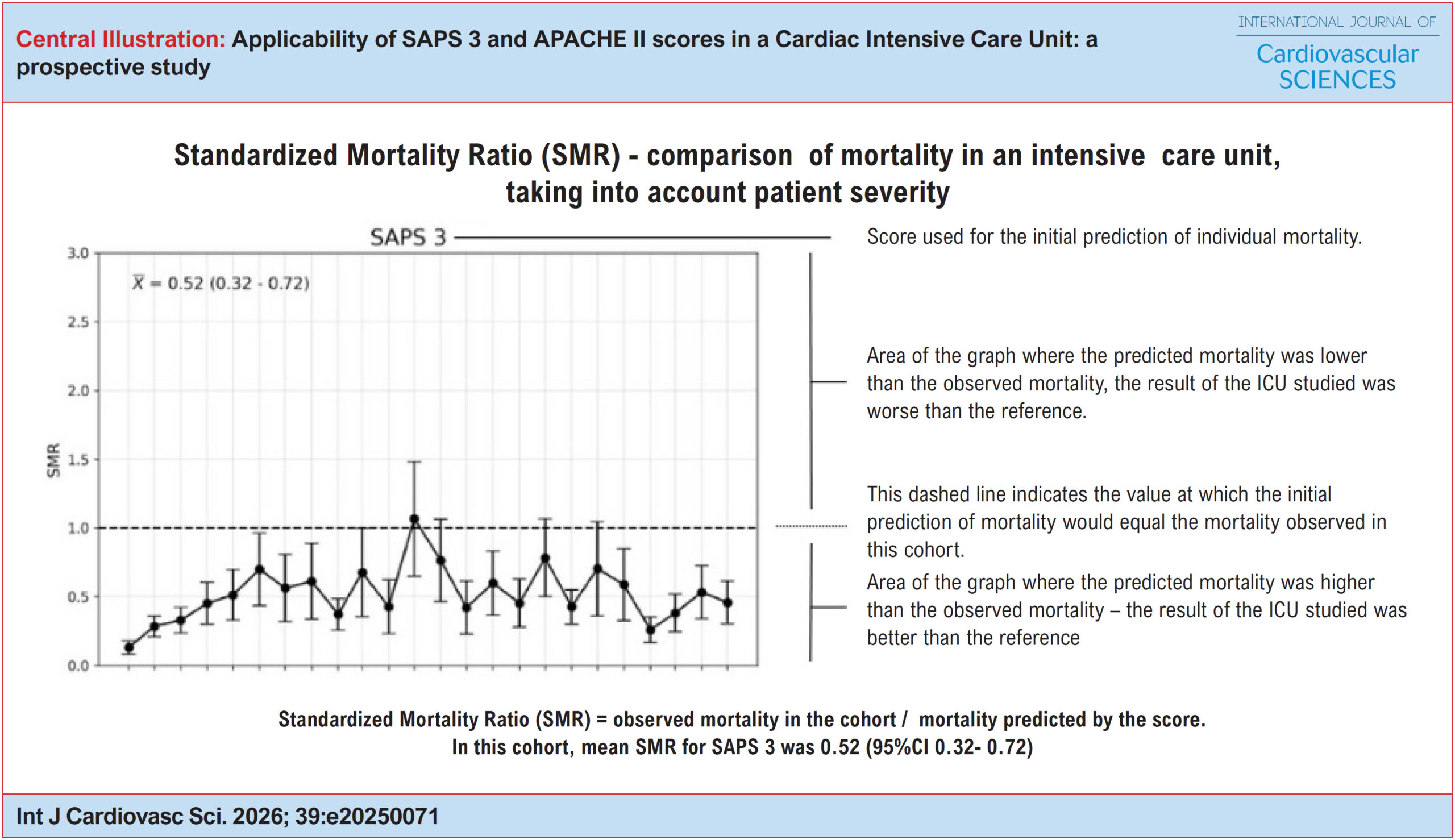
A total of 573 patients were included, 288 (50%) with three or more comorbidities, median age 63 years [IQR: 53–72], and 344 (60%) male. Cardiovascular diseases accounted for 76% of admissions. Overall mortality was 15%. Mean SMR values were: 0.52 (95% CI: 0.32–0.72) for SAPS 3; 0.40 (95% CI: 0.26–0.54) for SAPS 3 Latin America (AL); 0.79 (95% CI: 0.41–1.16) for SAPS 3 Brazil (BR); and 0.86 (95% CI: 0.42–1.29) for APACHE II. The analysis of the area under the curve (AUC) was 0.805 for SAPS 3 and its adapted versions, and 0.704 for APACHE II.

Conclusions

SAPS 3, particularly SAPS 3 Brazil (BR), demonstrated greater accuracy than APACHE II. Despite mortality being above the national average, the SMR indicated that observed mortality was lower than predicted, suggesting good care performance in the unit.
  • APACHE
  • Cardiology
  • Hospital Mortality
  • Intensive Care Units
  • Simplified Acute Physiology Score
Read Full Article
Creative Commons Attribution (CC BY) Creative Commons license
27/04/2026 DOI: 10.36660/ijcs.20250071 Views 1
Figure 1
IJCS
Editorial

Forty Years of Silent Revolutions in ICUs: From Clinical Records to Intelligent and Predictive Surveillance

Rubens Carmo Costa-Filho et al. Hugo Caire Castro Faria-Neto

Introduction

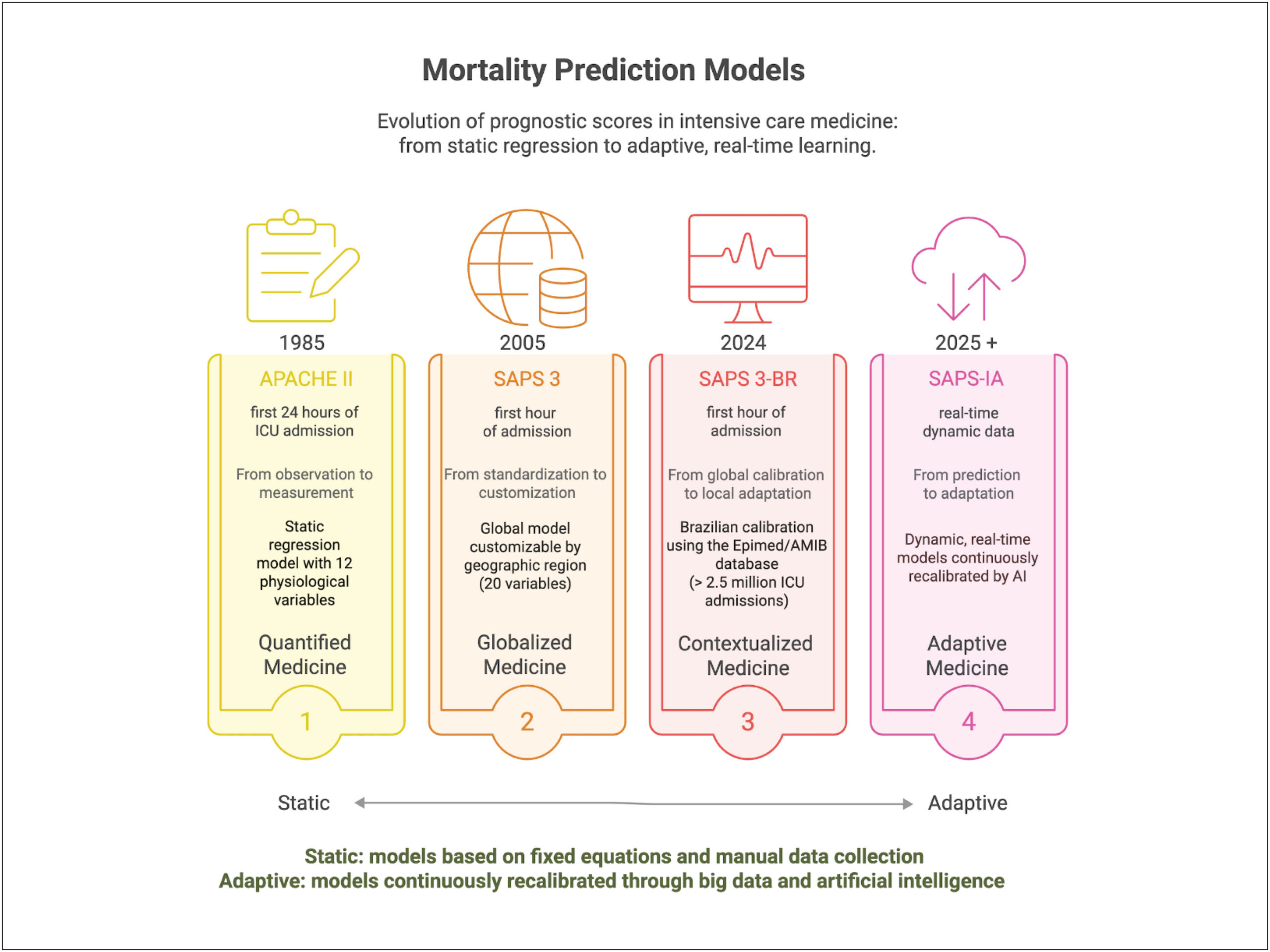
In the mid-1980s, as modern intensive care medicine was still consolidating as a specialty, a conceptual challenge emerged that would redefine critical care: how to objectively and comparably quantify the severity of illness across different patients and units. In 1985, William A. Knaus et al. published the Acute Physiology and Chronic Health Evaluation II (APACHE II). This landmark model translated clinical observations into a mathematical framework capable of estimating hospital mortality based on 12 physiological and chronic health variables collected during the first 24 hours of ICU admission.

At that time, computing power was limited, and data were collected manually, the technological ceiling of that era.

[…]

  • APACHE
  • Artificial Intelligence
  • Critical Care
  • Prognosis
  • Simplified Acute Physiology Score
Read Full Article
Creative Commons Attribution (CC BY) Creative Commons license
27/04/2026 DOI: 10.36660/ijcs.20250255 Views 1

How to cite this article

EndNote RIS

Electronic Document Format (Vancouver)

Pinheiro RP, Luna LC, Doellinger VR, Correia MG, Tura B, Lachtermacher S. Applicability of SAPS 3 and APACHE II Scores in a Cardiac Intensive Care Unit: A Prospective Study. International Journal of Cardiovascular Sciences 2026;39:e20250071.

Electronic Document Format (ABNT)

Pinheiro, Rafael Petri; Luna, Leonardo Castro; Doellinger, Vanessa dos Reis von; Correia, Marcelo Goulart; Tura, Bernardo; Lachtermacher, Stephan. Applicability of SAPS 3 and APACHE II Scores in a Cardiac Intensive Care Unit: A Prospective Study. International Journal of Cardiovascular Sciences, v. 39, e20250071, Apr. 2026.

Electronic Document Format (APA)

Pinheiro, R. P., Luna, L. C., Doellinger, V. R. , Correia, M. G., Tura, B., & Lachtermacher, S. (2026). Applicability of SAPS 3 and APACHE II Scores in a Cardiac Intensive Care Unit: A Prospective Study. International Journal of Cardiovascular Sciences, 39, e20250071.

Electronic Document Format (ISO)

Pinheiro, Rafael Petri and Luna, Leonardo Castro and Doellinger, Vanessa dos Reis von and Correia, Marcelo Goulart and Tura, Bernardo and Lachtermacher, Stephan. Applicability of SAPS 3 and APACHE II Scores in a Cardiac Intensive Care Unit: A Prospective Study. International Journal of Cardiovascular Sciences [online]. 2026, vol. 39, [cited 2026-10-14], e20250071. Available from: <https://journals.cardiol.br/en/article/applicability-of-saps-3-and-apache-ii-scores-in-a-cardiac-intensive-care-unit-a-prospective-study/>. ISSN 2359-4802

EndNote RIS

Electronic Document Format (Vancouver)

Costa-Filho RC, Faria-Neto HCC. Forty Years of Silent Revolutions in ICUs: From Clinical Records to Intelligent and Predictive Surveillance. International Journal of Cardiovascular Sciences 2026;39:e20250255.

Electronic Document Format (ABNT)

Costa-Filho, Rubens Carmo; Faria-Neto, Hugo Caire Castro. Forty Years of Silent Revolutions in ICUs: From Clinical Records to Intelligent and Predictive Surveillance. International Journal of Cardiovascular Sciences, v. 39, e20250255, Apr. 2026.

Electronic Document Format (APA)

Costa-Filho, R. C., & Faria-Neto, H. C. C. (2026). Forty Years of Silent Revolutions in ICUs: From Clinical Records to Intelligent and Predictive Surveillance. International Journal of Cardiovascular Sciences, 39, e20250255.

Electronic Document Format (ISO)

Costa-Filho, Rubens Carmo and Faria-Neto, Hugo Caire Castro. Forty Years of Silent Revolutions in ICUs: From Clinical Records to Intelligent and Predictive Surveillance. International Journal of Cardiovascular Sciences [online]. 2026, vol. 39, [cited 2026-10-14], e20250255. Available from: <https://journals.cardiol.br/en/article/forty-years-of-silent-revolutions-in-icus-from-clinical-records-to-intelligent-and-predictive-surveillance/>. ISSN 2359-4802

  • About ABC Family
  • Internal Regulation
  • Editorial Board
  • Brazilian Society of Cardiology (SBC)

Issues

SBC Guidelines

  • Videos
  • Podcasts
  • News