ABC Family Arquivos Brasileiros de Cardiologia International Journal of Cardiovascular Sciences ABC Heart Failure & Cardiomyopathy ABC Imagem Cardiovascular
Português English
ABC Family
Português English
  • About
    • About ABC Family
    • Internal Regulation
    • Editorial Board
    • Brazilian Society of Cardiology (SBC)
  • Issues
  • SBC Guidelines
  • Content
    • Videos
    • Podcasts
    • News
  • About
    • About ABC Family
    • Internal Regulation
    • Editorial Board
    • Brazilian Society of Cardiology (SBC)
  • Issues
  • SBC Guidelines
  • Content
    • Videos
    • Podcasts
    • News

ABC Family

  • ABC Family
  • Arquivos Brasileiros de Cardiologia
  • International Journal of Cardiovascular Sciences
  • ABC Heart Failure & Cardiomyopathy
  • ABC Imagem Cardiovascular
Search in

No content found.

Journals
Ordering
Article types
Others

  1. Home
  2. Keyword: Ablation
ABC
Editorial

Atrial Fibrillation Ablation: Are We Still Looking for the Best Shot?

Lucas Simonetto Faganello et al. Mauricio Pimentel

Atrial fibrillation (AF) is independently associated with increased risks of mortality, stroke, heart failure, impaired quality of life, and cognitive decline. Rhythm control has proven superior to rate control in reducing cardiovascular outcomes, with catheter ablation demonstrating greater efficacy than antiarrhythmic drug therapy.– Continuous advances in techniques and technologies have progressively established ablation as a cornerstone in the management of AF.

In recent years, 3D mapping and point-by-point ablation have evolved significantly with the introduction of contact force-sensing catheters and the development of lesion quality metrics, such as the Ablation Index and Lesion Size Index. These improvements have translated into better outcomes, reduced procedure times, and enhanced safety.– Pulmonary vein isolation remains the cornerstone of invasive AF treatment, with radiofrequency (RF) point-by-point ablation still being the most widely used technique despite the emergence of alternative energy sources. Procedural success relies on delivering continuous, irreversible, and transmural lesions encircling the pulmonary veins while sparing adjacent structures, such as the esophagus and phrenic nerve.

[…]

  • Ablation
  • Atrial Fibrillation
Read Full Article
Creative Commons Attribution (CC BY) Creative Commons license
25/08/2025 DOI: 10.36660/abc.20250396i Views 1
Figure 1
ABCIC
My Approach To

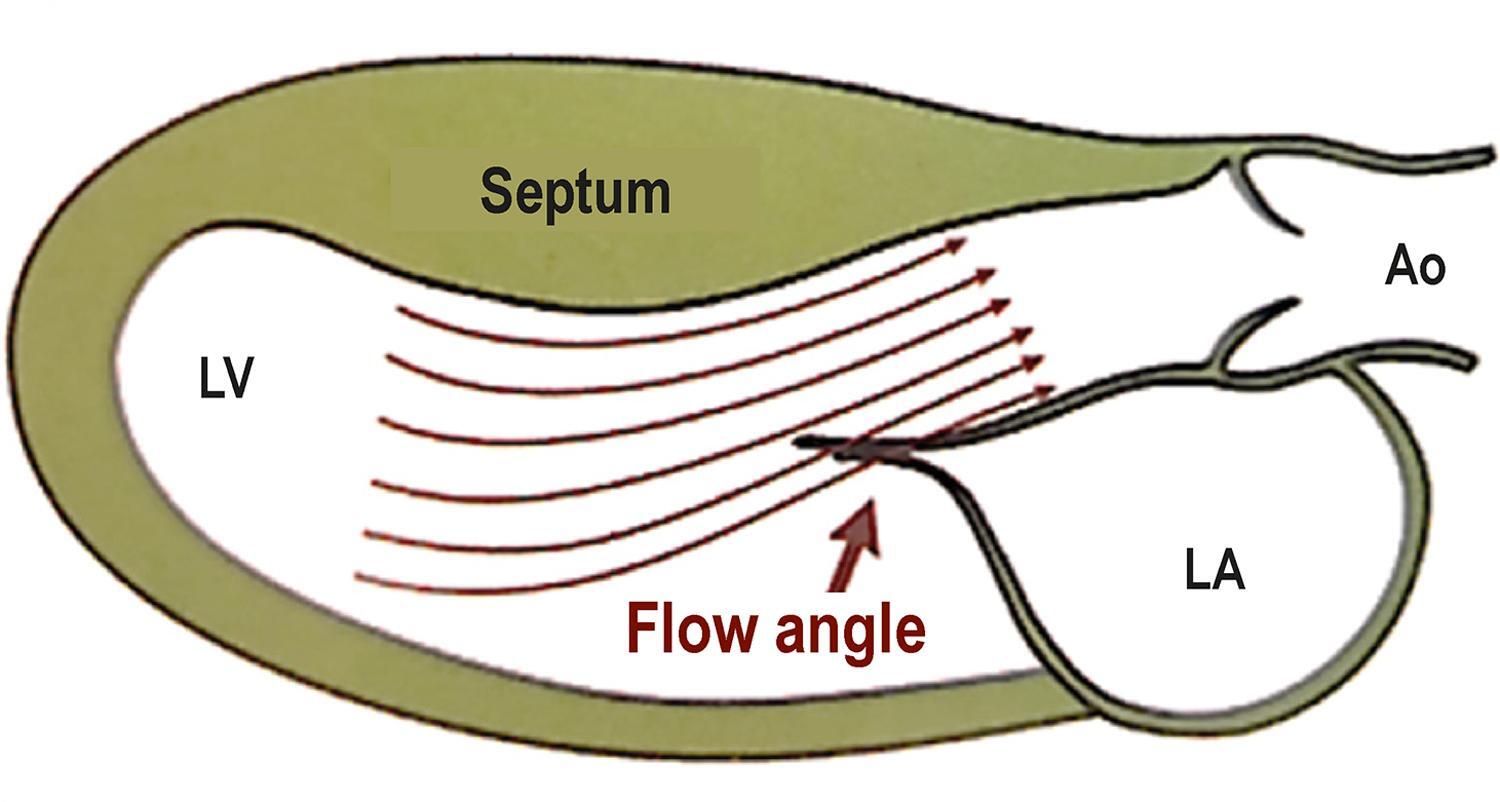
My Approach to Echocardiography in Radiofrequency Ablation of Hypertrophic Obstructive Cardiomyopathy

Antonio Tito Paladino et al. Andrea de Andrade Vilela Jorge Eduardo Assef Bruno Pereira Valdigem

Introduction

Hypertrophic cardiomyopathy (HCM), an autosomal dominant genetic disease that affects one in 500 people, is considered the most common isolated form of hereditary heart disease. HCM is characterized by varying degrees of ventricular hypertrophy, myocardial fiber disarray, interstitial fibrosis, and microvascular disease in the absence of cardiac or systemic conditions to justify these findings.

Echocardiography, an invaluable tool for the diagnosis and follow-up of patients with HCM, is used to assess morphology, hemodynamic disorders, left ventricular (LV) function, and patient prognosis. It also has a fundamental role in cases of hypertrophic obstructive cardiomyopathy (HOCM) in the indication of invasive treatments. Radiofrequency ablation (RFA) is a possible treatment under study.

[…]

  • Ablation
  • Cardiac Hypertrophy
  • Echocardiography
  • Radio Frequency
Read Full Article
Creative Commons Attribution (CC BY) Creative Commons license
27/05/2022 DOI: 10.47593/2675-312X/20223502ecom28 Views 2
ABC
Editorial

Reconnection of Pulmonary Veins After Ablation. A Challenge to be Overcome

Silvia Helena Cardoso Boghossian et al. Ricardo Mourilhe-Rocha

Atrial fibrillation (AF) is the most common sustained arrhythmia in the population and its incidence significantly increases with age.As life expectancy rises, it is estimated that AF prevalence will suffer a significant increase, and its adequate control will continue to be a major challenge.

Until the end of the 90s, the therapeutic options available and most used in the reversion and prevention of AF recurrences were antiarrhythmic drugs (AA) and electrical cardioversion; however, clinical treatment with AA drugs has been shown ineffective in maintaining sinus rhythm, with a recurrence rate above 50%.

[…]

  • Ablation
  • Atrial Fibrillation
  • Cryoablation
  • Pulmonary Veins
  • Reconnection
Read Full Article
Creative Commons Attribution (CC BY) Creative Commons license
26/07/2021 DOI: 10.36660/abc.20210438 Views 1
Contribution of the electrophysiological and anatomical analysis of the atypical atrioventricular nodal tachycardia circuit
ABC
Artigo Original

Contribution of the electrophysiological and anatomical analysis of the atypical atrioventricular nodal tachycardia circuit

Maila Seifert Macedo Silva et al. Roberto Luiz M. da Silva Sá Márcio Luiz A. Fagundes Fernando E. S. Cruz Filho … Leonardo B. Arantes Silvia Boghossian Adriana Monteiro C. David de Almeida Rafael Lopes Fagundes Luiz José Romeo Filho

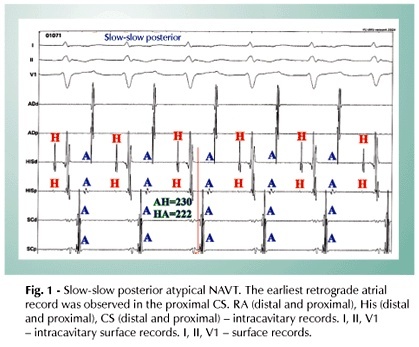
OBJECTIVES: To analyze retrograde conduction during junctional ectopic tachycardia (JET) episodes and investigate the existence of a relationship between the presence of a retrograde block and the risk of atrioventricular block (AVB) development during radiofrequency ablation procedures in patients with nodal atrioventricular tachycardia (NAVT). METHODS: 145 male and female patients aged 16-84 years, with NAVT who had undergone radiofrequency catheter ablation in the posteroseptal region of the right atrium were studied. Evaluation criteria were anatomical location and electrophysiological behavior of retrograde conduction during NAVT, in order to understand the nodal reentrant circuit (classifying the tachycardia as typical or atypical), and monitoring of retrograde conduction during JET episodes for risk-predicting AVB events. RESULTS: Of the 145 patients studied, 132 (91%) met electrophysiological and anatomical criteria of the typical form of NAVT, and 13 (9%) of atypical form. During the ablation, 5.3% with the typical form and 30.8% of the atypical form presented risk events for AVB. After the ablation, complications were a total AVB episode in one patient and a first-degree AVB episode in another in the typical group, and one first-degree AVB in the atypical group. All three episodes were preceded by risk events and resulted in permanent nodal injury. CONCLUSION: Patients with atypical NAVT presented higher percentages of risk events for atrioventricular block than did patients with the typical form (p=0.021).A careful observation of retrograde conduction during JET episodes is vital in order to avoid permanent damage in AV nodal conduction, such as TAVB, after the ablation procedure.

  • Ablation
  • Arrhythmia
  • nodal atrioventricular tachycardia
Read Full Article
Creative Commons Attribution (CC BY) Creative Commons license
20/03/2007 DOI: 10.1590/S0066-782X2007000200003 Views 2
Chart I
ABC
Original Article

Percutaneous transluminal septal alcoholization for the treatment of refractory hypertrophic obstructive cardiomyopathy: initial experience in the Federal District

Evandro César Vidal Osterne et al. Tamer Najar Seixas Walter Paulo Filho Ernesto Misael Cintra Osterne Otoni Moreira Gomes

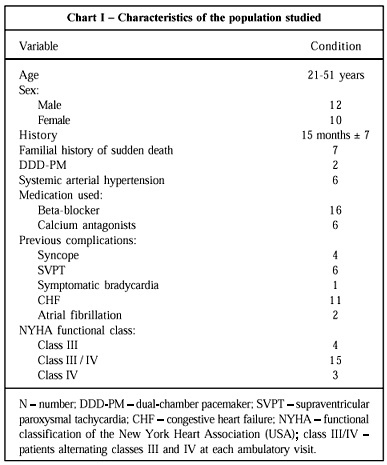
OBJECTIVE: To analyze the efficacy of percutaneous transluminal septal alcoholization in the treatment of refractory obstructive hypertrophic cardiomyopathy (HOC). METHODS: The patients were referred for alcoholization after Doppler echocardiography. Before and after alcoholization, the intraventricular pressure gradient was recorded. Alcoholization was performed with a 3mL injection of absolute alcohol through a coronary angioplasty balloon catheter. The procedure was concluded after a significant reduction or abolition of the pressure gradient. RESULTS: Of 22 patients, 18 (81.8%) successfully concluded the procedure with a reduction in intraventricular pressure gradient at baseline (from 67.6±24.2 mmHg to 3.8± 1.9 mmHg, p<0.005) and after extrasystole (from 110.4± 24.2 mmHg to 9.6±2.6 mm Hg, p<0.005). A significant reduction in mean interventricular septal thickness (from 2± 0.3 mm to 1.7±0.2 mm, p<0.005) and in peak pressure gradient (from 90.7±23.5 mmHg to 6.1±1.4 mmHg, p<0.005) was observed on Doppler echocardiography after 6 months, when all patients were in functional class I. The most frequent acute complication, present in 11% of the patients, was the need for definitive pacing implantation. Relapse of the symptoms and reappearance of the pressure gradient occurred in 16.6% of the patients. One patient (5.5%) died probably due to a diffuse coronary spasm prior to the procedure, and another died suddenly on late follow-up. CONCLUSION: Percutaneous transluminal septal alcoholization is effective and safe in the treatment of HOC.

  • Ablation
  • hypertrophic obstructive cardiomyopathy
  • percutaneous septal ablation
  • percutaneous septal alcoholization
Read Full Article
Creative Commons Attribution (CC BY) Creative Commons license
19/05/2003 DOI: 10.1590/S0066-782X2003000400002 Views 1

How to cite this article

EndNote RIS

Electronic Document Format (Vancouver)

Faganello LS, Pimentel M. Atrial Fibrillation Ablation: Are We Still Looking for the Best Shot?. Arquivos Brasileiros de Cardiologia 2025;122(7):e20250396.

Electronic Document Format (ABNT)

Faganello, Lucas Simonetto; Pimentel, Mauricio. Atrial Fibrillation Ablation: Are We Still Looking for the Best Shot?. Arquivos Brasileiros de Cardiologia, v. 122, n. 7, e20250396, Aug. 2025.

Electronic Document Format (APA)

Faganello, L. S., & Pimentel, M. (2025). Atrial Fibrillation Ablation: Are We Still Looking for the Best Shot?. Arquivos Brasileiros de Cardiologia, 122(7), e20250396.

Electronic Document Format (ISO)

Faganello, Lucas Simonetto and Pimentel, Mauricio. Atrial Fibrillation Ablation: Are We Still Looking for the Best Shot?. Arquivos Brasileiros de Cardiologia [online]. 2025, vol. 122, n. 7, [cited 2026-10-14], e20250396. Available from: <https://journals.cardiol.br/en/article/atrial-fibrillation-ablation-are-we-still-looking-for-the-best-shot/>. ISSN 0066-782X

EndNote RIS

Electronic Document Format (Vancouver)

Paladino AT, Vilela AA, Assef JE, Valdigem BP. My Approach to Echocardiography in Radiofrequency Ablation of Hypertrophic Obstructive Cardiomyopathy. Arquivos Brasileiros de Cardiologia Imagem cardiovascular 2022;35(2):ecom28.

Electronic Document Format (ABNT)

Paladino, Antonio Tito; Vilela, Andrea de Andrade; Assef, Jorge Eduardo; Valdigem, Bruno Pereira. My Approach to Echocardiography in Radiofrequency Ablation of Hypertrophic Obstructive Cardiomyopathy. Arquivos Brasileiros de Cardiologia Imagem cardiovascular, v. 35, n. 2, ecom28, May. 2022.

Electronic Document Format (APA)

Paladino, A. T., Vilela, A. A., Assef, J. E., & Valdigem, B. P. (2022). My Approach to Echocardiography in Radiofrequency Ablation of Hypertrophic Obstructive Cardiomyopathy. Arquivos Brasileiros de Cardiologia Imagem cardiovascular, 35(2), ecom28.

Electronic Document Format (ISO)

Paladino, Antonio Tito and Vilela, Andrea de Andrade and Assef, Jorge Eduardo and Valdigem, Bruno Pereira. My Approach to Echocardiography in Radiofrequency Ablation of Hypertrophic Obstructive Cardiomyopathy. Arquivos Brasileiros de Cardiologia Imagem cardiovascular [online]. 2022, vol. 35, n. 2, [cited 2026-10-14], ecom28. Available from: <https://journals.cardiol.br/en/article/my-approach-to-echocardiography-in-radiofrequency-ablation-of-hypertrophic-obstructive-cardiomyopathy/>. ISSN 2318-8219

EndNote RIS

Electronic Document Format (Vancouver)

Boghossian SHC, Mourilhe-Rocha R. Reconnection of Pulmonary Veins After Ablation. A Challenge to be Overcome. Arquivos Brasileiros de Cardiologia 2021;117(1):106-7.

Electronic Document Format (ABNT)

Boghossian, Silvia Helena Cardoso; Mourilhe-Rocha, Ricardo. Reconnection of Pulmonary Veins After Ablation. A Challenge to be Overcome. Arquivos Brasileiros de Cardiologia, v. 117, n. 1, p. 106-107, Jul. 2021.

Electronic Document Format (APA)

Boghossian, S. H. C., & Mourilhe-Rocha, R. (2021). Reconnection of Pulmonary Veins After Ablation. A Challenge to be Overcome. Arquivos Brasileiros de Cardiologia, 117(1), 106-107.

Electronic Document Format (ISO)

Boghossian, Silvia Helena Cardoso and Mourilhe-Rocha, Ricardo. Reconnection of Pulmonary Veins After Ablation. A Challenge to be Overcome. Arquivos Brasileiros de Cardiologia [online]. 2021, vol. 117, n. 1, [cited 2026-10-14], pp. 106-107. Available from: <https://journals.cardiol.br/en/article/reconnection-of-pulmonary-veins-after-ablation-a-challenge-to-be-overcome/>. ISSN 0066-782X

EndNote RIS

Electronic Document Format (Vancouver)

Silva MSM, Sá RLMS, Fagundes MLA, Cruz Filho FES, Arantes LB, Boghossian S, Almeida AMCD, et al. Contribution of the electrophysiological and anatomical analysis of the atypical atrioventricular nodal tachycardia circuit. Arquivos Brasileiros de Cardiologia 2007;88(2):144-51.

Electronic Document Format (ABNT)

Silva, Maila Seifert Macedo; Sá, Roberto Luiz M. da Silva; Fagundes, Márcio Luiz A.; Cruz Filho, Fernando E. S.; Arantes, Leonardo B.; Boghossian, Silvia; Almeida, Adriana Monteiro C. David de; Fagundes, Rafael Lopes; Romeo Filho, Luiz José. Contribution of the electrophysiological and anatomical analysis of the atypical atrioventricular nodal tachycardia circuit. Arquivos Brasileiros de Cardiologia, v. 88, n. 2, p. 144-151, Mar. 2007.

Electronic Document Format (APA)

Silva, M. S. M., Sá, R. L. M. S., Fagundes, M. L. A., Cruz Filho, F. E. S., Arantes, L. B., Boghossian, S., Almeida, A. M. C. D. , Fagundes, R. L., & Romeo Filho, L. J. (2007). Contribution of the electrophysiological and anatomical analysis of the atypical atrioventricular nodal tachycardia circuit. Arquivos Brasileiros de Cardiologia, 88(2), 144-151.

Electronic Document Format (ISO)

Silva, Maila Seifert Macedo and Sá, Roberto Luiz M. da Silva and Fagundes, Márcio Luiz A. and Cruz Filho, Fernando E. S. and Arantes, Leonardo B. and Boghossian, Silvia and Almeida, Adriana Monteiro C. David de and Fagundes, Rafael Lopes and Romeo Filho, Luiz José. Contribution of the electrophysiological and anatomical analysis of the atypical atrioventricular nodal tachycardia circuit. Arquivos Brasileiros de Cardiologia [online]. 2007, vol. 88, n. 2, [cited 2026-10-14], pp. 144-151. Available from: <https://journals.cardiol.br/en/article/contribution-of-the-electrophysiological-and-anatomical-analysis-of-the-atypical-atrioventricular-nodal-tachycardia-circuit/>. ISSN 0066-782X

EndNote RIS

Electronic Document Format (Vancouver)

Osterne ECV, Seixas TN, Paulo Filho W, Osterne EMC, Gomes OM. Percutaneous transluminal septal alcoholization for the treatment of refractory hypertrophic obstructive cardiomyopathy: initial experience in the Federal District. Arquivos Brasileiros de Cardiologia 2003;80(4):369-78.

Electronic Document Format (ABNT)

Osterne, Evandro César Vidal; Seixas, Tamer Najar; Paulo Filho, Walter; Osterne, Ernesto Misael Cintra; Gomes, Otoni Moreira. Percutaneous transluminal septal alcoholization for the treatment of refractory hypertrophic obstructive cardiomyopathy: initial experience in the Federal District. Arquivos Brasileiros de Cardiologia, v. 80, n. 4, p. 369-378, May. 2003.

Electronic Document Format (APA)

Osterne, E. C. V., Seixas, T. N., Paulo Filho, W., Osterne, E. M. C., & Gomes, O. M. (2003). Percutaneous transluminal septal alcoholization for the treatment of refractory hypertrophic obstructive cardiomyopathy: initial experience in the Federal District. Arquivos Brasileiros de Cardiologia, 80(4), 369-378.

Electronic Document Format (ISO)

Osterne, Evandro César Vidal and Seixas, Tamer Najar and Paulo Filho, Walter and Osterne, Ernesto Misael Cintra and Gomes, Otoni Moreira. Percutaneous transluminal septal alcoholization for the treatment of refractory hypertrophic obstructive cardiomyopathy: initial experience in the Federal District. Arquivos Brasileiros de Cardiologia [online]. 2003, vol. 80, n. 4, [cited 2026-10-14], pp. 369-378. Available from: <https://journals.cardiol.br/en/article/percutaneous-transluminal-septal-alcoholization-for-the-treatment-of-refractory-hypertrophic-obstructive-cardiomyopathy-initial-experience-in-the-federal-district/>. ISSN 0066-782X

  • About ABC Family
  • Internal Regulation
  • Editorial Board
  • Brazilian Society of Cardiology (SBC)

Issues

SBC Guidelines

  • Videos
  • Podcasts
  • News