ABC Family Arquivos Brasileiros de Cardiologia International Journal of Cardiovascular Sciences ABC Heart Failure & Cardiomyopathy ABC Imagem Cardiovascular
Português English
ABC Family
Português English
  • About
    • About ABC Family
    • Internal Regulation
    • Editorial Board
    • Brazilian Society of Cardiology (SBC)
  • Issues
  • SBC Guidelines
  • Content
    • Videos
    • Podcasts
    • News
  • About
    • About ABC Family
    • Internal Regulation
    • Editorial Board
    • Brazilian Society of Cardiology (SBC)
  • Issues
  • SBC Guidelines
  • Content
    • Videos
    • Podcasts
    • News

ABC Family

  • ABC Family
  • Arquivos Brasileiros de Cardiologia
  • International Journal of Cardiovascular Sciences
  • ABC Heart Failure & Cardiomyopathy
  • ABC Imagem Cardiovascular
Search in

No content found.

Journals
Ordering
Article types
Others

  1. Home
  2. Keyword: percutaneous septal ablation
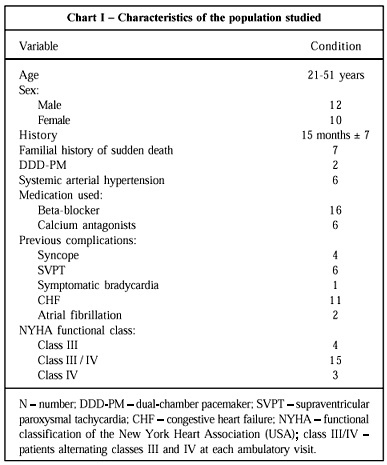
Chart I
ABC
Original Article

Percutaneous transluminal septal alcoholization for the treatment of refractory hypertrophic obstructive cardiomyopathy: initial experience in the Federal District

Evandro César Vidal Osterne et al. Tamer Najar Seixas Walter Paulo Filho Ernesto Misael Cintra Osterne Otoni Moreira Gomes

OBJECTIVE: To analyze the efficacy of percutaneous transluminal septal alcoholization in the treatment of refractory obstructive hypertrophic cardiomyopathy (HOC). METHODS: The patients were referred for alcoholization after Doppler echocardiography. Before and after alcoholization, the intraventricular pressure gradient was recorded. Alcoholization was performed with a 3mL injection of absolute alcohol through a coronary angioplasty balloon catheter. The procedure was concluded after a significant reduction or abolition of the pressure gradient. RESULTS: Of 22 patients, 18 (81.8%) successfully concluded the procedure with a reduction in intraventricular pressure gradient at baseline (from 67.6±24.2 mmHg to 3.8± 1.9 mmHg, p<0.005) and after extrasystole (from 110.4± 24.2 mmHg to 9.6±2.6 mm Hg, p<0.005). A significant reduction in mean interventricular septal thickness (from 2± 0.3 mm to 1.7±0.2 mm, p<0.005) and in peak pressure gradient (from 90.7±23.5 mmHg to 6.1±1.4 mmHg, p<0.005) was observed on Doppler echocardiography after 6 months, when all patients were in functional class I. The most frequent acute complication, present in 11% of the patients, was the need for definitive pacing implantation. Relapse of the symptoms and reappearance of the pressure gradient occurred in 16.6% of the patients. One patient (5.5%) died probably due to a diffuse coronary spasm prior to the procedure, and another died suddenly on late follow-up. CONCLUSION: Percutaneous transluminal septal alcoholization is effective and safe in the treatment of HOC.
  • Ablation
  • hypertrophic obstructive cardiomyopathy
  • percutaneous septal ablation
  • percutaneous septal alcoholization
Read Full Article
Creative Commons Attribution (CC BY) Creative Commons license
19/05/2003 DOI: 10.1590/S0066-782X2003000400002 Views 1
Vector electrocardiographic alterations after percutaneous septal ablation in obstructive hypertrophic cardiomyopathy: possible anatomic causes
ABC
Original Article

Vector electrocardiographic alterations after percutaneous septal ablation in obstructive hypertrophic cardiomyopathy: possible anatomic causes

Andrés Ricardo Pérez Riera et al. Silvia Judith Fortunato de Cano Manuel Nicolás Cano Vera Márcia L. Gimenez … Luciano Augusto de Padua Fleury Neto José Eduardo M. R. Sousa

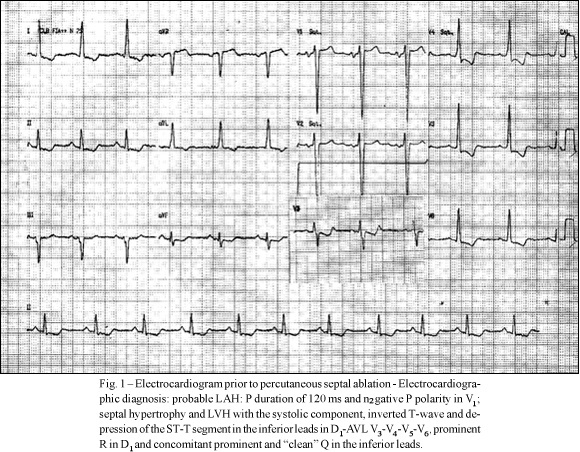
OBJECTIVE: Analyze the dromotropic disturbances (vector-electrocardiographic), and the possible anatomic causes, provoked by selective alcohol injection in the septal branch, for percutaneous treatment, of obstructive hypertrophic cardiomyopathy. METHODS: Ten patients with a mean age of 52.7 years underwent percutaneous septal ablation (PTSA) from october 1998; all in functional class III/IV). Twelve-lead electrocardiogram was performed prior to and during PTSA, and later electrocardiogram and vectorcardiogram according to Frank’s method. The patients were followed up for 32 months. RESULTS: On electrocardiogram (ECG) prior to PTSA all patients had sinus rhythm and left atrial enlargement, 8 left ventricular hypertrophy of systolic pattern. On ECG immediately after PTSA, 8 had complete right bundle-branch block; 1 transient total atrioventricular block; 1 alternating transient bundle-branch block either right or hemiblock. On late ECG 8 had complete right bundle-branch block confirmed by vectorcardiogram, type 1 or Grishman. CONCLUSION: Septal fibrosis following alcohol injection caused a predominance of complete right bundle-branch block, different from surgery of myotomy/myectomy.

  • obstructive hypertrophic cardiomyopathy
  • percutaneous septal ablation
  • vector electrocardiographic alterations
Read Full Article
Creative Commons Attribution (CC BY) Creative Commons license
17/12/2002 DOI: 10.1590/S0066-782X2002001400004

How to cite this article

EndNote RIS

Electronic Document Format (Vancouver)

Osterne ECV, Seixas TN, Paulo Filho W, Osterne EMC, Gomes OM. Percutaneous transluminal septal alcoholization for the treatment of refractory hypertrophic obstructive cardiomyopathy: initial experience in the Federal District. Arquivos Brasileiros de Cardiologia 2003;80(4):369-78.

Electronic Document Format (ABNT)

Osterne, Evandro César Vidal; Seixas, Tamer Najar; Paulo Filho, Walter; Osterne, Ernesto Misael Cintra; Gomes, Otoni Moreira. Percutaneous transluminal septal alcoholization for the treatment of refractory hypertrophic obstructive cardiomyopathy: initial experience in the Federal District. Arquivos Brasileiros de Cardiologia, v. 80, n. 4, p. 369-378, May. 2003.

Electronic Document Format (APA)

Osterne, E. C. V., Seixas, T. N., Paulo Filho, W., Osterne, E. M. C., & Gomes, O. M. (2003). Percutaneous transluminal septal alcoholization for the treatment of refractory hypertrophic obstructive cardiomyopathy: initial experience in the Federal District. Arquivos Brasileiros de Cardiologia, 80(4), 369-378.

Electronic Document Format (ISO)

Osterne, Evandro César Vidal and Seixas, Tamer Najar and Paulo Filho, Walter and Osterne, Ernesto Misael Cintra and Gomes, Otoni Moreira. Percutaneous transluminal septal alcoholization for the treatment of refractory hypertrophic obstructive cardiomyopathy: initial experience in the Federal District. Arquivos Brasileiros de Cardiologia [online]. 2003, vol. 80, n. 4, [cited 2026-10-14], pp. 369-378. Available from: <https://journals.cardiol.br/en/article/percutaneous-transluminal-septal-alcoholization-for-the-treatment-of-refractory-hypertrophic-obstructive-cardiomyopathy-initial-experience-in-the-federal-district/>. ISSN 0066-782X

EndNote RIS

Electronic Document Format (Vancouver)

Riera ARP, Cano SJF, Cano MN, Gimenez VML, Fleury Neto LAP, Sousa JEMR. Vector electrocardiographic alterations after percutaneous septal ablation in obstructive hypertrophic cardiomyopathy: possible anatomic causes. Arquivos Brasileiros de Cardiologia 2002;79(5):471-5.

Electronic Document Format (ABNT)

Riera, Andrés Ricardo Pérez; Cano, Silvia Judith Fortunato de; Cano, Manuel Nicolás; Gimenez, Vera Márcia L.; Fleury Neto, Luciano Augusto de Padua; Sousa, José Eduardo M. R.. Vector electrocardiographic alterations after percutaneous septal ablation in obstructive hypertrophic cardiomyopathy: possible anatomic causes. Arquivos Brasileiros de Cardiologia, v. 79, n. 5, p. 471-475, Dec. 2002.

Electronic Document Format (APA)

Riera, A. R. P., Cano, S. J. F. , Cano, M. N., Gimenez, V. M. L., Fleury Neto, L. A. P., & Sousa, J. E. M. R. (2002). Vector electrocardiographic alterations after percutaneous septal ablation in obstructive hypertrophic cardiomyopathy: possible anatomic causes. Arquivos Brasileiros de Cardiologia, 79(5), 471-475.

Electronic Document Format (ISO)

Riera, Andrés Ricardo Pérez and Cano, Silvia Judith Fortunato de and Cano, Manuel Nicolás and Gimenez, Vera Márcia L. and Fleury Neto, Luciano Augusto de Padua and Sousa, José Eduardo M. R.. Vector electrocardiographic alterations after percutaneous septal ablation in obstructive hypertrophic cardiomyopathy: possible anatomic causes. Arquivos Brasileiros de Cardiologia [online]. 2002, vol. 79, n. 5, [cited 2026-10-14], pp. 471-475. Available from: <https://journals.cardiol.br/en/article/vector-electrocardiographic-alterations-after-percutaneous-septal-ablation-in-obstructive-hypertrophic-cardiomyopathy-possible-anatomic-causes/>. ISSN 0066-782X

  • About ABC Family
  • Internal Regulation
  • Editorial Board
  • Brazilian Society of Cardiology (SBC)

Issues

SBC Guidelines

  • Videos
  • Podcasts
  • News