Sociodemographic, Clinical Condition, and Functional Aerobic Capacity in Patients With Heart Failure With Varying Ventricular Ejection Fraction
Abstract
Background
Recently, a new heart failure (HF) classification was made considering the left ventricular ejection fraction (LVEF) phenotype. Comprehensive assessments of the groups are required to guide patient management.
Objective
To determine the differences in sociodemographic, clinical, functional aerobic capacity, and health-related quality of life (HRQOL) variables in patients with HF classified with different LVEFs and to explore the correlations between the variables.
Methods
This work is a cross-sectional descriptive and correlational study. Three groups of patients with HF (LVEF≥50%, LVEF<40%, and LVEF40-49%) were compared. Sociodemographic, clinical variables and functional aerobic capacity with Sit to Stand (STS), 6-minute walk test (6MWT), Duke Activity Status Index (DASI), Minnesota Living with HF Questionnaire (MLFHQ), and Patient Health Questionnaire 9 (PHQ-9) were considered. The Chi-square test, one-way analysis of variance (ANOVA) test, and Spearman's correlation were used for statistical analysis. The statistical significance level was set at 5%.
Results
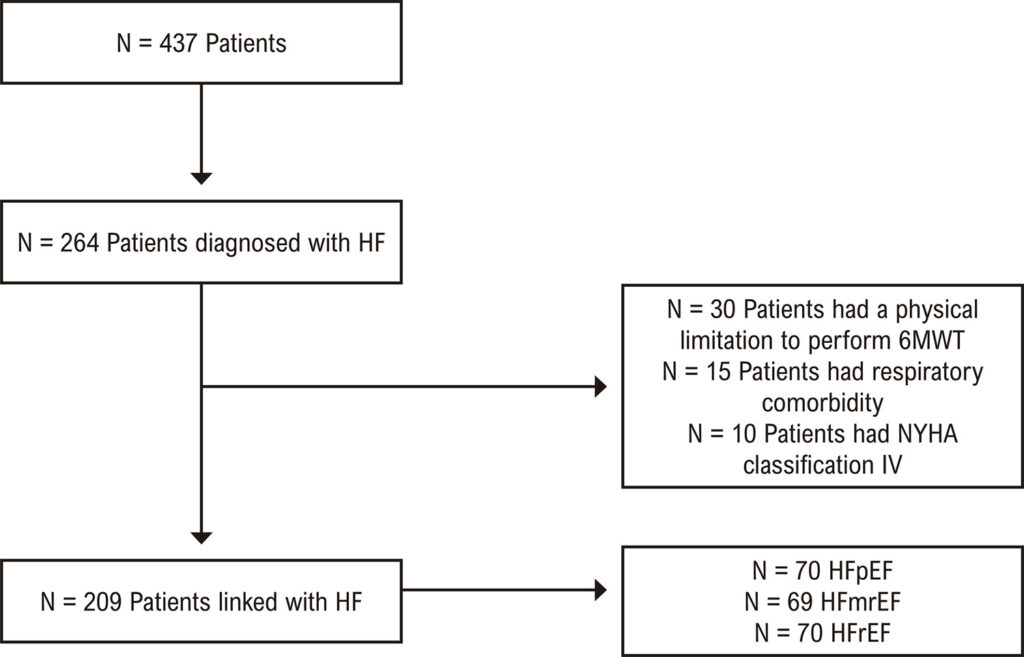
A total of 209 patients were admitted with a diagnosis of HF, with a more significant number of men. Marital status was a predominantly stable union in the HF with preserved ejection fraction (HFpEF) and HF with mid-range ejection fraction (HFmrEF) groups. A sedentary lifestyle was lower in the HF with reduced ejection fraction (HFrEF) group 59 (84.3%), p-value = 0.033, and the angina pectoris was higher in the HFpEF 30 (42.9%). Systolic blood pressure at the end of the 6MWT evidenced a higher score in HFpEF 132.0±17.25 concerning HFrEF 128.0±16.57, p-value=0.043. The fat percentage was higher in HFpEF 30.20±8.80 regarding the HFmrEF group 26.51±7.60, p-value = 0.028.
Conclusion
There were significant differences according to the LVEF classification in marital status, angina symptoms, fat percentage, and blood pressure at rest.
Images
Image gallery fullscreen viewer
Comments are moderated by the editorial team before publication. Discussions should be evidence-based and use scientific language. Conflicts of interest should be declared.