AI-Enhanced ECGs for the Diagnosis of HFpEF: A Promising Frontier, But Not Yet a Standalone Solution
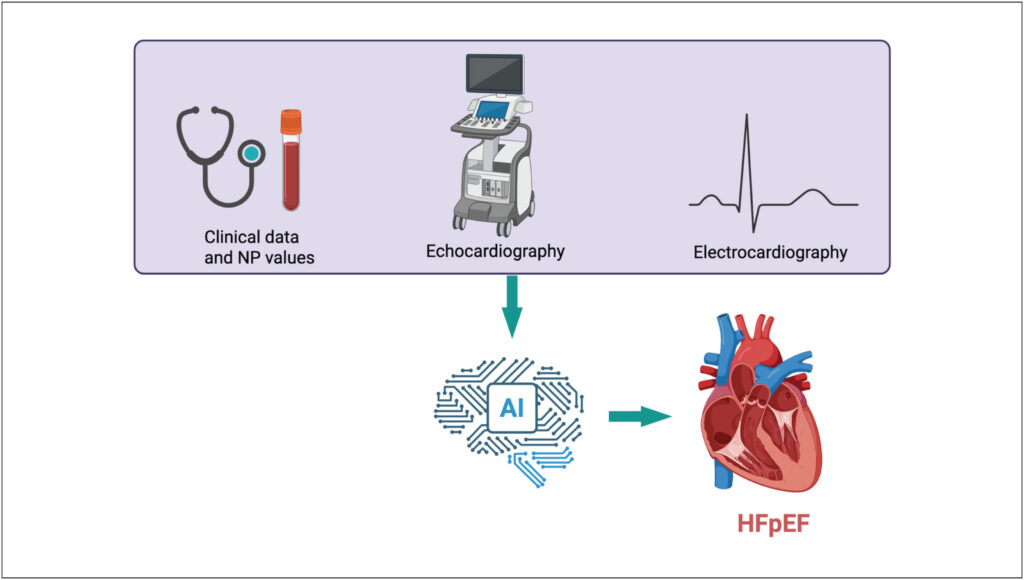
Heart Failure with preserved Ejection Fraction (HFpEF) is among the most challenging syndromes in contemporary cardiology. Despite accounting for nearly half of all heart failure cases, HFpEF remains chronically underdiagnosed and is associated with significant morbidity and mortality., The diagnosis of HFpEF is challenging and relies on clinical history, natriuretic peptide measurements, and echocardiography. Diagnostic scores have been developed that integrate these three key elements., Echocardiography is indispensable for identifying structural and functional criteria, but its availability and cost make population-level screening impractical in many healthcare systems. In addition, in many places, a comprehensive echocardiogram is not performed. Likewise, natriuretic peptides are not always available. Therefore, new solutions to facilitate diagnosis are welcome.
In this context, the systematic review and meta-analysis presented in this issue of International Journal of Cardiovascular Sciences, provide important insights into an increasingly discussed alternative: Artificial Intelligence-enhanced Electrocardiography (AI-ECG). Drawing from more than 170,000 patients across three observational studies, the authors report a pooled sensitivity of 0.89, specificity of 0.80, and an AUC of 0.89 for AI-ECG in detecting HFpEF. These findings suggest that deep learning models can extract subtle electrical signatures associated with diastolic dysfunction – signals that may be visually imperceptible on standard ECGs. The appeal is clear: the ECG is universal, inexpensive, rapid, and deeply embedded in clinical workflows. If Artificial Intelligence could reliably identify patients requiring echocardiographic confirmation, screening strategies might be revolutionized.
[…]
Images
Image gallery fullscreen viewer
Comments are moderated by the editorial team before publication. Discussions should be evidence-based and use scientific language. Conflicts of interest should be declared.