Permanent Artificial Cardiac Pacemaker in the Treatment of Bradyarrhythmias Caused by Chagas Disease
Government programs aimed at eliminating vector-borne transmission of Chagas disease have had a strong impact on the prevalence of cardiac bradyarrhythmias secondary to this etiology and, consequently, on the number of pacemaker implants performed in Brazil.– Data from the Brazilian Pacemaker Registry show that in 1995, of the 6,542 initial pacemaker implants reported, 30.2% were related to patients with Chagas disease. The proportion of patients with Chagas disease, however, decreased over time, and seven years later, when the 2002 data were presented, of the 11,347 initial implants reported, Chagas disease was reported as the etiology in 25.0% of cases. The total figures for the first 10 years of this century showed that Chagas disease accounted for 17.8% of initial pacemaker implants, falling to 11.7% in the latest publication of data from the Brazilian Pacemaker Registry, referring to the period from 2009 to 2014. Among the initial implants of conventional pacemakers performed at the Heart Institute-HC-FMUSP in the last six years (01/01/2020 to 31/12/2025), of the 2689 patients operated on, only 236 (8.8%) had Chagas disease as the etiology of their bradyarrhythmia, according to clinical and demographic data of consecutive patients undergoing procedures for implantation of electronic cardiac devices from 01/01/2020 to 31/12/2025 at Incor-HC-FMUSP.
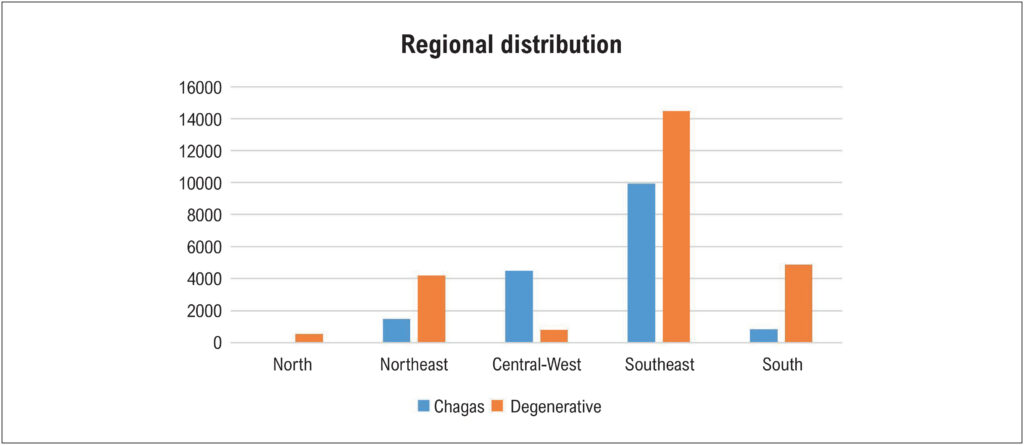
A comparative analysis of the demographic and clinical data of 25,648 individuals with Chagas disease and 31,984 with degenerative heart disease who underwent conventional pacemaker implantation between 1995 and 2003 showed similarities between these two groups of individuals regarding sex distribution, with 47.8% women among those with Chagas disease and 48.5% in the degenerative disease group (p=0.186). On the other hand, a significant difference was observed when evaluating the average age of these two populations, with 58.6 ± 15.3 years for Chagas disease and 73.5 ± 12.6 for the degenerative disease group (p=0.001).
[…]
Images
Image gallery fullscreen viewer
Comments are moderated by the editorial team before publication. Discussions should be evidence-based and use scientific language. Conflicts of interest should be declared.