Is abnormal adrenergic activation associated with abnormal Heart Rate Recovery?
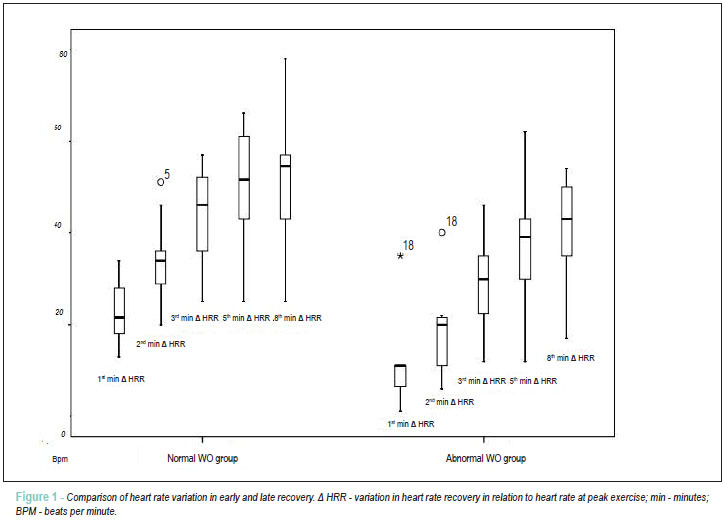
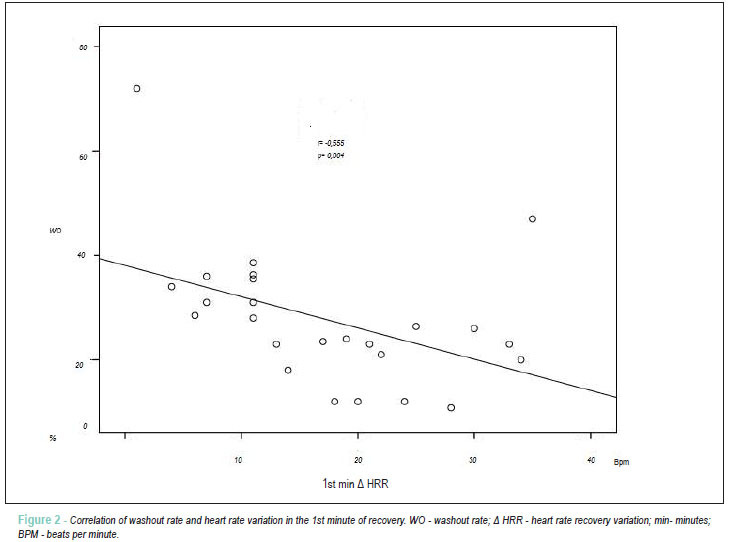
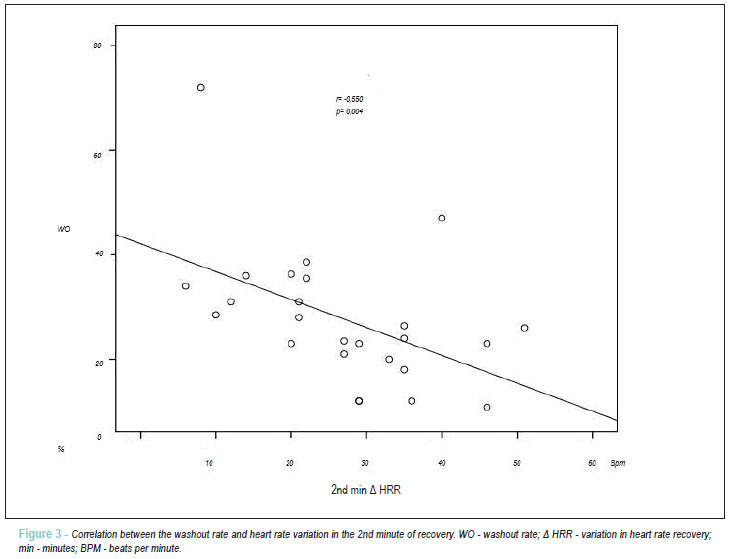
BACKGROUND: Heart Rate Recovery (HRR) reflects the capacity of the cardiovascular system to reverse the vagal withdrawal caused by exercise. Scintigraphy with metaiodobenzylguanidine (I¹23 MIBG) evaluates innervation and cardiac adrenergic activation. The association of these two methods is not well established. OBJECTIVE: To evaluate the association between HRR and washout rate (WO) of I¹²³ MIBG in patients with heart failure (HF). METHODS: wenty-five patients with ejection fraction < 45% underwent exercise testing, and analysis of the variation of HRR from the 1st to the 8th minute after exertion. Submitted to I¹²³ MIBG, they were separated into groups by WO: G1) 27%. For the statistical analysis Mann-Whitney’s U test and Spearman’s correlation coefficient were used. RESULTS: G2 showed a slower variation of HRR: 1st minute: G1: 21.5 (16.12 to 26.87) vs. G2: 11.00 (8.5 to 13.5) bpm, p = 0.001; 2nd minute: G1: 34 (29-39) vs. G2: 20 (14 – 26) bpm, p = 0.001; 3rd minute: G1: 46 (37.8 – 54.1) vs. G2: 30 (22 – 38) bpm, p = 0.005; 5th minute: G1: 51.5 (42 – 61) vs. G2: 39 (31.5 to 46.5) bpm, p = 0.013, and in the 8th minute: G1: 54.5 (46.5 – 62.5) vs. G2: 43 (34 – 52) bpm, p = 0.037. HRR in the 1st (r = -0.555, p = 0.004), and in the 2nd minute (r = -0.550, p = 0.004) were negatively correlated with WO. CONCLUSION: Patients with high HF and WO showed an abnormal HRR compared with patients with normal WO. These findings suggest that adrenergic activation may influence the HRR.
Images
Image gallery fullscreen viewer
Comments are moderated by the editorial team before publication. Discussions should be evidence-based and use scientific language. Conflicts of interest should be declared.