Risk Factors, Management, and Evolution after the First Acute Myocardial Infarction: A Real-World Study Comparing Cohorts of Women and Men in the TriNetX Network
Abstract
Background:
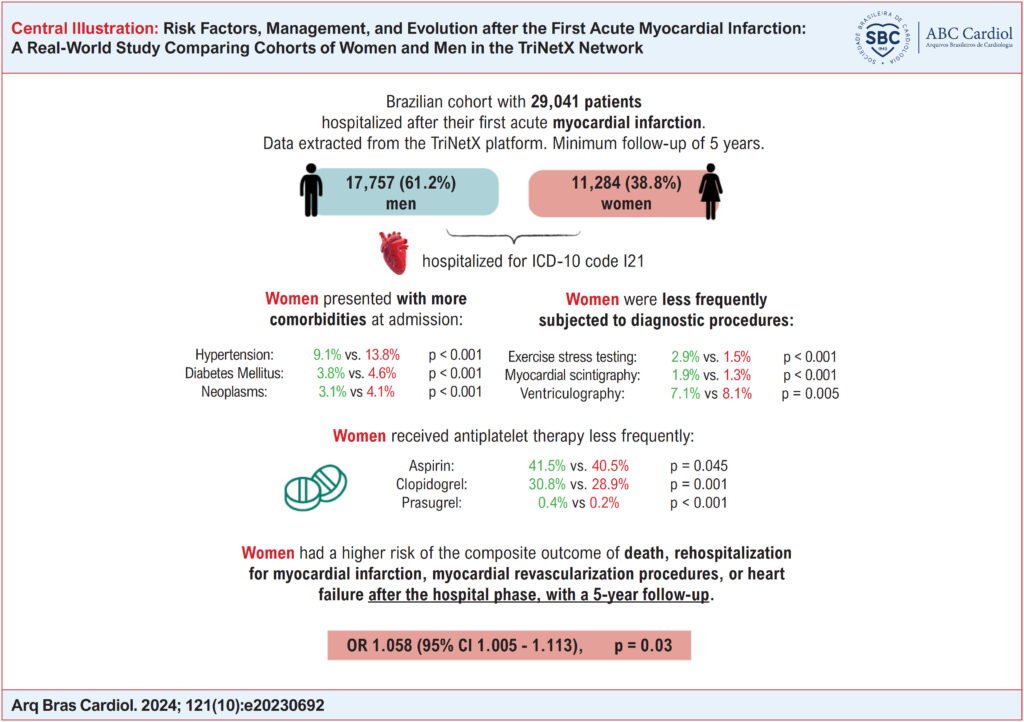
International cohort studies have consistently demonstrated an unfavorable prognosis in female patients after the first acute myocardial infarction (AMI) over the past decades. However, national data on this topic are limited.
Objectives:
This study aims to compare national cohorts of men and women hospitalized due to the first acute myocardial infarction, examining long-term outcomes.
Methods:
A retrospective, observational study using real-world data extracted from the global TriNetX platform, including patients of both sexes with a confirmed diagnosis of AMI according to the International Classification of Diseases (ICD), version 11, code I21. The level of statistical significance adopted in the analysis was 5% (0.05). The primary outcome assessed was a composite of death, new hospitalization for AMI, myocardial revascularization procedures, or heart failure after the hospital phase with a 5-year follow-up.
Results:
Data from 29,041 patients were evaluated, of which 11,284 (38.4%) were women. The mean age of the female and male populations was 64.4 and 59.8 years, respectively. The group of women showed a higher occurrence of the composite outcome of death, new hospitalization for AMI, myocardial revascularization procedures, or heart failure after the hospital phase with a 5-year follow-up (OR 1.058; CI 1.005 – 1.113; p = 0.03).
Conclusions:
In this large Brazilian cohort, the female sex was associated with a higher occurrence of cardiovascular events within 5 years after hospital discharge.
Images
Image gallery fullscreen viewer
Comments are moderated by the editorial team before publication. Discussions should be evidence-based and use scientific language. Conflicts of interest should be declared.