Reference Echocardiographic Values for Cardiac Chambers in Brazil: A Multiregional, Multi-Racial Study
Abstract
Background
Reference values for cardiac chamber quantification are essential for clinical decision-making. Brazil is a continental country with marked racial diversity and substantial regional socioeconomic and anthropometric variability, which may not be adequately represented in international echocardiographic standards.
Objective
To establish reference echocardiographic measurements for healthy Brazilian adults and to investigate geographic and sex-related differences across Brazil’s major regions.
Methods
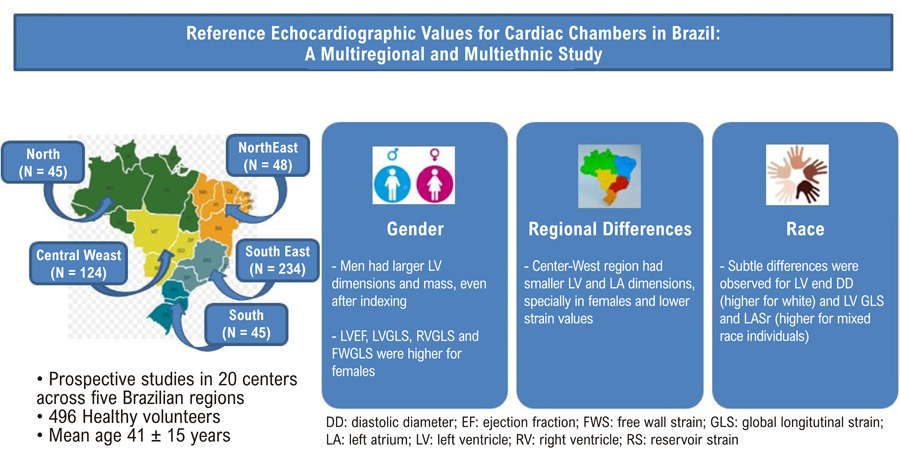
In this prospective, multicenter study, transthoracic echocardiograms were performed in 496 healthy volunteers (mean age 41 ± 15 years; 55% women) from five Brazilian regions. Left ventricular (LV) and left atrial (LA) dimensions, volumes, mass, ejection fraction, and global longitudinal strain (GLS) were analyzed in accordance with current guidelines. Comparisons were conducted by sex (Student’s t test or Mann-Whitney U test) and by region (analysis of variance).
Results
Cardiac chamber dimensions and LV mass were greater in men, even after indexing for body surface area. LA volumes were also higher in men, although these differences were attenuated after indexing. Absolute LVGLS and right ventricle (RV) GLS (RVGLS) values were higher in women, whereas LA strain reservoir (LASr) was similar between sexes. Regionally, the Center-West exhibited significantly smaller LV volumes, a difference primarily driven by women, along with lower LVGLS and RVGLS (p < 0.001). In contrast, LA volumes were smaller in the Northeast region. No significant associations were observed between self-reported race and echocardiographic parameters, except for RVGLS and LASr, which were lower in White participants.
Conclusion
This study establishes echocardiographic reference values in a nationally representative Brazilian cohort, confirms expected sex-related differences, and identifies previously unrecognized regional variations in cardiac chamber dimensions. These findings underscore the need for population-specific standards to ensure accurate cardiac quantification.
Images
Image gallery fullscreen viewer
Comments are moderated by the editorial team before publication. Discussions should be evidence-based and use scientific language. Conflicts of interest should be declared.