Prevalence and risk factors for combined coronary artery disease and aortic aneurysm
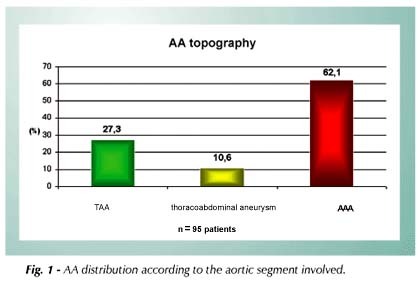
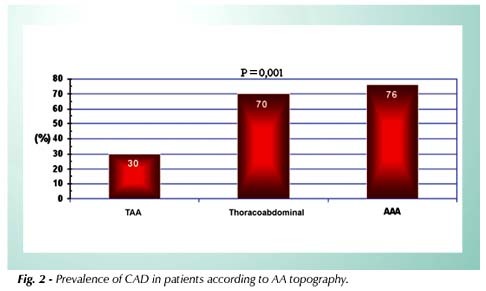
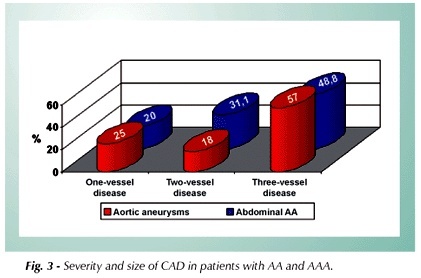
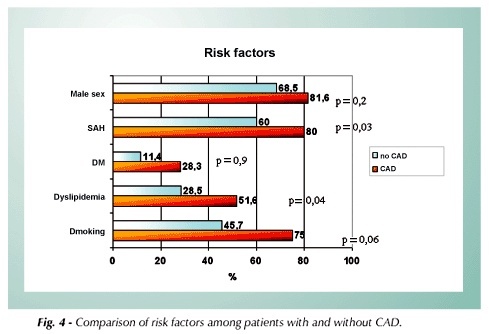
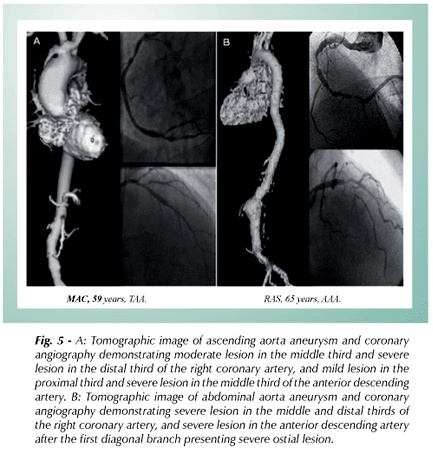
OBJECTIVE: To evaluate CAD prevalence in patients with aortic aneurysm, as well as differences related to aneurysm topographies. To describe the primary risk factors for CAD related to this association and their occasional differences according to AA topographies. METHODS: This was an open, prospective, nonrandomized study that evaluated 95 patients (66 men and 33 women, mean age 63 ± 11.8). All patients, asymptomatic for CAD, had undergone aortic CT and coronary angiography. According to the AA topography, they were classified into three groups: 1) patients with thoracic aortic aneurysm (TAA); 2) thoracoabdominal aortic aneurysm (TAAA); and 3) abdominal aortic aneurysm (AAA). A database was created to store information from clinical data and complementary examinations. Statistical analysis was performed using the Student’s t test or analysis of variance (ANOVA) for continuous variables and chi-square test for categorical variables. P values 70% and 19 (31.6%), > 50%. Fifteen patients (25%) had single-vessel disease, 11 (18%) had two-vessel disease, and 34 (57%) had three-vessel disease. CONCLUSION: Asymptomatic CAD is highly prevalent in AA patients, particularly among those with AAA. Study results suggest the need for diagnostic stratification for CAD in patients with AA, especially those with AAA.
Images
Image gallery fullscreen viewer
Comments are moderated by the editorial team before publication. Discussions should be evidence-based and use scientific language. Conflicts of interest should be declared.