Non-Invasive Central Blood Pressure and Intracranial Waveform Assessment in Hypertensive Patients: A Cross-Sectional Study
Abstract
Background
There is a strong association between hypertension and cerebrovascular disease, mainly with stroke and cognitive impairment. However, but the mechanistic of this relationship are not completely understood.
Objective
To analyze the relationship of central, peripheral blood pressure (BP) and arterial stiffness, with intracranial pressure (ICP) in long-term chronic hypertensive patients.
Methods
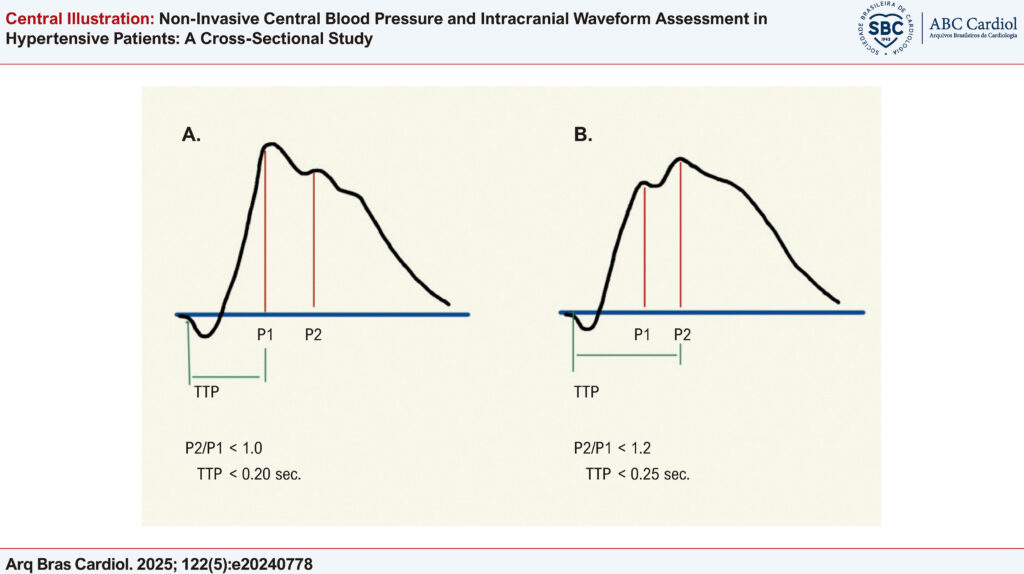
Adult individuals were consecutively included in the study from November 2022 to August 2023. The cut-off point identified to define intracranial hypertension (ICHT) by the wave peak (P2/P1) ratio was > 1.2, and the cut-off for time to peak (TTP) was > 0.25. The level of significance adopted in the statistical analysis was 5%.
Results
A total of 145 patients (32 male, 113 female) with long-term hypertension (average of time since diagnoses 20 ± 12 years) were evaluated over a period of 10 months. The median age was 69.0 (61.8 – 75.7) years and median body mass index 29.0 (25.4 – 33.1) kg/m2. Median value of P2/P1 ratio for all cohort was 1.4 (1.2 – 1.5) and TTP 0.24 (0.21 – 0.29). The analysis was performed considering presence or not of ICHT, and parameters of central BP and pulse wave velocity. There was higher central systolic (SBP), diastolic blood pressure (DBP), and peripheral DBP among patients with ICHT based on the P2/P1 ratio.
Conclusions
Central SBP levels are more linked to ICHT than office peripheral SBP measurements, while DBP measurements are similar, raising questions about the most suitable BP assessment method for hypertensive patients with cerebrovascular damage.
Images
Image gallery fullscreen viewer
Comments are moderated by the editorial team before publication. Discussions should be evidence-based and use scientific language. Conflicts of interest should be declared.