Middle-Aged Women — A High-Risk Group for Post-Myocardial Infarction Mortality
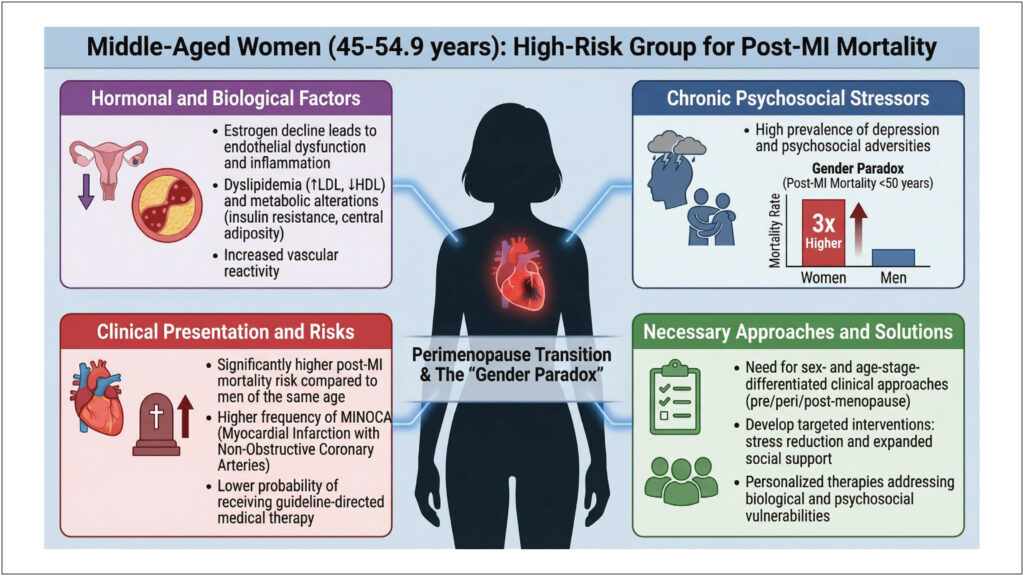
Cardiovascular diseases (CVD) remain the leading cause of death worldwide, with acute myocardial infarction (MI) accounting for significant morbidity and mortality. Despite substantial reductions in overall cardiovascular mortality, gender disparities persist, particularly affecting women in different demographic contexts. In this mini-editorial, we highlight recent evidence from an original study conducted in the Brazilian Unified Health System (SUS) in Curitiba, Brazil, which followed 4,896 patients hospitalized for acute MI between 2008 and 2015. This pioneering study demonstrated that middle-aged women (45 to 54.9 years) have a significantly higher risk of post-infarction mortality compared to men of the same age group, regardless of adjusted clinical factors. These data provide a critical warning about the need for differentiated, specific clinical approaches for this group (). The analysis of the Brazilian public cohort strengthens international evidence on the gender paradox in CVD. It reinforces the critical role of hormonal changes and psychosocial determinants in worsening the prognosis for women after MI. This contradicts the common assumption that women in this age group maintain natural cardiovascular protection, raising critical questions about the attention given to cardiovascular health at this vital stage of life.
The so-called “gender paradox” in CVD is well established, especially among younger women. Studies show that women under 50 have almost three times higher mortality after MI than men of the same age group, regardless of previous medical history, disease severity, or type of treatment., This paradox is remarkable, given that middle-aged women often have fewer traditional cardiovascular risk factors and tend to have better outcomes after percutaneous coronary intervention. The study findings are aligned with global and national data that indicate that women develop MI approximately 5 years later than men (mean age 65.1 vs. 60.3 years). Still, the protective effect of the female sex diminishes and reverses in the 45-54.9 age range. This period coincides with perimenopause and the onset of menopause, highlighting the importance of hormonal changes in increasing cardiovascular susceptibility.
[…]
Images
Image gallery fullscreen viewer
Comments are moderated by the editorial team before publication. Discussions should be evidence-based and use scientific language. Conflicts of interest should be declared.