Long-term Health-Related Quality of Life and Outcomes after Hospitalization for COVID-19 in Brazil: Post-COVID Brazil 1 Study Protocol
Abstract
Background
The long-term impact of hospitalization for COVID-19 on patients’ physical, mental, and cognitive health still needs further assessment.
Objectives
This study aims to evaluate factors associated with quality of life and cardiovascular and non-cardiovascular outcomes 12 months after hospitalization for COVID-19.
Methods
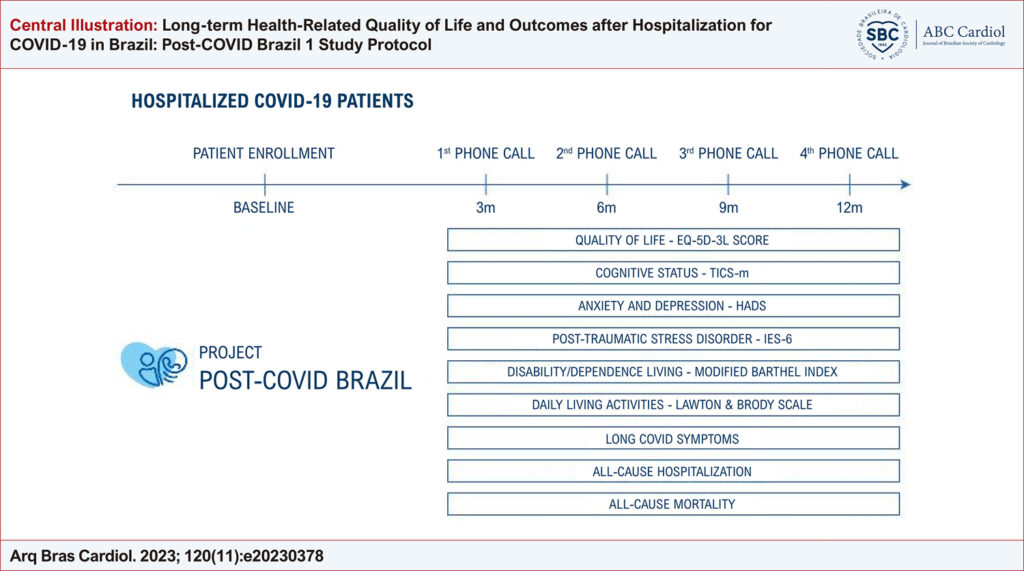
This prospective multicenter study intends to enroll 611 patients hospitalized due to COVID-19 (NCT05165979). Centralized telephone interviews are scheduled to occur at three, six, nine, and 12 months after hospital discharge. The primary endpoint is defined as the health-related quality-of-life utility score assessed by the EuroQol-5D-3L (EQ-5D-3L) questionnaire at 12 months. Secondary endpoints are defined as the EQ-5D-3L at three, six and nine months, return to work or education, persistent symptoms, new disabilities in instrumental activities of daily living, cognitive impairment, anxiety, depression, and post-traumatic stress symptoms, major cardiovascular events, rehospitalization, as well as all-cause mortality at 3, 6, 9, and 12 months after SARS-CoV-2 infection. A p-value <0.05 will be assumed as statistically significant for all analyses.
Results
The primary endpoint will be presented as the frequency of the EQ-5D-3L score 12 months after COVID-19 hospitalization. A sub-analysis to identify possible associations of independent variables with study outcomes will be presented.
Conclusions
This study will determine the impact of COVID-19 on the quality of life and cardiovascular and non-cardiovascular outcomes of hospitalized patients 12 months after discharge providing insights to the public health system in Brazil.
Images
Image gallery fullscreen viewer
Comments are moderated by the editorial team before publication. Discussions should be evidence-based and use scientific language. Conflicts of interest should be declared.