Identification of Hypertension Phenotypes by Sex: A Real-World Study of 7,852 Treated Patients
Abstract
Background
Although blood pressure (BP) thresholds are well established, there is a lack of data on potential hypertension phenotypes across sexes.
Objectives
To identify hypertension phenotypes in men and women undergoing antihypertensive treatment.
Methods
Adults aged 18 to 80 years with diagnosed hypertension and undergoing pharmacological treatment were opportunistically recruited from various regions of Brazil. Assessments included office BP measurements and home blood pressure monitoring (HBPM). Four hypertension phenotypes were defined: (i) controlled hypertension: office BP < 140/90 mmHg and HBPM < 130/80 mmHg; (ii) white-coat uncontrolled hypertension: office BP ≥ 140/90 mmHg and HBPM < 130/80 mmHg; (iii) masked uncontrolled hypertension: office BP < 140/90 mmHg and HBPM ≥ 130/80 mmHg; (iv) sustained uncontrolled hypertension: office BP ≥ 140/90 mmHg and HBPM ≥ 130/80 mmHg. A significance level of 5% (p < 0.05) was adopted.
Results
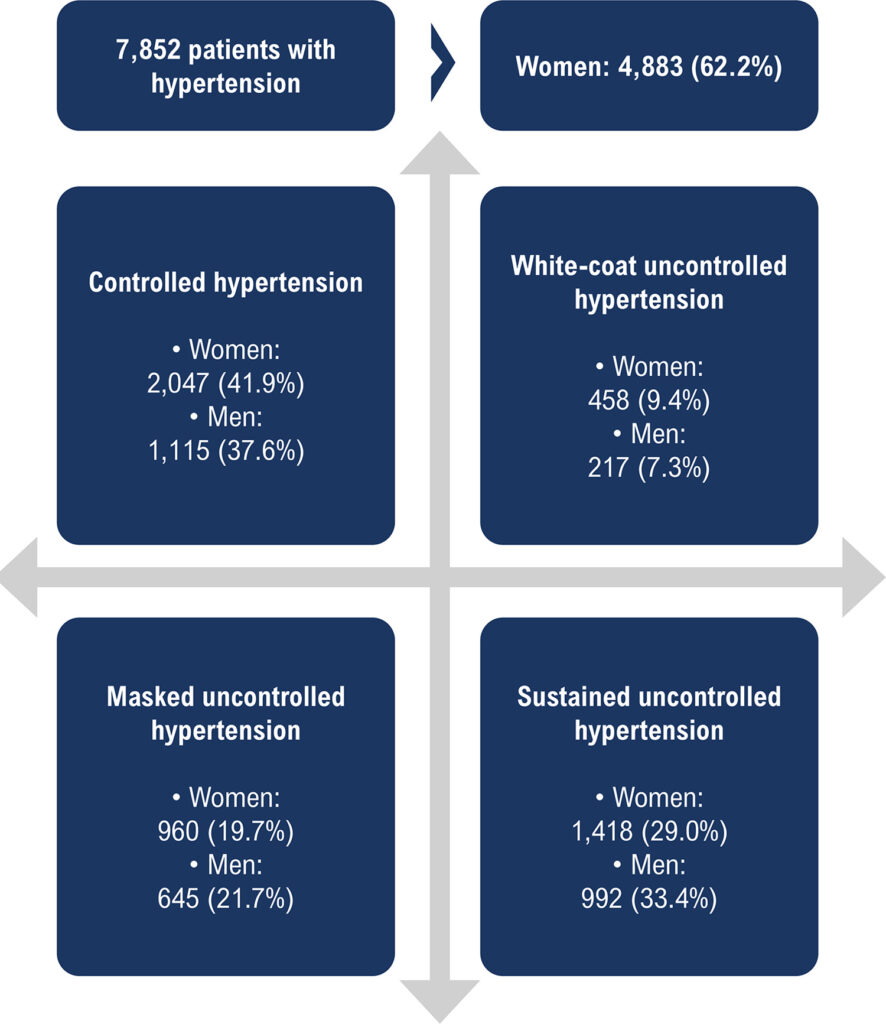
Among the 7,852 patients on antihypertensive therapy, 3,162 (40.3%) had controlled hypertension, including 1,115 (37.6%) men and 2,047 (41.9%) women (p < 0.001); 675 (8.6%) had white-coat uncontrolled hypertension, with 217 (7.3%) men and 458 (9.4%) women (p < 0.001); 1,605 (20.4%) had masked uncontrolled hypertension, including 645 (21.7%) men and 960 (19.7%) women (p < 0.001); and 2,410 (30.7%) had sustained uncontrolled hypertension, including 992 (33.4%) men and 1,418 (29%) women (p < 0.001).
Conclusions
This is the first Brazilian population-based study to assess hypertension phenotypes by sex. Women demonstrated better BP control than men, both in clinical settings and at home.
Images
Image gallery fullscreen viewer
Comments are moderated by the editorial team before publication. Discussions should be evidence-based and use scientific language. Conflicts of interest should be declared.