Beyond Ejection Fraction: In Pacemaker-Induced Cardiomyopathy, are We Closer to Identifying At-Risk Patients Early?
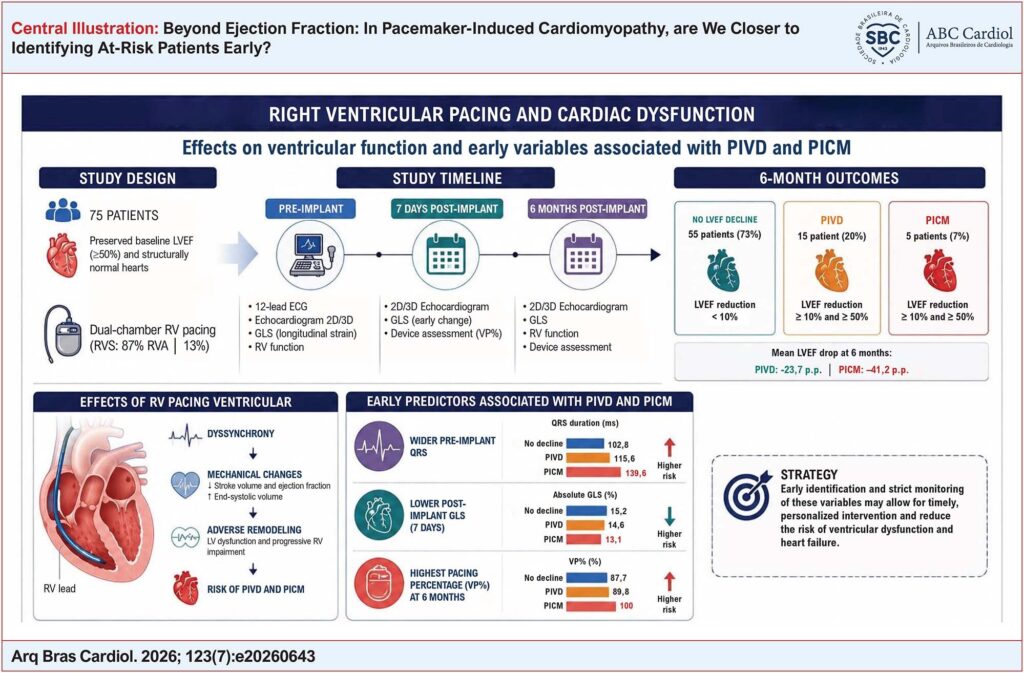
The natural history of symptomatic bradyarrhythmias was greatly impacted from the 1950s onwards with the implementation of cardiac pacemakers, initiating the era of Artificial Cardiac Stimulation. Dual-chamber pacemakers are routinely used in advanced atrioventricular blocks in structurally normal hearts. Right ventricular pacing, despite its effectiveness in correcting conduction disturbances, has deleterious effects on ventricular mechanics. It promotes ventricular dyssynchrony, triggering a reduction in systolic function and, in a portion of patients, the development of pacemaker-induced cardiomyopathy (PICM). In this context, in addition to ejection fraction, the identification of risk predictors for ventricular dysfunction (VID) and PICM allows for better clinical decision-making and a reduction in the impact of heart failure in patients dependent on right ventricular pacing.
This exploratory study presents global longitudinal strain (GLS) as an early marker of myocardial impairment. Although left ventricular ejection fraction (LVEF) remains the most widely used metric in clinical practice, its reduction is known to often represent a relatively late stage of functional injury. In contrast, GLS allows the identification of subclinical changes in longitudinal contractility before significant changes in LVEF occur. The study shows that GLS reductions are early, already observable as early as seven days after implantation in patients who subsequently developed IVP or PICM. The possibility of identifying vulnerable patients as early as the first week after implantation is particularly attractive.
[…]
Images
Image gallery fullscreen viewer
Comments are moderated by the editorial team before publication. Discussions should be evidence-based and use scientific language. Conflicts of interest should be declared.