Atrial Function in Patients with Breast Cancer After Treatment with Anthracyclines
Abstract
Background:
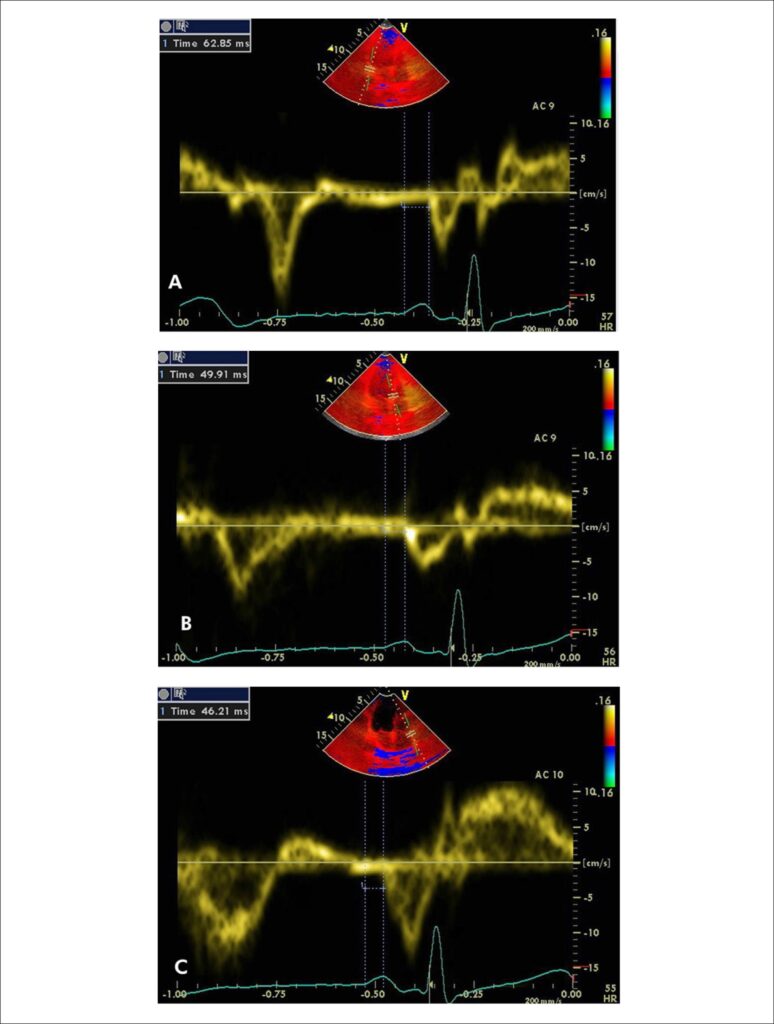
Atrial electromechanical delay (EMD) is used to predict atrial fibrillation, measured by echocardiography.
Objectives:
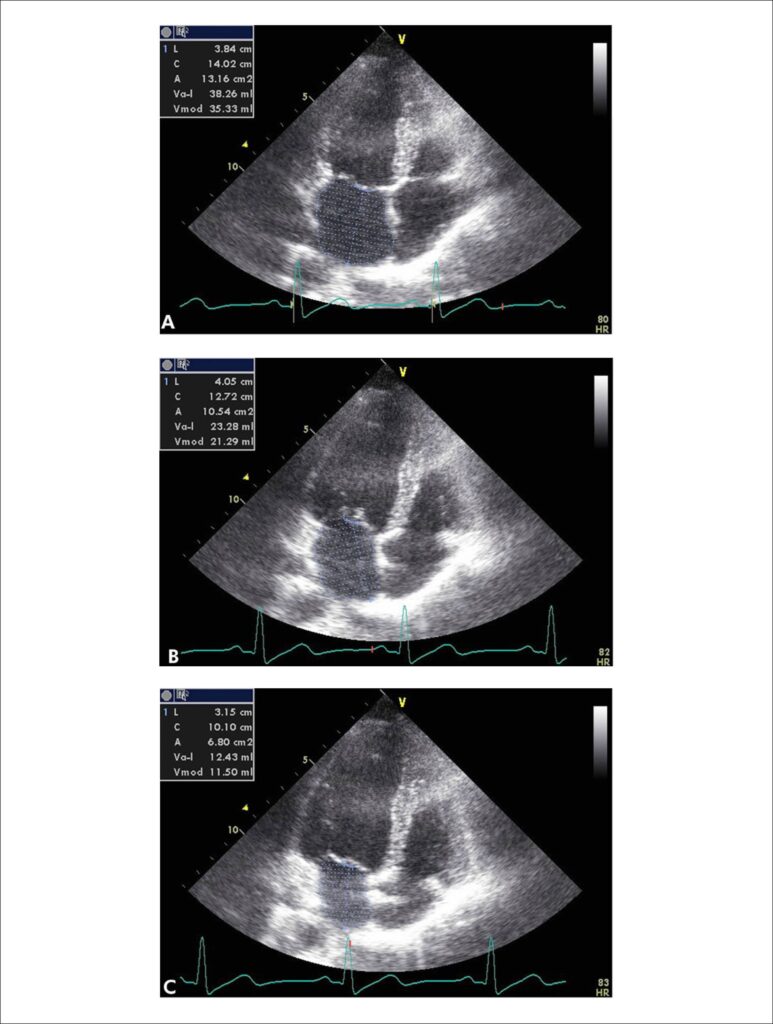
The aim of this study was to assess atrial EMD and mechanical function after anthracycline-containing chemotherapy.
Methods:
Fifty-three patients with breast cancer (48 ± 8 years old) who received 240 mg/m2of Adriamycin, 2400 mg/m2 of cyclophosphamide, and 960 mg/m2 of paclitaxel were included in this retrospective study, as were 42 healthy subjects (47 ± 9 years old). Echocardiographic measurements were performed 11 ± 7 months (median 9 months) after treatment with anthracyclines.
Results:
Left intra-atrial EMD (11.4 ± 6.0 vs. 8.1 ± 4.9, p=0.008) and inter-atrial EMD (19.7 ± 7.4 vs. 14.7 ± 6.5, p=0.001) were prolonged; LA passive emptying volume and fraction were decreased (p=0.0001 and p=0.0001); LA active emptying volume and fraction were increased (p=0.0001 and p=0.0001); Mitral A velocity (0.8 ± 0.2 vs. 0.6 ± 0.2, p=0.0001) and mitral E-wave deceleration time (201.2 ± 35.6 vs. 163.7 ± 21.8, p=0.0001) were increased; Mitral E/A ratio (1.0 ± 0.3 vs. 1.3 ± 0.3, p=0.0001) and mitral Em (0.09 ± 0.03 vs. 0.11 ± 0.03, p=0.001) were decreased; Mitral Am (0.11 ± 0.02 vs. 0.09 ± 0.02, p=0.0001) and mitral E/Em ratio (8.8 ± 3.2 vs. 7.6 ± 2.6, p=0.017) were increased in the patients.
Conclusions:
In patients with breast cancer after anthracycline therapy: Left intra-atrial, inter-atrial electromechanical intervals were prolonged. Diastolic function was impaired. Impaired left ventricular relaxation and left atrial electrical conduction could be contributing to the development of atrial arrhythmias.
Images
Image gallery fullscreen viewer
Comments are moderated by the editorial team before publication. Discussions should be evidence-based and use scientific language. Conflicts of interest should be declared.