Amiodarone causes endothelium-dependent vasodilation in canine coronary arteries
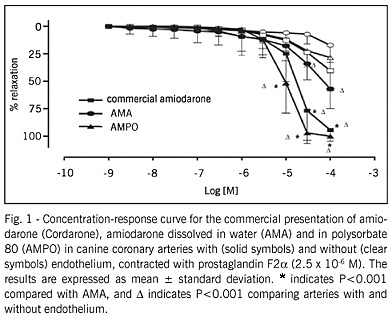
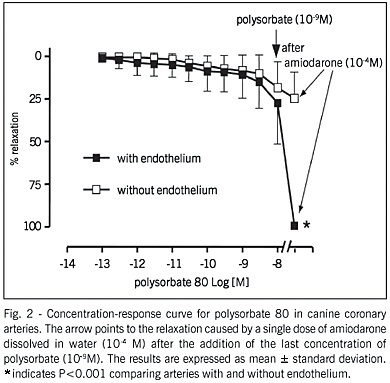
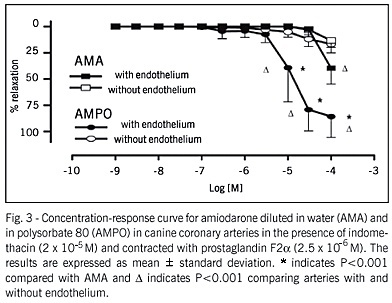
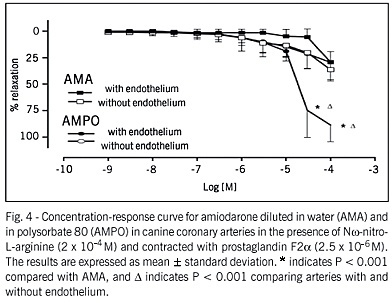
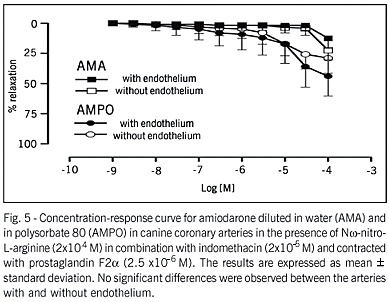
OBJECTIVE: To assess the vasodilating effects of amiodarone on canine coronary arteries by using solutions of amiodarone dissolved in polysorbate 80 or water. METHODS: Rings of coronary arteries, with or without intact endothelium, were immersed in Krebs solution and connected to a transducer for measuring the isometric force promoted by a vascular contraction. The arteries were exposed to increasing concentrations of polysorbate 80, amiodarone dissolved in water, amiodarone dissolved in polysorbate 80, and a commercial presentation of amiodarone (Cordarone). The experiments were conducted in the presence of the following enzymatic blockers: only indomethacin, Nw-nitro-L-arginine associated with indomethacin, and only Nw-nitro-L-arginine. RESULTS: Polysorbate 80 caused a small degree of nonendothelium-dependent relaxation. Cordarone, amiodarone dissolved in water, and amiodarone dissolved in polysorbate 80 caused endothelium-dependent relaxation, which was greater for amiodarone dissolved in polysorbate and for Cordarone. Only the association of indomethacin and Nw-nitro-L-arginine could eliminate the endothelium-dependent relaxation caused by amiodarone dissolved in polysorbate 80. CONCLUSION: The results obtained indicate that vasodilation promoted by amiodarone in canine coronary arteries is mainly caused by stimulation of the release of nitric oxide and cyclooxygenase-dependent relaxing endothelial factors.
Images
Image gallery fullscreen viewer
Comments are moderated by the editorial team before publication. Discussions should be evidence-based and use scientific language. Conflicts of interest should be declared.