ABC Family Arquivos Brasileiros de Cardiologia International Journal of Cardiovascular Sciences ABC Heart Failure & Cardiomyopathy ABC Imagem Cardiovascular
Português English
ABC Family
Português English
  • About
    • About ABC Family
    • Internal Regulation
    • Editorial Board
    • Brazilian Society of Cardiology (SBC)
  • Issues
  • SBC Guidelines
  • Content
    • Videos
    • Podcasts
    • News
  • About
    • About ABC Family
    • Internal Regulation
    • Editorial Board
    • Brazilian Society of Cardiology (SBC)
  • Issues
  • SBC Guidelines
  • Content
    • Videos
    • Podcasts
    • News

ABC Family

  • ABC Family
  • Arquivos Brasileiros de Cardiologia
  • International Journal of Cardiovascular Sciences
  • ABC Heart Failure & Cardiomyopathy
  • ABC Imagem Cardiovascular
Search in

No content found.

Journals
Ordering
Article types
Others

  1. Home
  2. Keyword: ventricular arrhythmias
Syncope in patients with right ventricle outflow tract premature beats and no apparent structural cardiopathy
ABC
Artigo Original

Syncope in patients with right ventricle outflow tract premature beats and no apparent structural cardiopathy

Ana Cristina Ludovice et al. Denise Tessariol Hachul Francisco Carlos Darrieux Silvana Cardoso Bastos … Eduardo Argentino Sosa Mauricio Ibrahim Scanavacca

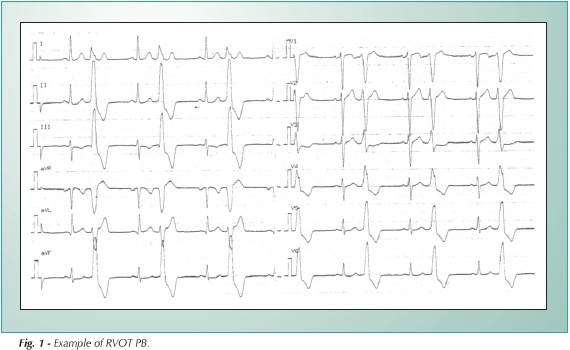
OBJECTIVE: Study the prevalence of neurocardiogenic etiology in patients with unexplained syncope and ventricular premature beats, with right ventricle outflow tract morphology (RVOT) and no apparent structural cardiopathy. METHODS: Ninety patients (66 women, mean age 40.2±16.95 years of age) with monomorphic premature beats originated at RVOT were evaluated prospectively. Fifty-four patients reported syncopes or near-syncopes associated to palpitations or not; twenty-seven presented palpitations with no pre-syncope or syncope, and nine were asymptomatic. All patients were submitted to echocardiogram, high resolution ECG and cardiac MRI to rule out structural cardiopathy, to exertion test to rule out adrenergic dependent ventricular tachycardia, and ECG prolonged outpatient monitoring (Holter and symptomatic events monitor) to correlate symptoms and ventricular arrhythmias. Investigation on the susceptibility to neurocardiogenic syncope was evaluated by Tilt Table Test (TTT). Groups were compared regarding gender, age, premature beats frequency and complexity, at exertion or not, TTT results and clinical course. RESULTS: In the syncope and pre-syncope groups, TTT was positive for 38% of cases, and in groups with palpitations and assymptomatics, it was positive for 11% (p = 0.0257). After recommendations and treatment of neurocardiogenic syncope, 85% of syncope and pre-syncope patients and positive TTT was asymptomatic along the 40-month follow-up. Two patients with syncope and negative TTT presented spontaneous, sustained ventricular tachycardia during clinic course. CONCLUSION: The prevalence of neurocardiogenic syncope in patients with idiopathic RVOT premature beats is high. Patients with recurrent, unexplained syncope and idiopathic VE must be kept under investigation.

  • neurocardiogenic syncope
  • ventricular arrhythmias
  • Ventricular premature beats
  • Ventricular tachycardia
Read Full Article
Creative Commons Attribution (CC BY) Creative Commons license
06/03/2007 DOI: 10.1590/S0066-782X2006001800004
ABC
Original Article

Biventricular pacing improves clinical behavior and reduces prevalence of ventricular srrhythmia in patients with heart failure

Martino Martinelli Filho et al. Anísio A. A. Pedrosa Roberto Costa Silvana A. D. Nishioka … Sérgio F. Siqueira Wagner T. Tamaki Eduardo Sosa

PURPOSE: To analyze the influence of biventricular pacing (BP) on clinical behavior, ventricular arrhythmia (VA) prevalence, and left ventricular ejection fraction (LV EF) by gated ventriculography. METHODS: Twenty-four patients with left bundle branch block (LBBB) and NYHA class III and IV underwent pacemaker implantation and were randomized either to the conventional or BP group, all receiving BP after 6 months. RESULTS: Sixteen patients were in NYHA class IV (66.6%) and 8 were in class III (33.4%). After 1-year follow-up, 14 patients were in class II (70%) and 5 were in class III (25%). Two sudden cardiac deaths occurred. A significant reduction in QRS length was found with BP (p=0.006). A significant statistical increase, from a mean of 19.13 ± 5.19% (at baseline) to 25.33 ± 5.90% (with BP) was observed in LVEF Premature ventricular contraction prevalence decreased from a mean of 10,670.00 ± 12,595.39 SD or to a mean of 3,007.00 ± 3,216.63 SD PVC/24 h with BP (p<0.05). Regarding the hospital admission rate over 1 year, we observed a significant reduction from 60. To 16 admissions with BP (p<0.05). CONCLUSION: Patients with LBBB and severe heart failure experienced, with BP, a significant NYHA class and LVEF improvement. A reduction in the hospital admission rate and VA prevalence also occurred.

  • biventricular pacing
  • Heart Failure
  • ventricular arrhythmias
Read Full Article
Creative Commons Attribution (CC BY) Creative Commons license
19/02/2002 DOI: 10.1590/S0066-782X2002000100010 Views 1

How to cite this article

EndNote RIS

Electronic Document Format (Vancouver)

Ludovice AC, Hachul DT, Darrieux FC, Bastos SC, Sosa EA, Scanavacca MI. Syncope in patients with right ventricle outflow tract premature beats and no apparent structural cardiopathy. Arquivos Brasileiros de Cardiologia 2007;87(5):570-4.

Electronic Document Format (ABNT)

Ludovice, Ana Cristina; Hachul, Denise Tessariol; Darrieux, Francisco Carlos; Bastos, Silvana Cardoso; Sosa, Eduardo Argentino; Scanavacca, Mauricio Ibrahim. Syncope in patients with right ventricle outflow tract premature beats and no apparent structural cardiopathy. Arquivos Brasileiros de Cardiologia, v. 87, n. 5, p. 570-574, Mar. 2007.

Electronic Document Format (APA)

Ludovice, A. C., Hachul, D. T., Darrieux, F. C., Bastos, S. C., Sosa, E. A., & Scanavacca, M. I. (2007). Syncope in patients with right ventricle outflow tract premature beats and no apparent structural cardiopathy. Arquivos Brasileiros de Cardiologia, 87(5), 570-574.

Electronic Document Format (ISO)

Ludovice, Ana Cristina and Hachul, Denise Tessariol and Darrieux, Francisco Carlos and Bastos, Silvana Cardoso and Sosa, Eduardo Argentino and Scanavacca, Mauricio Ibrahim. Syncope in patients with right ventricle outflow tract premature beats and no apparent structural cardiopathy. Arquivos Brasileiros de Cardiologia [online]. 2007, vol. 87, n. 5, [cited 2026-10-14], pp. 570-574. Available from: <https://journals.cardiol.br/en/article/syncope-in-patients-with-right-ventricle-outflow-tract-premature-beats-and-no-apparent-structural-cardiopathy/>. ISSN 0066-782X

EndNote RIS

Electronic Document Format (Vancouver)

Martinelli Filho M, Pedrosa AAA, Costa R, Nishioka SAD, Siqueira SF, Tamaki WT, Sosa E, et al. Biventricular pacing improves clinical behavior and reduces prevalence of ventricular srrhythmia in patients with heart failure. Arquivos Brasileiros de Cardiologia 2002;78(1):110-3.

Electronic Document Format (ABNT)

Martinelli Filho, Martino; Pedrosa, Anísio A. A.; Costa, Roberto; Nishioka, Silvana A. D.; Siqueira, Sérgio F.; Tamaki, Wagner T.; Sosa, Eduardo. Biventricular pacing improves clinical behavior and reduces prevalence of ventricular srrhythmia in patients with heart failure. Arquivos Brasileiros de Cardiologia, v. 78, n. 1, p. 110-113, Feb. 2002.

Electronic Document Format (APA)

Martinelli Filho, M., Pedrosa, A. A. A., Costa, R., Nishioka, S. A. D., Siqueira, S. F., Tamaki, W. T., & Sosa, E. (2002). Biventricular pacing improves clinical behavior and reduces prevalence of ventricular srrhythmia in patients with heart failure. Arquivos Brasileiros de Cardiologia, 78(1), 110-113.

Electronic Document Format (ISO)

Martinelli Filho, Martino and Pedrosa, Anísio A. A. and Costa, Roberto and Nishioka, Silvana A. D. and Siqueira, Sérgio F. and Tamaki, Wagner T. and Sosa, Eduardo. Biventricular pacing improves clinical behavior and reduces prevalence of ventricular srrhythmia in patients with heart failure. Arquivos Brasileiros de Cardiologia [online]. 2002, vol. 78, n. 1, [cited 2026-10-14], pp. 110-113. Available from: <https://journals.cardiol.br/en/article/biventricular-pacing-improves-clinical-behavior-and-reduces-prevalence-of-ventricular-srrhythmia-in-patients-with-heart-failure/>. ISSN 0066-782X

  • About ABC Family
  • Internal Regulation
  • Editorial Board
  • Brazilian Society of Cardiology (SBC)

Issues

SBC Guidelines

  • Videos
  • Podcasts
  • News