ABC Family Arquivos Brasileiros de Cardiologia International Journal of Cardiovascular Sciences ABC Heart Failure & Cardiomyopathy ABC Imagem Cardiovascular
Português English
ABC Family
Português English
  • About
    • About ABC Family
    • Internal Regulation
    • Editorial Board
    • Brazilian Society of Cardiology (SBC)
  • Issues
  • SBC Guidelines
  • Content
    • Videos
    • Podcasts
    • News
  • About
    • About ABC Family
    • Internal Regulation
    • Editorial Board
    • Brazilian Society of Cardiology (SBC)
  • Issues
  • SBC Guidelines
  • Content
    • Videos
    • Podcasts
    • News

ABC Family

  • ABC Family
  • Arquivos Brasileiros de Cardiologia
  • International Journal of Cardiovascular Sciences
  • ABC Heart Failure & Cardiomyopathy
  • ABC Imagem Cardiovascular
Search in

No content found.

Journals
Ordering
Article types
Others

  1. Home
  2. Keyword: ventilation
ABC
Editorial

Ventilation and Respiratory Parameters in CPR: Where are We and Next Steps!

Hélio Penna Guimarães

The first mention of cardiopulmonary resuscitation refers to the moment of Adam’s creation, in which God “breathed into his mouth, giving him life.” The Bible also mentions, in the book of the Kings, prophet Elisha, a disciple of Elijah, who revived a young son of a Shunamite widow, whose description is less symbolic and more precise in its detailing, being considered by many historians to be the first account of CPR maneuvers. “… and he went up, and lay upon the child, and put his mouth upon his mouth, and his eyes upon his eyes, and his hands upon his hands: and he stretched himself upon the child; the child sneezed seven times, and the child opened his eyes,” maneuver performed by Elisha, narrated in II Kings 4:34-35141.

Paracelsus evaluated, in 1530, the use of fireplace bellows to introduce air into the lungs of apparently dead individuals, characterizing the first and rustic attempts at artificial ventilation, based on the current principle of positive pressure ventilation using the bag-valve-mask units.

[…]

  • Cardiopulmonary Resuscitation
  • Heart Arrest
  • ventilation
Read Full Article
Creative Commons Attribution (CC BY) Creative Commons license
18/09/2023 DOI: 10.36660/abc.20230492
Cardiorespiratory responses during progressive maximal exercise test in healthy children
ABC
Artigo Original

Cardiorespiratory responses during progressive maximal exercise test in healthy children

Danilo Marcelo Leite do Prado et al. Ana Maria F. Wanderley Braga Maria Urbana Pinto Rondon Luciene Ferreira Azevedo … Luciana D. N. J. Matos Carlos Eduardo Negrão Ivani Credidio Trombetta

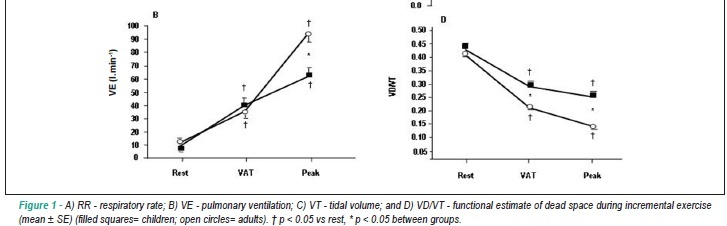
BACKGROUND: Little is known about cardiorespiratory and metabolic response in healthy children during progressive maximal exercise test. OBJECTIVE: To test the hypothesis that children show different responses in cardiorespiratory and metabolic parameters during progressive maximal exercise test when compared with adults. METHODS: Twenty-five healthy children (gender, 15M/10F; age, 10.2 ± 0.2) and 20 healthy adults (gender, 11M/9F; age, 27.5 ± 0.4) underwent a progressive treadmill cardiopulmonary test until exhaustion to determine the maximal aerobic capacity and ventilatory anaerobic threshold (VAT). RESULTS: The peak workload (5.9±0.1 vs 5.6±0.1 mph, respectively; p>0.05), exercise time (9.8±0.4 vs 10.2±0.4 min, respectively; p>0.05), and relative aerobic fitness (VO2peak, 39.4±2.1 vs 39.1±2.0 ml.kg-1.min-1, respectively; p>0.05) were similar in children and adults. At ventilatory anaerobic threshold, the heart rate, VO2 ml.kg-1.min-1, respiratory rate (RR), functional estimate of dead space (VD/VT), ventilatory equivalent for oxygen (VE/VO2) and end-tidal pressure for oxygen (PETO2) were higher in children, while tidal volume (VT), O2 pulse and end-tidal pressure for carbon dioxide (PETCO2) were lower. At peak of exercise, children showed higher RR and VD/VT. However, O2 pulse, VT, pulmonary ventilation, PETCO2 and respiratory exchange ratio were lower in children than adults. CONCLUSION: Cardiorespiratory and metabolic responses during progressive exercise test are different in children as compared to adults. Specifically, these differences suggest that children have lower cardiovascular and ventilatory efficiency. However, children showed higher metabolic efficiency during exercise. In summary, despite the differences observed, children showed similar levels of exercising capacity when compared with adults.

  • Child
  • Comparative Study
  • Exercise Test
  • Metabolism
  • ventilation
Read Full Article
Creative Commons Attribution (CC BY) Creative Commons license
05/03/2010 DOI: 10.1590/S0066-782X2010005000007 Views 1

How to cite this article

EndNote RIS

Electronic Document Format (Vancouver)

Guimarães HP. Ventilation and Respiratory Parameters in CPR: Where are We and Next Steps!. Arquivos Brasileiros de Cardiologia 2023;120(7):e20230492.

Electronic Document Format (ABNT)

Guimarães, Hélio Penna. Ventilation and Respiratory Parameters in CPR: Where are We and Next Steps!. Arquivos Brasileiros de Cardiologia, v. 120, n. 7, e20230492, Sep. 2023.

Electronic Document Format (APA)

Guimarães, H. P. (2023). Ventilation and Respiratory Parameters in CPR: Where are We and Next Steps!. Arquivos Brasileiros de Cardiologia, 120(7), e20230492.

Electronic Document Format (ISO)

Guimarães, Hélio Penna. Ventilation and Respiratory Parameters in CPR: Where are We and Next Steps!. Arquivos Brasileiros de Cardiologia [online]. 2023, vol. 120, n. 7, [cited 2026-10-14], e20230492. Available from: <https://journals.cardiol.br/en/article/ventilation-and-respiratory-parameters-in-cpr-where-are-we-and-next-steps/>. ISSN 0066-782X

EndNote RIS

Electronic Document Format (Vancouver)

Prado DML, Braga AMFW, Rondon MUP, Azevedo LF, Matos LDNJ, Negrão CE, Trombetta IC, et al. Cardiorespiratory responses during progressive maximal exercise test in healthy children. Arquivos Brasileiros de Cardiologia 2010;94(4):493-9.

Electronic Document Format (ABNT)

Prado, Danilo Marcelo Leite do; Braga, Ana Maria F. Wanderley; Rondon, Maria Urbana Pinto; Azevedo, Luciene Ferreira; Matos, Luciana D. N. J.; Negrão, Carlos Eduardo; Trombetta, Ivani Credidio. Cardiorespiratory responses during progressive maximal exercise test in healthy children. Arquivos Brasileiros de Cardiologia, v. 94, n. 4, p. 493-499, Mar. 2010.

Electronic Document Format (APA)

Prado, D. M. L. , Braga, A. M. F. W., Rondon, M. U. P., Azevedo, L. F., Matos, L. D. N. J., Negrão, C. E., & Trombetta, I. C. (2010). Cardiorespiratory responses during progressive maximal exercise test in healthy children. Arquivos Brasileiros de Cardiologia, 94(4), 493-499.

Electronic Document Format (ISO)

Prado, Danilo Marcelo Leite do and Braga, Ana Maria F. Wanderley and Rondon, Maria Urbana Pinto and Azevedo, Luciene Ferreira and Matos, Luciana D. N. J. and Negrão, Carlos Eduardo and Trombetta, Ivani Credidio. Cardiorespiratory responses during progressive maximal exercise test in healthy children. Arquivos Brasileiros de Cardiologia [online]. 2010, vol. 94, n. 4, [cited 2026-10-14], pp. 493-499. Available from: <https://journals.cardiol.br/en/article/cardiorespiratory-responses-during-progressive-maximal-exercise-test-in-healthy-children/>. ISSN 0066-782X

  • About ABC Family
  • Internal Regulation
  • Editorial Board
  • Brazilian Society of Cardiology (SBC)

Issues

SBC Guidelines

  • Videos
  • Podcasts
  • News