ABC Family Arquivos Brasileiros de Cardiologia International Journal of Cardiovascular Sciences ABC Heart Failure & Cardiomyopathy ABC Imagem Cardiovascular
Português English
ABC Family
Português English
  • About
    • About ABC Family
    • Internal Regulation
    • Editorial Board
    • Brazilian Society of Cardiology (SBC)
  • Issues
  • SBC Guidelines
  • Content
    • Videos
    • Podcasts
    • News
  • About
    • About ABC Family
    • Internal Regulation
    • Editorial Board
    • Brazilian Society of Cardiology (SBC)
  • Issues
  • SBC Guidelines
  • Content
    • Videos
    • Podcasts
    • News

ABC Family

  • ABC Family
  • Arquivos Brasileiros de Cardiologia
  • International Journal of Cardiovascular Sciences
  • ABC Heart Failure & Cardiomyopathy
  • ABC Imagem Cardiovascular
Search in

No content found.

Journals
Ordering
Article types
Others

  1. Home
  2. Keyword: STEMI
Figure 1
ABC
Editorial

Worse Prognosis of STEMI Patients during Off-Hours: What are we Missing?

Marco Antônio Smiderle Gelain et al. Henrique Barbosa Ribeiro

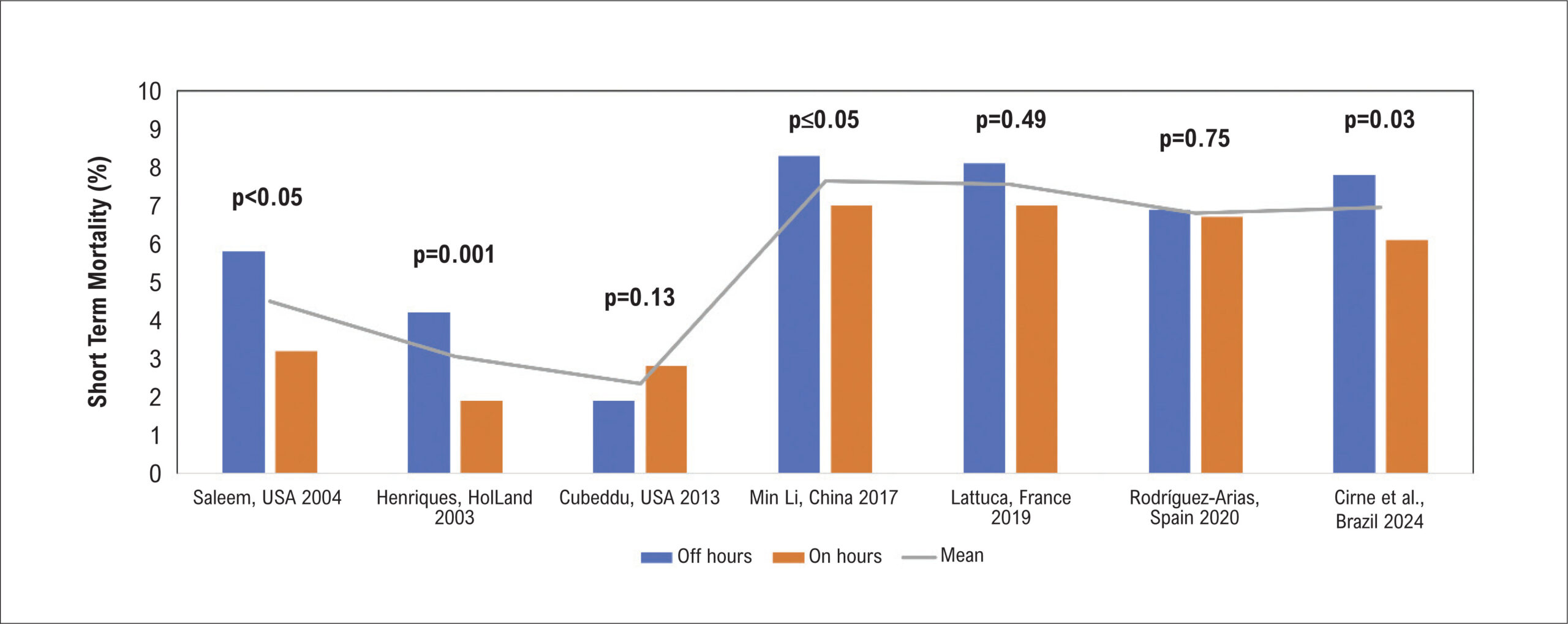
In Brazil, the annual incidence of myocardial infarction is estimated at approximately 300,000 to 400,000 cases. Despite advancements in treatment, myocardial infarction remains the leading cause of death in Brazil and globally, with a lethality rate of around 9%. According to the BRACE registry, acute coronary syndrome (ACS) accounts for 45% of hospitalizations in Brazil, with two-thirds attributed to acute myocardial infarction (AMI), including both ST-segment elevation myocardial infarction (STEMI) and non-ST-segment elevation myocardial infarction (NSTEMI). Notably, 40% to 60% of STEMI patients present during off-hours, between 7 PM and 7 AM, and on weekends., Given that the treatment of STEMI is time-sensitive and requires a complex multidisciplinary team in the catheterization laboratory, the impact of presentation timing on patient outcomes remains a contentious issue. Thus, the question of whether off-hours presentation results in a poorer prognosis is still debated.

In this issue of the journal, Cirne et al. examined a prospective registry from a high-volume ACS center in Southern Brazil, encompassing 4,436 consecutive STEMI patients who underwent primary percutaneous coronary intervention (PPCI) between 2009 and 2019. Patients were stratified by presentation time: on-hours versus off-hours. The primary outcome was a composite of major adverse cardiac events (MACE), which included death, AMI, or stroke at one year, along with MACE at 30 days, stent thrombosis, and the need for new revascularization. Among the cohort, 2,576 (57%) patients were treated during off-hours, with no significant differences between the groups concerning age, sex, infarction-related artery, or Killip classification. Additionally, symptom-to-hospital time (mean 240 minutes) and door-to-balloon time (DTB) (mean 70 minutes) were similar. No differences were observed in procedural complexity, complications, intra-aortic balloon pump usage, or angioplasty success rates; however, off-hours patients exhibited a higher thrombotic burden (49.6% vs. 45.5%, p<0.01). Despite comparable baseline clinical and angiographic characteristics, those presenting off-hours had higher rates of MACE at 30 days and one year (10.2% vs. 8.5% and 15.4% vs. 13.1%, respectively), as well as increased mortality (in-hospital: 7.9% vs. 6.1%; 30 days: 7.8% vs. 6.1%; 1 year: 11.1% vs. 9%, respectively). No differences were noted in AMI or stroke incidence.

[…]

  • Acute coronary syndrome
  • Off-hours
  • STEMI
Read Full Article
Creative Commons Attribution (CC BY) Creative Commons license
10/02/2025 DOI: 10.36660/abc.20240701i
IJCS
Editorial

Quality of Life Assessment in Patients With ST-Elevation Myocardial Infarction (STEMI): An Opportunity to Improve the Quality of Care That Should Not Be Missed

Ana Teresa Timóteo

In chronic diseases, the Quality of Life (QoL) is one of the most important patient-reported outcomes. Cardiovascular diseases are the main cause of death worldwide and ischemic heart disease represents an important health burden. In a large population-based cohort, individuals with self-reported previous myocardial infarction (MI) presented worse self-perceived health statuses in all domains, particularly in mobility and anxiety / depression. However, QoL was not independently associated with MI but instead was associated with age, sex and number of comorbidities, which were significantly higher in patients with prior MI. In this study, long-term QoL was more impaired in men, as compared to women. Nevertheless, in population-based cohorts, we have many possible pitfalls, considering that a diagnosis of MI and other chronic diseases is self-reported; therefore, it is impossible to confirm this diagnosis. It is also impossible to differentiate between ST-elevation MI (STEMI) and non-STEMI, and it is rarely possible to assess the QoL at the same point in time after MI. In fact, we can expect QoL to be much different in the first few months after MI when compared with the QoL several years later.

A more structured study was performed in Australia, in which the QoL was assessed at earlier time points (4 weeks and 6 months). The study sample consisted primarily of males (representing more than 75%), but with a mean age similar to previous studies in MI populations. Health-related QoL improved at 6 months following primary percutaneous coronary intervention for physical and mental health. All aspects of cardiac-specific health status had improved (physical limitation, anginal frequency, treatment satisfaction, and QoL), except for angina stability. Patients aged ≥ 70 years had poorer physical QoL and physical limitations, but better mental QoL at both time points. However, patients were from a specific remote geographic region and were included in 2010 and 2011. Therefore, this did not represent a contemporary sample of patients, and it does not reflect current treatment standards. All in all, those results are not comparable with current populations of STEMI patients from different regions around the world.

[…]

  • Myocardial Infarction
  • Quality of life
  • ST Elevation Myocardial Infarction
  • STEMI
Read Full Article
Creative Commons Attribution (CC BY) Creative Commons license
13/11/2023 DOI: 10.36660/ijcs.20230136 Views 1

How to cite this article

EndNote RIS

Electronic Document Format (Vancouver)

Gelain MAS, Ribeiro HB. Worse Prognosis of STEMI Patients during Off-Hours: What are we Missing?. Arquivos Brasileiros de Cardiologia 2025;121(11):e20240701.

Electronic Document Format (ABNT)

Gelain, Marco Antônio Smiderle; Ribeiro, Henrique Barbosa. Worse Prognosis of STEMI Patients during Off-Hours: What are we Missing?. Arquivos Brasileiros de Cardiologia, v. 121, n. 11, e20240701, Feb. 2025.

Electronic Document Format (APA)

Gelain, M. A. S., & Ribeiro, H. B. (2025). Worse Prognosis of STEMI Patients during Off-Hours: What are we Missing?. Arquivos Brasileiros de Cardiologia, 121(11), e20240701.

Electronic Document Format (ISO)

Gelain, Marco Antônio Smiderle and Ribeiro, Henrique Barbosa. Worse Prognosis of STEMI Patients during Off-Hours: What are we Missing?. Arquivos Brasileiros de Cardiologia [online]. 2025, vol. 121, n. 11, [cited 2026-10-14], e20240701. Available from: <https://journals.cardiol.br/en/article/worse-prognosis-of-stemi-patients-during-off-hours-what-are-we-missing/>. ISSN 0066-782X

EndNote RIS

Electronic Document Format (Vancouver)

Timóteo AT. Quality of Life Assessment in Patients With ST-Elevation Myocardial Infarction (STEMI): An Opportunity to Improve the Quality of Care That Should Not Be Missed. International Journal of Cardiovascular Sciences 2023;36:e20230136.

Electronic Document Format (ABNT)

Timóteo, Ana Teresa. Quality of Life Assessment in Patients With ST-Elevation Myocardial Infarction (STEMI): An Opportunity to Improve the Quality of Care That Should Not Be Missed. International Journal of Cardiovascular Sciences, v. 36, e20230136, Nov. 2023.

Electronic Document Format (APA)

Timóteo, A. T. (2023). Quality of Life Assessment in Patients With ST-Elevation Myocardial Infarction (STEMI): An Opportunity to Improve the Quality of Care That Should Not Be Missed. International Journal of Cardiovascular Sciences, 36, e20230136.

Electronic Document Format (ISO)

Timóteo, Ana Teresa. Quality of Life Assessment in Patients With ST-Elevation Myocardial Infarction (STEMI): An Opportunity to Improve the Quality of Care That Should Not Be Missed. International Journal of Cardiovascular Sciences [online]. 2023, vol. 36, [cited 2026-10-14], e20230136. Available from: <https://journals.cardiol.br/en/article/quality-of-life-assessment-in-patients-with-st-elevation-myocardial-infarction-stemi-an-opportunity-to-improve-the-quality-of-care-that-should-not-be-missed/>. ISSN 2359-4802
  • About ABC Family
  • Internal Regulation
  • Editorial Board
  • Brazilian Society of Cardiology (SBC)

Issues

SBC Guidelines

  • Videos
  • Podcasts
  • News