ABC Family Arquivos Brasileiros de Cardiologia International Journal of Cardiovascular Sciences ABC Heart Failure & Cardiomyopathy ABC Imagem Cardiovascular
Português English
ABC Family
Português English
  • About
    • About ABC Family
    • Internal Regulation
    • Editorial Board
    • Brazilian Society of Cardiology (SBC)
  • Issues
  • SBC Guidelines
  • Content
    • Videos
    • Podcasts
    • News
  • About
    • About ABC Family
    • Internal Regulation
    • Editorial Board
    • Brazilian Society of Cardiology (SBC)
  • Issues
  • SBC Guidelines
  • Content
    • Videos
    • Podcasts
    • News

ABC Family

  • ABC Family
  • Arquivos Brasileiros de Cardiologia
  • International Journal of Cardiovascular Sciences
  • ABC Heart Failure & Cardiomyopathy
  • ABC Imagem Cardiovascular
Search in

No content found.

Journals
Ordering
Article types
Others

  1. Home
  2. Keyword: Pulmonary Circulation
Figure 1
ABC
Original Article

Pulmonary Vascular Volume Estimated by Automated Software is a Mortality Predictor after Acute Pulmonary Embolism

Leonardo Soriano et al. Marcel Koenigkam Santos Danilo Tadeu Wada Kelvin Vilalva … Talita Tavares Castro Oliver Weinheimer Valdair Francisco Muglia Antonio Pazin Filho Carlos Henrique Miranda

Abstract

Background:

Acute pulmonary embolism (APE) has a variable clinical outcome. Computed tomography pulmonary angiography (CTPA) is the gold standard for this diagnosis.

Objective:

To evaluate if the pulmonary vascular volume (PVV) quantified by automated software is a mortality predictor after APE.

Methods:

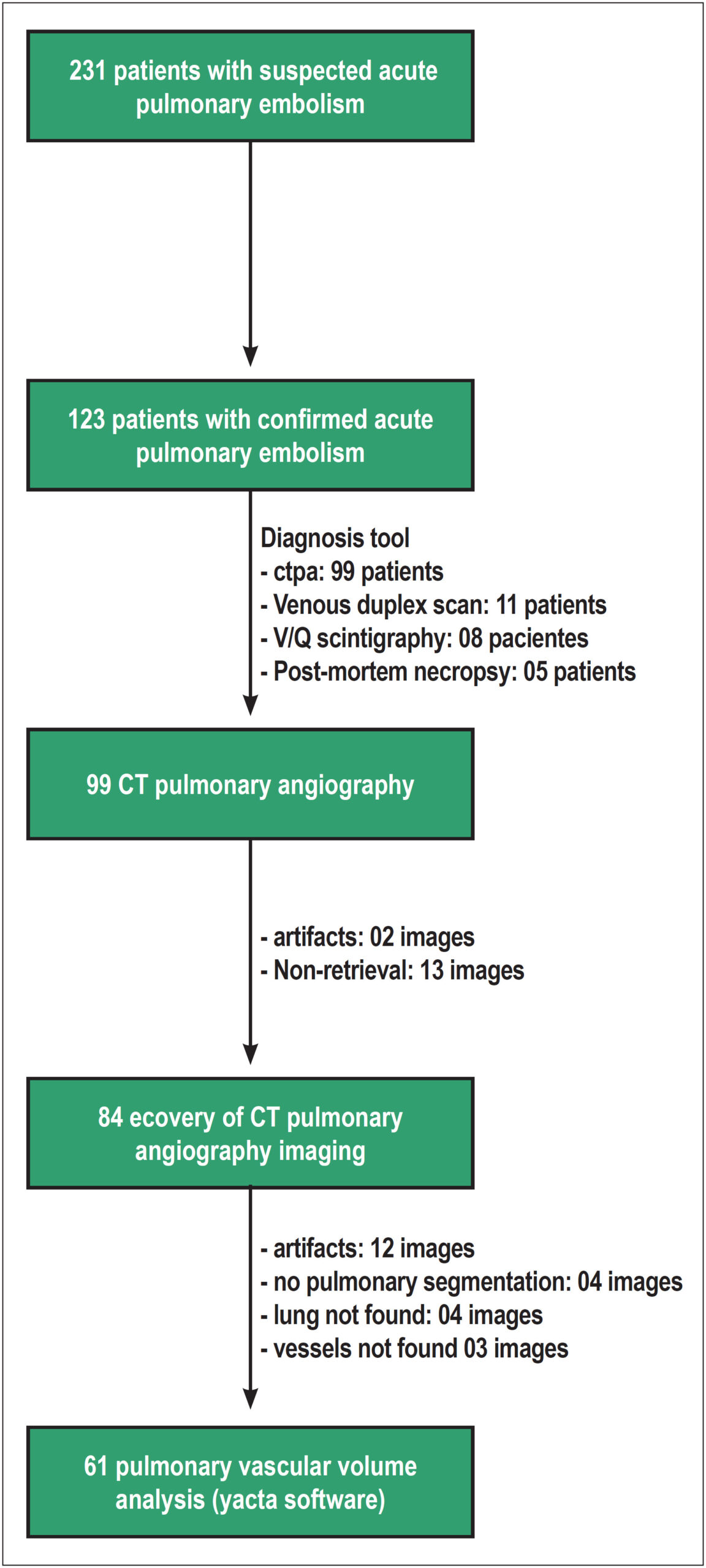
Retrospective cohort study where the CTPA imaging of 61 patients with APE was reanalyzed. Pulmonary vascular volume (PVV) and pulmonary volume (PV) were automatically estimated using the Yacta software. We calculated the adjusted PVV by the ratio: PVV(cm3)/PV(liters). Classical prognostic CTPA parameters (clot load index, right ventricle/left ventricle diameter ratio, pulmonary artery/aorta diameter ratio, ventricular septal bowing, pulmonary infarction and reflux of contrast into the hepatic vein) were assessed. The outcome assessed was one-month mortality. We considered a p-value <0.05 as statistically significant.

Results:

Seven deaths (11%) occurred at one month among these 61 patients. PVV<23cm3/L was an independent predictor of one-month mortality in the univariate [odds ratio (OR): 26; 95% confidence interval (CI): 3-244; p=0.004] and multivariate analyses [adjusted OR: 19; 95%CI: 1.3-270; p=0.03]. The classical CTPA parameters were not associated with one-month mortality in this sample. The PVV<23cm3/L showed a sensitivity of 86%, a specificity of 82%, a negative predictive value of 94% and a positive predictive value of 64% to identify the patients who died.

Conclusion:

PVV<23cm3/L was an independent predictor of one-month mortality after APE. This parameter showed better prognostic performance than other classical CTPA findings. (Arq Bras Cardiol. 2020; 115(5):809-818)
  • Diagnostic Imaging
  • Emergency Medical Services
  • Mortality
  • Prognosis
  • Pulmonary Circulation
  • Pulmonary embolism
  • Tomography Computed
Read Full Article
Creative Commons Attribution (CC BY) Creative Commons license
07/12/2020 DOI: 10.36660/abc.20190392 Views 2
Figure 1
ABC
Case Report

Platypnea-Orthodeoxia Syndrome Due to Venovenous Malformation

Meng-Luen Lee et al. Ing-Sh Chiu

Introduction

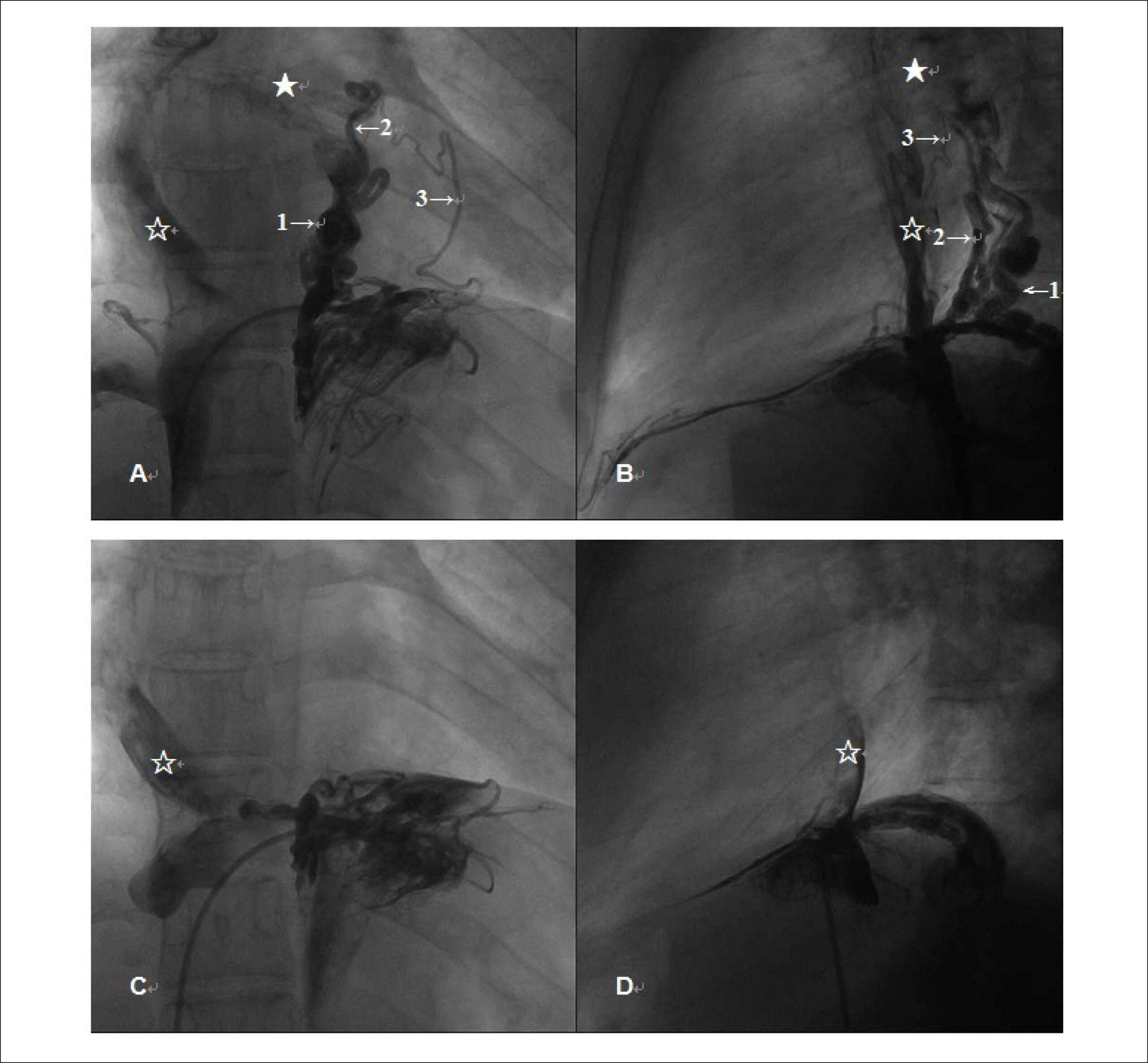
The platypnea-orthodeoxia syndrome (POS) is a rare clinical condition characterized by dyspnea occurring in the upright position and relieved in the supine position (platypnea) associated with oxygen desaturation noted in the upright position (orthodeoxia). A diagnosis of POS requires two of the following criteria: 1) orthodeoxia, 2) platypnea, 3) presence of an interatrial communication, 4) right-to-left shunt, and 5) absence of pulmonary arterial hypertension or right atrial hypertension., POS can originate in the heart, lungs, abdomen, or elsewhere due to either an intracardiac (cardiac POS) or intrapulmonary shunt, or a ventilation-perfusion mismatch. However, a venovenous malformation (VVM) as a cause of cardiac POS has never been reported in the literature.

We report here the case of a 24-year-old female patient who presented with cardiac POS due to a VVM. The syndrome emerged insidiously 16 years after an extracardiac total cavopulmonary connection (TCPC) for a complex of congenital cardiovascular malformations and was successfully treated with percutaneous transvenous coil embolization.

[…]

  • Arteriovenous Malformations / etiology
  • Arteriovenous Malformations / surgery
  • Dyspnea / etiology
  • Pulmonary Circulation
  • Septal occluder device
Read Full Article
Creative Commons Attribution (CC BY) Creative Commons license
01/04/2016 DOI: 10.5935/abc.20160059 Views 3

How to cite this article

EndNote RIS

Electronic Document Format (Vancouver)

Soriano L, Santos MK, Wada DT, Vilalva K, Castro TT, Weinheimer O, Muglia VF, et al. Pulmonary Vascular Volume Estimated by Automated Software is a Mortality Predictor after Acute Pulmonary Embolism. Arquivos Brasileiros de Cardiologia 2020;115(5):809-18.

Electronic Document Format (ABNT)

Soriano, Leonardo; Santos, Marcel Koenigkam; Wada, Danilo Tadeu; Vilalva, Kelvin; Castro, Talita Tavares; Weinheimer, Oliver; Muglia, Valdair Francisco; Pazin Filho, Antonio; Miranda, Carlos Henrique. Pulmonary Vascular Volume Estimated by Automated Software is a Mortality Predictor after Acute Pulmonary Embolism. Arquivos Brasileiros de Cardiologia, v. 115, n. 5, p. 809-818, Dec. 2020.

Electronic Document Format (APA)

Soriano, L., Santos, M. K., Wada, D. T., Vilalva, K., Castro, T. T., Weinheimer, O., Muglia, V. F., Pazin Filho, A., & Miranda, C. H. (2020). Pulmonary Vascular Volume Estimated by Automated Software is a Mortality Predictor after Acute Pulmonary Embolism. Arquivos Brasileiros de Cardiologia, 115(5), 809-818.

Electronic Document Format (ISO)

Soriano, Leonardo and Santos, Marcel Koenigkam and Wada, Danilo Tadeu and Vilalva, Kelvin and Castro, Talita Tavares and Weinheimer, Oliver and Muglia, Valdair Francisco and Pazin Filho, Antonio and Miranda, Carlos Henrique. Pulmonary Vascular Volume Estimated by Automated Software is a Mortality Predictor after Acute Pulmonary Embolism. Arquivos Brasileiros de Cardiologia [online]. 2020, vol. 115, n. 5, [cited 2026-10-14], pp. 809-818. Available from: <https://journals.cardiol.br/en/article/pulmonary-vascular-volume-estimated-by-automated-software-is-a-mortality-predictor-after-acute-pulmonary-embolism/>. ISSN 0066-782X

EndNote RIS

Electronic Document Format (Vancouver)

Lee M, Chiu I. Platypnea-Orthodeoxia Syndrome Due to Venovenous Malformation. Arquivos Brasileiros de Cardiologia 2016;106(4):345-8.

Electronic Document Format (ABNT)

Lee, Meng-Luen; Chiu, Ing-Sh. Platypnea-Orthodeoxia Syndrome Due to Venovenous Malformation. Arquivos Brasileiros de Cardiologia, v. 106, n. 4, p. 345-348, Mar. 2016.

Electronic Document Format (APA)

Lee, M., & Chiu, I. (2016). Platypnea-Orthodeoxia Syndrome Due to Venovenous Malformation. Arquivos Brasileiros de Cardiologia, 106(4), 345-348.

Electronic Document Format (ISO)

Lee, Meng-Luen and Chiu, Ing-Sh. Platypnea-Orthodeoxia Syndrome Due to Venovenous Malformation. Arquivos Brasileiros de Cardiologia [online]. 2016, vol. 106, n. 4, [cited 2026-10-14], pp. 345-348. Available from: <https://journals.cardiol.br/en/article/platypnea-orthodeoxia-syndrome-due-to-venovenous-malformation/>. ISSN 0066-782X

  • About ABC Family
  • Internal Regulation
  • Editorial Board
  • Brazilian Society of Cardiology (SBC)

Issues

SBC Guidelines

  • Videos
  • Podcasts
  • News