ABC Family Arquivos Brasileiros de Cardiologia International Journal of Cardiovascular Sciences ABC Heart Failure & Cardiomyopathy ABC Imagem Cardiovascular
Português English
ABC Family
Português English
  • About
    • About ABC Family
    • Internal Regulation
    • Editorial Board
    • Brazilian Society of Cardiology (SBC)
  • Issues
  • SBC Guidelines
  • Content
    • Videos
    • Podcasts
    • News
  • About
    • About ABC Family
    • Internal Regulation
    • Editorial Board
    • Brazilian Society of Cardiology (SBC)
  • Issues
  • SBC Guidelines
  • Content
    • Videos
    • Podcasts
    • News

ABC Family

  • ABC Family
  • Arquivos Brasileiros de Cardiologia
  • International Journal of Cardiovascular Sciences
  • ABC Heart Failure & Cardiomyopathy
  • ABC Imagem Cardiovascular
Search in

No content found.

Journals
Ordering
Article types
Others

  1. Home
  2. Keyword: Osborn Waves
Figure 1
ABC
Image

Hypothermia-Induced Electrocardiographic Changes

Ana Marques et al. Daniel Caldeira Alexandra Briosa Isabel João Hélder Pereira

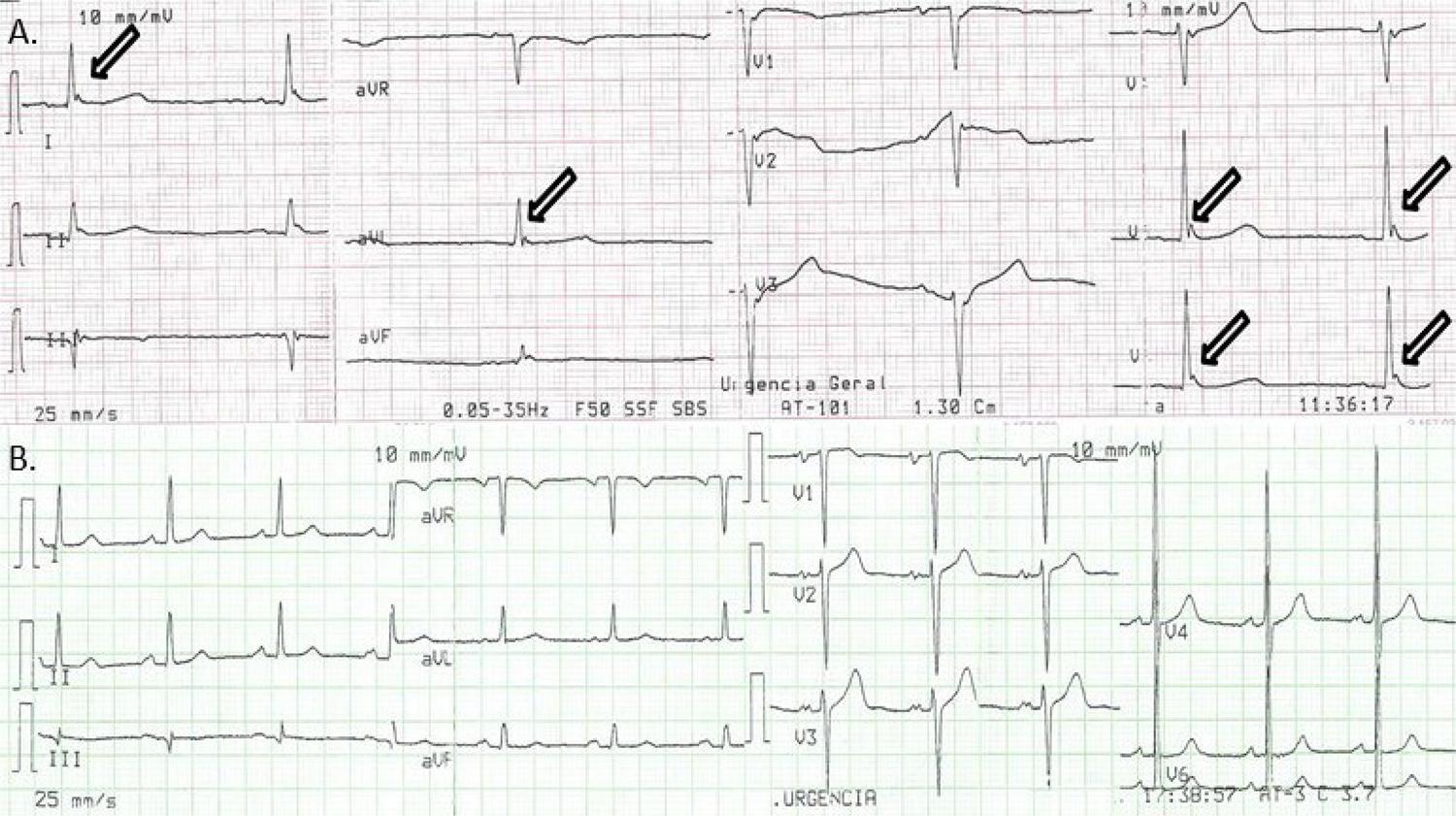
An elderly female patient was brought to the Emergency Department due to loss of consciousness. The past medical history was remarkable for hypercholesterolemia and essential hypertension. The patient was not treated with any negative chronotropic drug. At the admission, the patient’s blood pressure was 90/60 mmHg, she had bradycardia (42/minute), and hypothermia (33ºC). Electrocardiogram (ECG) showed sinus bradycardia, 1st grade atrioventricular block, long corrected QT interval, and Osborn waves at the end of QRS complexes ( , arrowheads). Accordingly, these positive notching deflections were best seen in lateral precordial leads and disappeared after warming the patient to 36ºC ( ). The bradycardia, atrioventricular block, and QT prolongation were also resolved ( ). During the inward stay, head computed tomography scan, 24-hour Holter, and laboratory analysis were unremarkable for pathological findings. Transthoracic echocardiogram only revealed degenerative aortic and mitral valve changes. This case is illustrative of hypothermia-induced electrocardiographic changes, namely prolongation of the PR, RR and QT intervals and particularly the presence of Osborn Waves. ,

[…]

  • Atrioventricular block
  • Bradycardia
  • Electrocardiography/methods
  • hypothermia
  • Osborn Waves
Read Full Article
Creative Commons Attribution (CC BY) Creative Commons license
03/07/2020 DOI: 10.36660/abc.20200081 Views 1

How to cite this article

EndNote RIS

Electronic Document Format (Vancouver)

Marques A, Caldeira D, Briosa A, João I, Pereira H. Hypothermia-Induced Electrocardiographic Changes. Arquivos Brasileiros de Cardiologia 2020;114(6):1076-7.

Electronic Document Format (ABNT)

Marques, Ana; Caldeira, Daniel; Briosa, Alexandra; João, Isabel; Pereira, Hélder. Hypothermia-Induced Electrocardiographic Changes. Arquivos Brasileiros de Cardiologia, v. 114, n. 6, p. 1076-1077, Jul. 2020.

Electronic Document Format (APA)

Marques, A., Caldeira, D., Briosa, A., João, I., & Pereira, H. (2020). Hypothermia-Induced Electrocardiographic Changes. Arquivos Brasileiros de Cardiologia, 114(6), 1076-1077.

Electronic Document Format (ISO)

Marques, Ana and Caldeira, Daniel and Briosa, Alexandra and João, Isabel and Pereira, Hélder. Hypothermia-Induced Electrocardiographic Changes. Arquivos Brasileiros de Cardiologia [online]. 2020, vol. 114, n. 6, [cited 2026-10-14], pp. 1076-1077. Available from: <https://journals.cardiol.br/en/article/hypothermia-induced-electrocardiographic-changes/>. ISSN 0066-782X

  • About ABC Family
  • Internal Regulation
  • Editorial Board
  • Brazilian Society of Cardiology (SBC)

Issues

SBC Guidelines

  • Videos
  • Podcasts
  • News