ABC Family Arquivos Brasileiros de Cardiologia International Journal of Cardiovascular Sciences ABC Heart Failure & Cardiomyopathy ABC Imagem Cardiovascular
Português English
ABC Family
Português English
  • About
    • About ABC Family
    • Internal Regulation
    • Editorial Board
    • Brazilian Society of Cardiology (SBC)
  • Issues
  • SBC Guidelines
  • Content
    • Videos
    • Podcasts
    • News
  • About
    • About ABC Family
    • Internal Regulation
    • Editorial Board
    • Brazilian Society of Cardiology (SBC)
  • Issues
  • SBC Guidelines
  • Content
    • Videos
    • Podcasts
    • News

ABC Family

  • ABC Family
  • Arquivos Brasileiros de Cardiologia
  • International Journal of Cardiovascular Sciences
  • ABC Heart Failure & Cardiomyopathy
  • ABC Imagem Cardiovascular
Search in

No content found.

Journals
Ordering
Article types
Others

  1. Home
  2. Keyword: Long Noncoding RNA
ABC
Editorial

LncRNA ZEB1-AS1: A New Player in Epigenetic Control of Cardiac Hypertrophy

Fernando R. Giugni

Cardiac hypertrophy represents a fundamental adaptive response of the myocardium to hemodynamic stress. Although initially compensatory, persistent hypertrophy predisposes to maladaptive remodeling, diastolic dysfunction, and ultimately heart failure. Despite substantial progress in neurohormonal blockade and blood pressure control, therapies directly targeting the molecular mechanisms that sustain pathological hypertrophy remain limited. In recent years, growing attention has turned toward noncoding RNAs—particularly long noncoding RNAs (lncRNAs)—as regulators of cardiomyocyte growth, contractility, and survival., Understanding how these molecules orchestrate gene expression and chromatin remodeling offers new opportunities to modulate the hypertrophic process at its regulatory core.

While several lncRNAs such as TUG1, NEAT1, and PVT1 have been linked to the hypertrophic response, the diversity of these transcripts and the context-specificity of their effects suggest that many key regulators remain unidentified. Among these, ZEB1-AS1, originally characterized in cancer biology as a modulator of cell proliferation and migration, had not been studied in the heart. Whether this lncRNA contributes to cardiac remodeling, and through which molecular intermediates, remains unknown.

[…]

  • Hypertrophy
  • Long Noncoding RNA
Read Full Article
Creative Commons Attribution (CC BY) Creative Commons license
19/01/2026 DOI: 10.36660/abc.20250692i Views 2
Knockdown of the Long Noncoding RNA ZEB1-AS1 Accelerates Cardiac Hypertrophy via the miR-186-5p/HDAC2 Pathway
ABC
Original Article

Knockdown of the Long Noncoding RNA ZEB1-AS1 Accelerates Cardiac Hypertrophy via the miR-186-5p/HDAC2 Pathway

Bingfeng Cao et al. Qingxia Liu Xiaoyuan Zhang Yufeng Wang

Abstract

Background

The role of the long noncoding RNA ZEB1-AS1 in cardiac hypertrophy (CH) remains unclear.

Objectives

To investigate the function of ZEB1-AS1 in the development and progression of CH as well as elucidate its underlying molecular mechanism.

Methods

RNA expression levels were quantified by quantitative real-time PCR. Surface area of AC16 cells was assessed by immunofluorescence staining. Protein expression was evaluated by Western blotting. Interactions among RNAs were examined using luciferase reporter assays and RNA immunoprecipitation. Statistical significance was set at p < 0.05.

Results

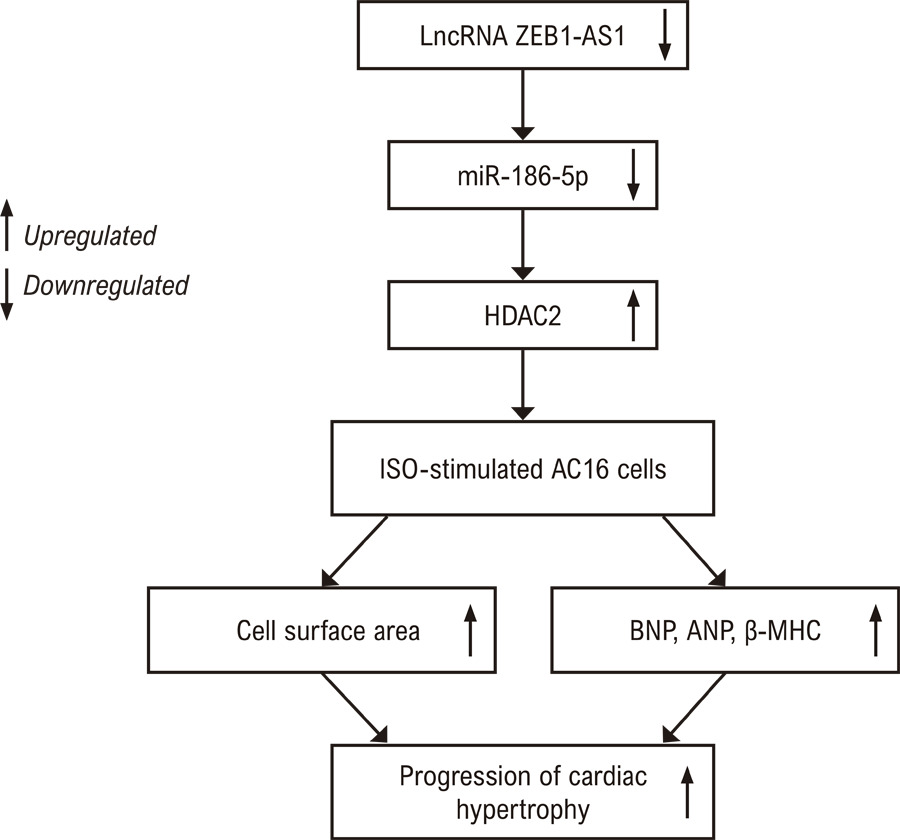
The expression of ZEB1-AS1 was upregulated in myocardial tissues and in isoproterenol (ISO)-stimulated AC16 cells. The knockdown of ZEB1-AS1 mitigated ISO-induced hypertrophic responses. Mechanistically, ZEB1-AS1 modulated histone deacetylase 2 (HDAC2) expression by acting as a molecular sponge for miR-186-5p. Consistently, the knockdown of ZEB1-AS1 reduced HDAC2 and decreased the expression of hypertrophic markers, including B-type natriuretic peptide, atrial natriuretic peptide, and β-myosin heavy chain, thereby restraining the progression of CH.

Conclusions

ZEB1-AS1 is upregulated in myocardial tissues and ISO-stimulated AC16 cells. Our findings indicate the ZEB1-AS1/miR-186-5p/HDAC2 axis contributes to CH, providing a mechanistic basis and potential therapeutic target for clinical intervention.

  • Cardiomegaly
  • Histone Deacetylase 2
  • Long Noncoding RNA
Read Full Article
Creative Commons Attribution (CC BY) Creative Commons license
16/01/2026 DOI: 10.36660/abc.20240703i Views 2
Transcriptome High-Throughput Sequencing Analysis of lncRNA and mRNA Expression in Patients with Coronary Slow Flow
ABC
Original Article

Transcriptome High-Throughput Sequencing Analysis of lncRNA and mRNA Expression in Patients with Coronary Slow Flow

Haibing Jiang et al. Yi Yang Xueqin Zhai Lijing Zhang Aerziya Kahaerjiang

Abstract

Background

Long non-coding RNAs (lncRNAs) and microRNAs (miRNAs) are believed to play key roles in the pathophysiology of coronary slow flow (CSF).

Objectives

This study aimed to explore the complex biological networks involved in CSF using whole-transcriptome sequencing, with the goal of identifying potential diagnostic biomarkers and therapeutic targets.

Methods

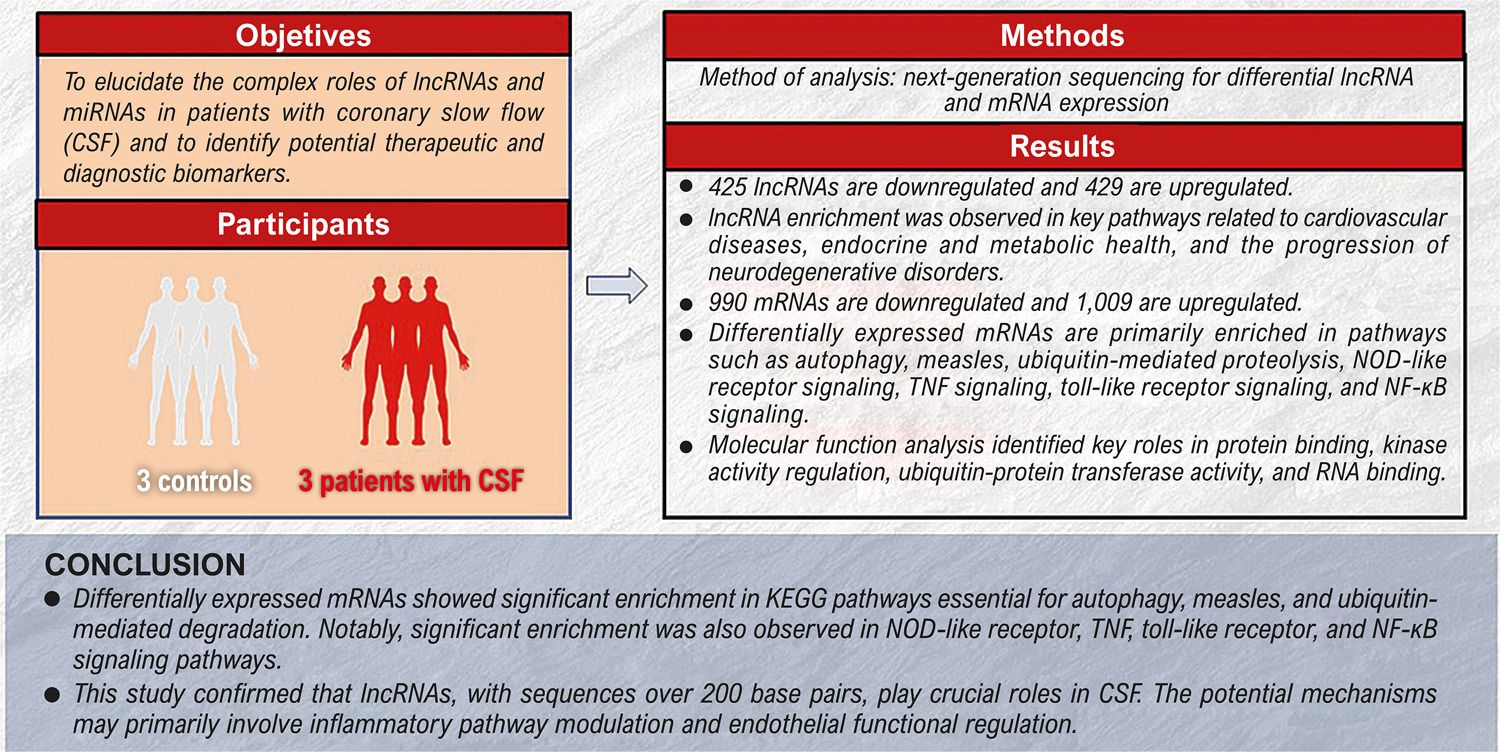
Whole-transcriptome sequencing was performed on samples from three patients with CSF and three matched control subjects. A p-value < 0.05 was considered statistically significant.

Results

A total of 854 lncRNAs were differentially expressed, with 425 downregulated and 429 upregulated. KEGG pathway analysis showed significant enrichment of lncRNAs in pathways associated with cardiovascular diseases, endocrine and metabolic disorders, and neurodegenerative disease progression. Additionally, 1,999 mRNAs were differentially expressed, including 990 downregulated and 1,009 upregulated. Molecular function analysis identified roles in protein binding, regulation of kinase activity, ubiquitin-protein transferase activity, and RNA binding. KEGG analysis indicated that the differentially expressed mRNAs were primarily involved in autophagy, measles, ubiquitin-mediated proteolysis, the NOD-like receptor signaling pathway, the tumor necrosis factor (TNF) signaling pathway, the toll-like receptor (TLR) signaling pathway, and the NF-κB signaling pathway.

Conclusions

Differentially expressed mRNAs were significantly enriched in KEGG pathways related to autophagy, measles, and ubiquitin-mediated degradation, as well as in signaling cascades involving NOD-like receptors, TNF, TLR, and NF-κB. Further studies are required to validate these findings.

  • High-Throughput Nucleotide Sequencing
  • Inflamação
  • Long Noncoding RNA
  • Messenger RNA
Read Full Article
Creative Commons Attribution (CC BY) Creative Commons license
29/09/2025 DOI: 10.36660/abc.20240847i Views 1
ABC
Editorial

Diabetic Cardiomyopathy: Unraveling Pathophysiological Mechanisms via Non-coding RNAs

Elida Paula Benquique Ojopi et al. Éder Anderson Rodrigues Gustavo Augusto Ferreira Mota Marina Politi Okoshi Luana Urbano Pagan

Diabetic cardiomyopathy (DCM) is a serious complication of diabetes mellitus (DM) characterized by changes that result in cardiac remodeling with ventricular dysfunction and eventually heart failure in the absence of other conditions such as arterial hypertension, valvular heart disease, coronary artery disease, and congenital heart disease. DCM develops independently of other cardiovascular risk factors and is associated with metabolic abnormalities, including hyperglycemia and hyperlipidemia. Multiple mechanisms contribute to DCM pathogenesis, such as impaired cardiac insulin signaling, mitochondrial dysfunction, oxidative stress, inflammation, and calcium handling defects. Despite its increasing prevalence, the underlying mechanisms of DCM remain largely unelucidated, and effective treatment is still needed.

Non-coding RNAs (ncRNAs) are transcriptional outputs that do not translate into proteins, exhibiting a diverse range of biogenesis, size, shape, and function. The most extensively studied ncRNAs are microRNAs (miRNAs) and long non-coding RNAs (lncRNAs). It has become a broadly accepted definition that ncRNAs over 200 nucleotides in length are classified as lncRNAs. miRNAs belong to a broader class of ncRNAs known as ‘small RNAs’, which are defined by their size (20–28 nucleotides) and association with Argonaute (Ago) family proteins. Small RNAs act as guides, directing Ago proteins to target nucleic acids to induce gene silencing. miRNAs and lncRNAs regulate various processes involved in DCM, including oxidative stress, inflammation, apoptosis, and autophagy. Therefore, they have been explored as potential biomarkers and therapeutic targets.,

[…]

  • Diabetic Cardiomyopathies
  • Long Noncoding RNA
  • MicroRNAs
Read Full Article
Creative Commons Attribution (CC BY) Creative Commons license
25/08/2025 DOI: 10.36660/abc.20250395i Views 1

How to cite this article

EndNote RIS

Electronic Document Format (Vancouver)

Giugni FR. LncRNA ZEB1-AS1: A New Player in Epigenetic Control of Cardiac Hypertrophy. Arquivos Brasileiros de Cardiologia 2026;122(11):e20250692.

Electronic Document Format (ABNT)

Giugni, Fernando R.. LncRNA ZEB1-AS1: A New Player in Epigenetic Control of Cardiac Hypertrophy. Arquivos Brasileiros de Cardiologia, v. 122, n. 11, e20250692, Jan. 2026.

Electronic Document Format (APA)

Giugni, F. R. (2026). LncRNA ZEB1-AS1: A New Player in Epigenetic Control of Cardiac Hypertrophy. Arquivos Brasileiros de Cardiologia, 122(11), e20250692.

Electronic Document Format (ISO)

Giugni, Fernando R.. LncRNA ZEB1-AS1: A New Player in Epigenetic Control of Cardiac Hypertrophy. Arquivos Brasileiros de Cardiologia [online]. 2026, vol. 122, n. 11, [cited 2026-10-14], e20250692. Available from: <https://journals.cardiol.br/en/article/lncrna-zeb1-as1-a-new-player-in-epigenetic-control-of-cardiac-hypertrophy/>. ISSN 0066-782X

EndNote RIS

Electronic Document Format (Vancouver)

Cao B, Liu Q, Zhang X, Wang Y. Knockdown of the Long Noncoding RNA ZEB1-AS1 Accelerates Cardiac Hypertrophy via the miR-186-5p/HDAC2 Pathway. Arquivos Brasileiros de Cardiologia 2026;122(11):e20240703.

Electronic Document Format (ABNT)

Cao, Bingfeng; Liu, Qingxia; Zhang, Xiaoyuan; Wang, Yufeng. Knockdown of the Long Noncoding RNA ZEB1-AS1 Accelerates Cardiac Hypertrophy via the miR-186-5p/HDAC2 Pathway. Arquivos Brasileiros de Cardiologia, v. 122, n. 11, e20240703, Jan. 2026.

Electronic Document Format (APA)

Cao, B., Liu, Q., Zhang, X., & Wang, Y. (2026). Knockdown of the Long Noncoding RNA ZEB1-AS1 Accelerates Cardiac Hypertrophy via the miR-186-5p/HDAC2 Pathway. Arquivos Brasileiros de Cardiologia, 122(11), e20240703.

Electronic Document Format (ISO)

Cao, Bingfeng and Liu, Qingxia and Zhang, Xiaoyuan and Wang, Yufeng. Knockdown of the Long Noncoding RNA ZEB1-AS1 Accelerates Cardiac Hypertrophy via the miR-186-5p/HDAC2 Pathway. Arquivos Brasileiros de Cardiologia [online]. 2026, vol. 122, n. 11, [cited 2026-10-14], e20240703. Available from: <https://journals.cardiol.br/en/article/knockdown-of-the-long-noncoding-rna-zeb1-as1-accelerates-cardiac-hypertrophy-via-the-mir-186-5p-hdac2-pathway/>. ISSN 0066-782X

EndNote RIS

Electronic Document Format (Vancouver)

Jiang H, Yang Y, Zhai X, Zhang L, Kahaerjiang A. Transcriptome High-Throughput Sequencing Analysis of lncRNA and mRNA Expression in Patients with Coronary Slow Flow. Arquivos Brasileiros de Cardiologia 2025;122(9):e20240847.

Electronic Document Format (ABNT)

Jiang, Haibing; Yang, Yi; Zhai, Xueqin; Zhang, Lijing; Kahaerjiang, Aerziya. Transcriptome High-Throughput Sequencing Analysis of lncRNA and mRNA Expression in Patients with Coronary Slow Flow. Arquivos Brasileiros de Cardiologia, v. 122, n. 9, e20240847, Sep. 2025.

Electronic Document Format (APA)

Jiang, H., Yang, Y., Zhai, X., Zhang, L., & Kahaerjiang, A. (2025). Transcriptome High-Throughput Sequencing Analysis of lncRNA and mRNA Expression in Patients with Coronary Slow Flow. Arquivos Brasileiros de Cardiologia, 122(9), e20240847.

Electronic Document Format (ISO)

Jiang, Haibing and Yang, Yi and Zhai, Xueqin and Zhang, Lijing and Kahaerjiang, Aerziya. Transcriptome High-Throughput Sequencing Analysis of lncRNA and mRNA Expression in Patients with Coronary Slow Flow. Arquivos Brasileiros de Cardiologia [online]. 2025, vol. 122, n. 9, [cited 2026-10-14], e20240847. Available from: <https://journals.cardiol.br/en/article/transcriptome-high-throughput-sequencing-analysis-of-lncrna-and-mrna-expression-in-patients-with-coronary-slow-flow/>. ISSN 0066-782X

EndNote RIS

Electronic Document Format (Vancouver)

Ojopi EPB, Rodrigues A, Mota GAF, Okoshi MP, Pagan LU. Diabetic Cardiomyopathy: Unraveling Pathophysiological Mechanisms via Non-coding RNAs. Arquivos Brasileiros de Cardiologia 2025;122(7):e20250395.

Electronic Document Format (ABNT)

Ojopi, Elida Paula Benquique; Rodrigues, Éder Anderson; Mota, Gustavo Augusto Ferreira; Okoshi, Marina Politi; Pagan, Luana Urbano. Diabetic Cardiomyopathy: Unraveling Pathophysiological Mechanisms via Non-coding RNAs. Arquivos Brasileiros de Cardiologia, v. 122, n. 7, e20250395, Aug. 2025.

Electronic Document Format (APA)

Ojopi, E. P. B., Rodrigues, A., Mota, G. A. F., Okoshi, M. P., & Pagan, L. U. (2025). Diabetic Cardiomyopathy: Unraveling Pathophysiological Mechanisms via Non-coding RNAs. Arquivos Brasileiros de Cardiologia, 122(7), e20250395.

Electronic Document Format (ISO)

Ojopi, Elida Paula Benquique and Rodrigues, Éder Anderson and Mota, Gustavo Augusto Ferreira and Okoshi, Marina Politi and Pagan, Luana Urbano. Diabetic Cardiomyopathy: Unraveling Pathophysiological Mechanisms via Non-coding RNAs. Arquivos Brasileiros de Cardiologia [online]. 2025, vol. 122, n. 7, [cited 2026-10-14], e20250395. Available from: <https://journals.cardiol.br/en/article/diabetic-cardiomyopathy-unraveling-pathophysiological-mechanisms-via-non-coding-rnas/>. ISSN 0066-782X

  • About ABC Family
  • Internal Regulation
  • Editorial Board
  • Brazilian Society of Cardiology (SBC)

Issues

SBC Guidelines

  • Videos
  • Podcasts
  • News