Abstract
Background
Alcohol septal ablation (ASA) is an alternative to surgical myectomy for patients with symptomatic hypertrophic obstructive cardiomyopathy (HOCM) and significant left ventricular (LV) outflow tract (LVOT) obstruction. Although widely studied worldwide, data on ASA outcomes in Brazil are still limited.
Objective
To assess the safety and effectiveness of ASA in symptomatic HOCM patients receiving optimal medical therapy using current techniques across multiple centers in Brazil.
Methods
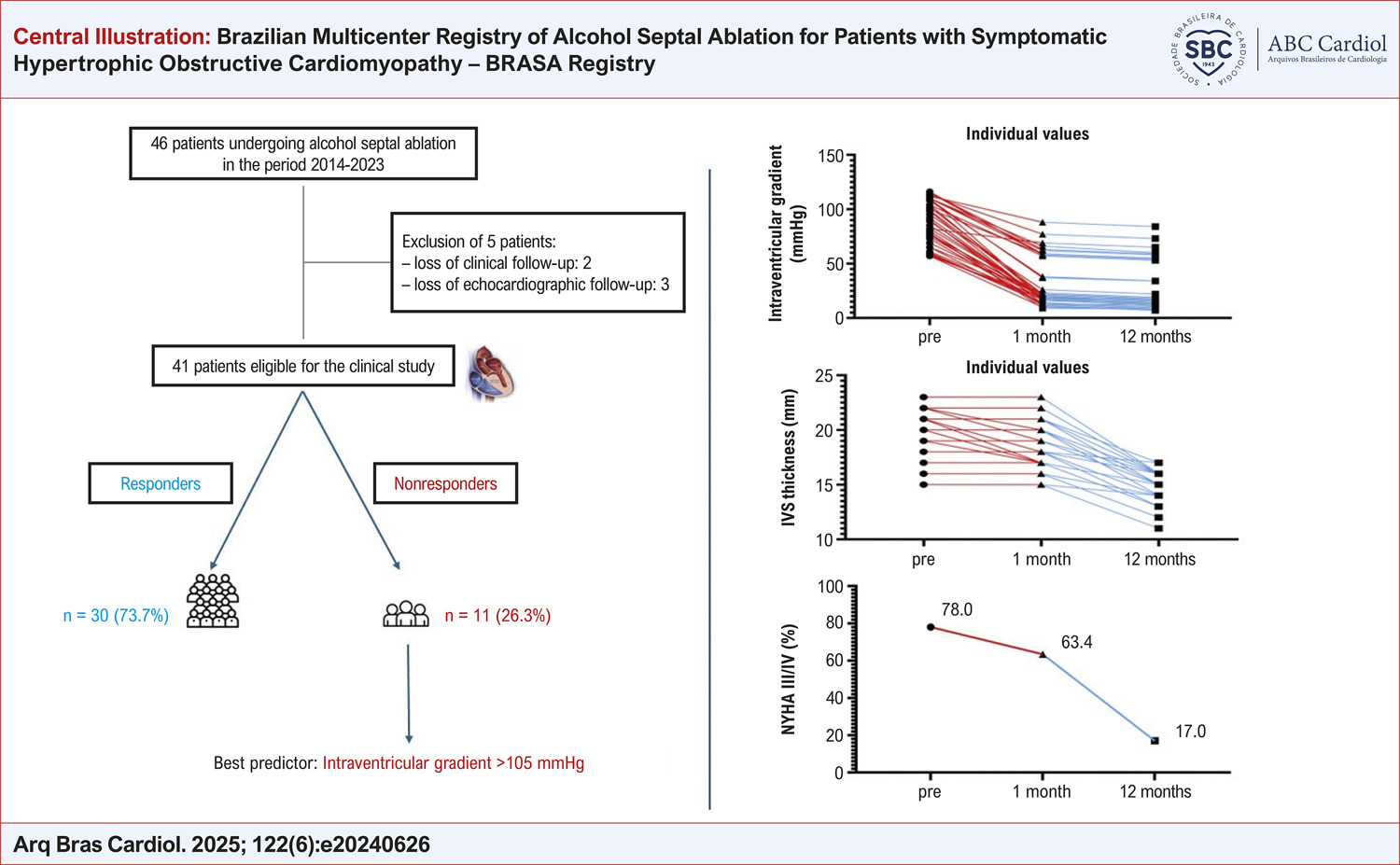
Patients with HOCM and angina (classified by the Canadian Cardiovascular Society [CCS]) or dyspnea (classified by the New York Heart Association [NYHA]) class >II who did not respond to optimal medical treatment were included. The primary efficacy endpoint was defined as a reduction of more than 50% in the maximum resting LVOT gradient, with a final gradient <50 mmHg. Patients were classified as responders or nonresponders. A p-value <0.05 was considered statistically significant.
Results
A total of 41 patients (median age 66.4 years; 73% female) underwent ASA. At baseline, 93.2% were in NYHA class III/IV or CCS class III/IV. The mean LV ejection fraction (LVEF) was 66.4%, and the mean LVOT gradient was 88.4 mmHg. After 12 months, 92.8% had improved to NYHA class I/II or CCS class I/II (p<0.01). The mean LVOT gradient dropped from 88.4 mmHg to 27.0 mmHg (p=0.003), and interventricular septum (IVS) thickness decreased from 19.3 mm to 14.7 mm (p=0.048). Responders had lower baseline gradients (73.4 vs 112.6 mmHg, p=0.04) and fewer hospitalizations (21.1% vs 82.4%, p=0.04). Complete atrioventricular block occurred in 16.7% of patients, and 4.8% required pacemakers. No deaths were reported during a median follow-up of 394 days. At the last in-person evaluation, 78.4% were in functional class I/II.
Conclusions
ASA is a safe, effective option for relieving symptoms in selected HOCM patients. It reduces LVOT gradient and septal thickness. Patients with higher baseline gradients were less likely to respond to the procedure.