ABC Family Arquivos Brasileiros de Cardiologia International Journal of Cardiovascular Sciences ABC Heart Failure & Cardiomyopathy ABC Imagem Cardiovascular
Português English
ABC Family
Português English
  • About
    • About ABC Family
    • Internal Regulation
    • Editorial Board
    • Brazilian Society of Cardiology (SBC)
  • Issues
  • SBC Guidelines
  • Content
    • Videos
    • Podcasts
    • News
  • About
    • About ABC Family
    • Internal Regulation
    • Editorial Board
    • Brazilian Society of Cardiology (SBC)
  • Issues
  • SBC Guidelines
  • Content
    • Videos
    • Podcasts
    • News

ABC Family

  • ABC Family
  • Arquivos Brasileiros de Cardiologia
  • International Journal of Cardiovascular Sciences
  • ABC Heart Failure & Cardiomyopathy
  • ABC Imagem Cardiovascular
Search in

No content found.

Journals
Ordering
Article types
Others

  1. Home
  2. Keyword: Clinical Competence
ABC
Editorial

Retention of Cardiopulmonary Resuscitation Skills in Medical Students: What Can Be Done to Improve Them?

Sergio Timerman et al. Thatiane Facholi Polatri

Since the beginning, great researchers have been working on estimating the best technique for maintaining the body blood flow of a victim undergoing CPA. Several techniques were applied, such as the Trotting method and rolling over a barrel. The technique of external chest compressions was conceived in 1960, based on the observation made by Kouwenhoven, Jude, and Knickerbocker that adequate compression on the lower third of the sternum provided sufficient artificial circulation to sustain life in animals and humans with cardiac arrest. Since then, many studies have been carried out to improve the depth and frequency of appropriate compressions to maintain coronary perfusion at an adequate level, contributing to the return of spontaneous circulation.

According to the 2020 worldwide guidelines publications, performing high-quality compressions refers to performing compressions at a frequency of 100 -120 per minute, depth of 5-6cm, returning the chest to the normal position between compression minimize interruptions in compressions avoiding excessive ventilation. In this sense, a big question arises: do we understand the parameters for performing good compressions, which significantly increase the survival of CPA victims? However, how to ensure that health professionals and the general public can learn the technique and retain this learning to the point of reproducing it in an actual emergency?

[…]

  • Cardiopulmonary Resuscitation/methods
  • Clinical Competence
  • Health Occupations/education
  • Medicine
  • Professional Training
  • Students, Health Occupational
Read Full Article
Creative Commons Attribution (CC BY) Creative Commons license
22/11/2021 DOI: 10.36660/abc.20210856 Views 1
Figure 1
ABC
Original Article

Clinical Competence in ST-segment Elevation Myocardial Infarction Management by Recently Graduated Physicians Applying for a Medical Residency Program

Ugo Stocco Aimoli et al. Carlos Henrique Miranda

Abstract

Background:

A significant reduction in the morbidity and mortality related to ST-segment elevation myocardial infarction (STEMI) has been achieved with the development of reperfusion therapies. Early diagnosis and correct initial management are important to ensure this benefit. In Brazil, recent graduates in medicine are responsible for a large part of the initial care provided for these patients.

Objective:

To assess the clinical competence in the diagnosis and initial treatment of STEMI by newly graduated physicians applying for a medical residency program.

Methods:

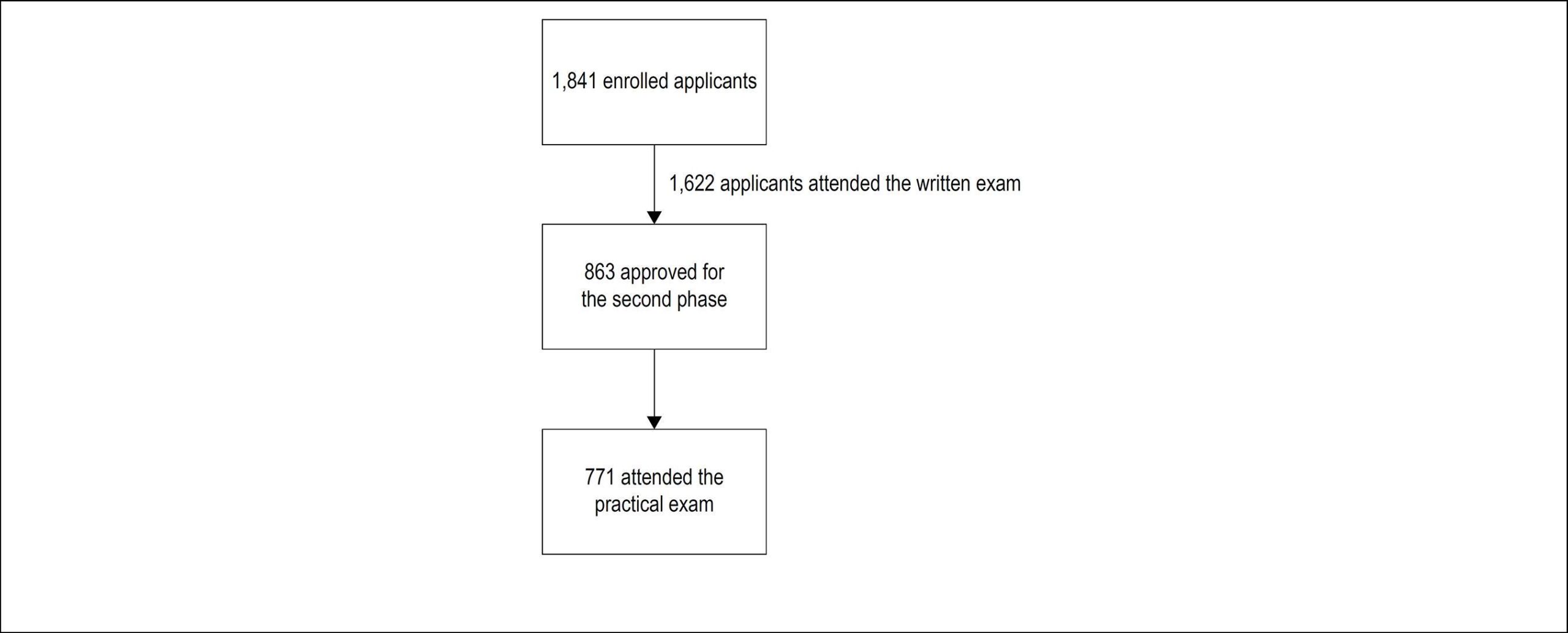
We assessed the performance of 771 applicants for the direct entry selection process of the FMRP-USP Clinical Hospital Medicine Residency Program, performed in a simulated setting of STEMI, with professional actors and medical evaluators, using a standardized checklist following the recommendations of the Brazilian Guidelines for the management of this disease.

Results:

The general performance score presented a median of 7 and an interquartile range of 5.5-8.0. In relation to the items assessed: 83% required ECG monitoring, 57% requested the insertion of a peripheral venous access catheter, 95% administered acetylsalicylic acid, 80% administered a second antiplatelet agent (p2y12 inhibitor), 66% administered nitrate, 71% administered morphine, 69% recognized the diagnosis of STEMI, 71% assessed the pain duration, 63% recognized the need for immediate transfer, 34% showed adequate communication skills and only 25% insisted on the transfer even in case of non-availability of beds.

Conclusions:

The initial diagnosis and management of STEMI need to be improved in medical undergraduate courses and inserted into the reality of the hierarchical network structure of the Brazilian Unified Health System (SUS).

  • Clinical Competence
  • Education, Medical
  • Internship and Residence
  • Medical Staff, Hospital
  • ST Elevation Myocardial Infarction
Read Full Article
Creative Commons Attribution (CC BY) Creative Commons license
10/02/2020 DOI: 10.36660/abc.20180309 Views 1

How to cite this article

EndNote RIS

Electronic Document Format (Vancouver)

Timerman S, Polatri TF. Retention of Cardiopulmonary Resuscitation Skills in Medical Students: What Can Be Done to Improve Them?. Arquivos Brasileiros de Cardiologia 2021;117(5):1036-7.

Electronic Document Format (ABNT)

Timerman, Sergio; Polatri, Thatiane Facholi. Retention of Cardiopulmonary Resuscitation Skills in Medical Students: What Can Be Done to Improve Them?. Arquivos Brasileiros de Cardiologia, v. 117, n. 5, p. 1036-1037, Nov. 2021.

Electronic Document Format (APA)

Timerman, S., & Polatri, T. F. (2021). Retention of Cardiopulmonary Resuscitation Skills in Medical Students: What Can Be Done to Improve Them?. Arquivos Brasileiros de Cardiologia, 117(5), 1036-1037.

Electronic Document Format (ISO)

Timerman, Sergio and Polatri, Thatiane Facholi. Retention of Cardiopulmonary Resuscitation Skills in Medical Students: What Can Be Done to Improve Them?. Arquivos Brasileiros de Cardiologia [online]. 2021, vol. 117, n. 5, [cited 2026-10-14], pp. 1036-1037. Available from: <https://journals.cardiol.br/en/article/retention-of-cardiopulmonary-resuscitation-skills-in-medical-students-what-can-be-done-to-improve-them/>. ISSN 0066-782X

EndNote RIS

Electronic Document Format (Vancouver)

Aimoli US, Miranda CH. Clinical Competence in ST-segment Elevation Myocardial Infarction Management by Recently Graduated Physicians Applying for a Medical Residency Program. Arquivos Brasileiros de Cardiologia 2020;114(1):35-44.

Electronic Document Format (ABNT)

Aimoli, Ugo Stocco; Miranda, Carlos Henrique. Clinical Competence in ST-segment Elevation Myocardial Infarction Management by Recently Graduated Physicians Applying for a Medical Residency Program. Arquivos Brasileiros de Cardiologia, v. 114, n. 1, p. 35-44, Feb. 2020.

Electronic Document Format (APA)

Aimoli, U. S., & Miranda, C. H. (2020). Clinical Competence in ST-segment Elevation Myocardial Infarction Management by Recently Graduated Physicians Applying for a Medical Residency Program. Arquivos Brasileiros de Cardiologia, 114(1), 35-44.

Electronic Document Format (ISO)

Aimoli, Ugo Stocco and Miranda, Carlos Henrique. Clinical Competence in ST-segment Elevation Myocardial Infarction Management by Recently Graduated Physicians Applying for a Medical Residency Program. Arquivos Brasileiros de Cardiologia [online]. 2020, vol. 114, n. 1, [cited 2026-10-14], pp. 35-44. Available from: <https://journals.cardiol.br/en/article/clinical-competence-in-st-segment-elevation-myocardial-infarction-management-by-recently-graduated-physicians-applying-for-a-medical-residency-program/>. ISSN 0066-782X

  • About ABC Family
  • Internal Regulation
  • Editorial Board
  • Brazilian Society of Cardiology (SBC)

Issues

SBC Guidelines

  • Videos
  • Podcasts
  • News