ABC Family Arquivos Brasileiros de Cardiologia International Journal of Cardiovascular Sciences ABC Heart Failure & Cardiomyopathy ABC Imagem Cardiovascular
Português English
ABC Family
Português English
  • About
    • About ABC Family
    • Internal Regulation
    • Editorial Board
    • Brazilian Society of Cardiology (SBC)
  • Issues
  • SBC Guidelines
  • Content
    • Videos
    • Podcasts
    • News
  • About
    • About ABC Family
    • Internal Regulation
    • Editorial Board
    • Brazilian Society of Cardiology (SBC)
  • Issues
  • SBC Guidelines
  • Content
    • Videos
    • Podcasts
    • News

ABC Family

  • ABC Family
  • Arquivos Brasileiros de Cardiologia
  • International Journal of Cardiovascular Sciences
  • ABC Heart Failure & Cardiomyopathy
  • ABC Imagem Cardiovascular
Search in

No content found.

Journals
Ordering
Article types
Others

  1. Home
  2. Keyword: Heme
ABC
Editorial

Influence of Doxorubicin Treatment on Heme Metabolism in Cardiomyoblasts: An In Vitro Study

Mariana Gatto et al. Gustavo Augusto Ferreira Mota

The last decades have been marked with potential advances in cancer diagnosis and therapy, leading to a decrease in mortality and increased patient survival. Doxorubicin is a drug that belongs to the anthracycline family, a class of anticancer drugs extracted from streptomycin. Although the mechanism of action of this drug in cancer is complex, it is known that it interferes with the synthesis of DNA and RNA in addition to inducing the production of free radicals that damage the cell membrane and DNA. However, many of the chemotherapeutic agents used in the neoplasms treatment protocols induce several side effects, including cardiac toxicity and negative repercussions in the vascular system such as thrombolytic ischemia, arterial hypertension, ventricular dysfunction and heart failure., The cardiotoxic effect of doxorubicin is dose-dependent, and the primary mechanism of toxicity is the induction of oxidative stress in the myocardium, with high production of reactive oxygen (ROS) and nitrogen (RNS) species that trigger DNA damage and deregulation of various processes intracellular.

The heme molecule mediates the iron availability and is essential for numerous biological processes in aerobic organisms. In the cardiovascular system, it plays a crucial role in antioxidant defense, signal transduction, oxygen transport, hemoglobin storage, and mitochondrial electron transport. Four mitochondrial and four cytoplasmic enzymes participate in heme metabolism. For heme synthesis, glycine and succinyl coenzyme A are condensed into δ-aminolevulinic acid (ALA) by the enzymes aminolevulinic acid synthases (ALAS), known as ALAS1 and ALAS2. The degradation of heme is carried out by enzymes called heme oxygenase (HOX), which produces carbon monoxide, biliverdin, and iron. HOX-1 isoenzyme regulates normal physiological conditions while HOX-2 isoenzyme protects the cells from oxidative stress. On the other hand, experimental studies have shown that elevated heme protein levels are related to increased oxidative stress and toxicity in cardiomyocytes., However, few studies in the literature verified the influence of anthracyclines on heme protein metabolism in cardiomyocytes.

[…]
  • Anthracyclines
  • Doxorubicin/therapeutic use
  • Heme
  • Hemoglobin E/metabolism
  • Myocytes, Cardiac
Read Full Article
Creative Commons Attribution (CC BY) Creative Commons license
01/03/2021 DOI: 10.36660/abc.20200662 Views 1
Figure 1
ABC
Original Article

Effects of Doxorubicin on Heme Biosynthesis and Metabolism in Cardiomyocyte

Zuoyan Wang et al. Junyi Gao Haobo Teng Jianjun Peng

Abstract

Background

Doxorubicin is associated with cardiotoxicity and late cardiac morbidity. Heme is related to cellular oxidative stress. However, its specific regulation in cardiomyocytes under doxorubicin effects has not yet been documented.

Objective

This study seeks to evaluate the changing profiles of rate-limiting enzymes in the heme metabolism pathway under the effect of doxorubicin.

Methods

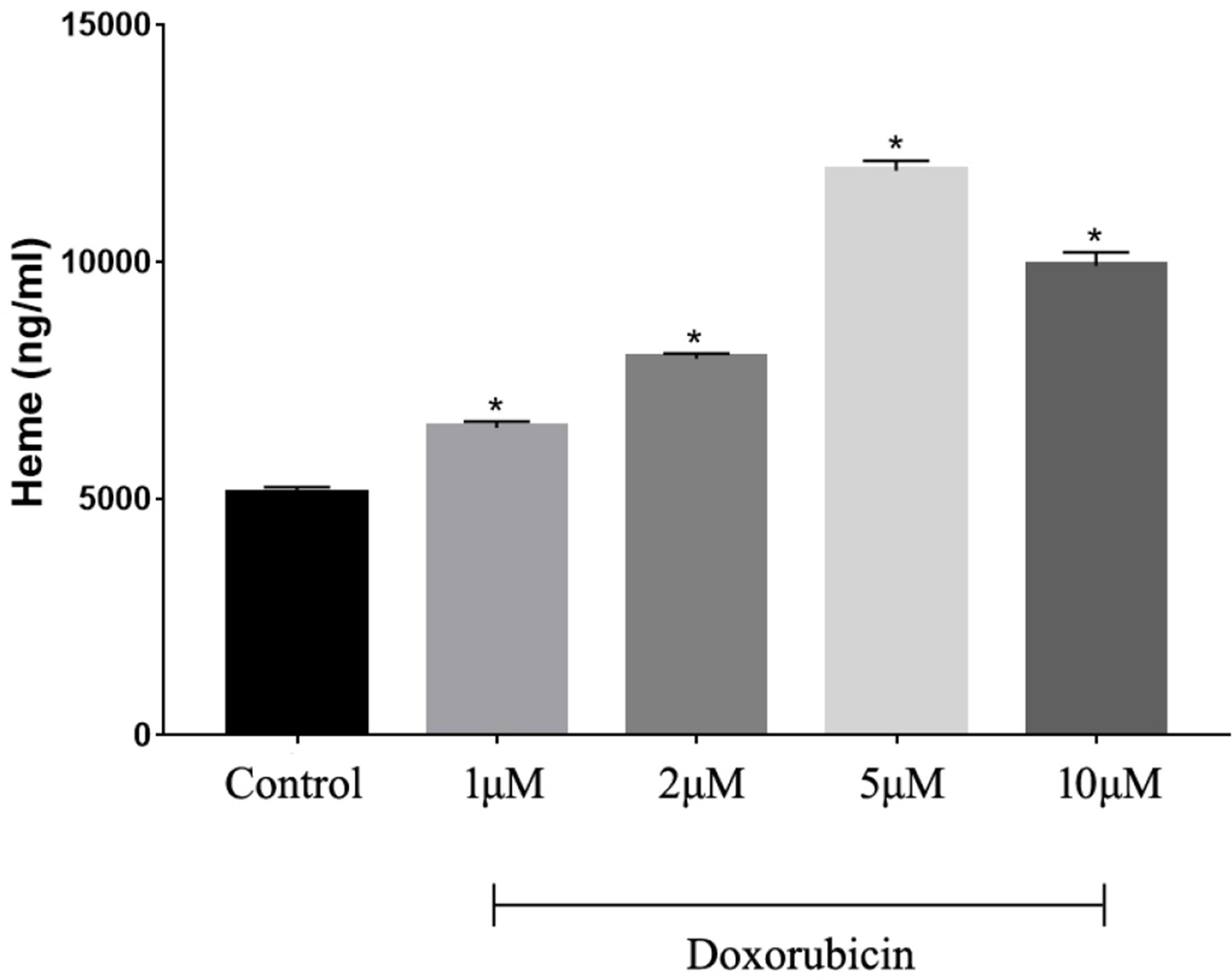
H9c2 cardiomyocytes were incubated with doxorubicin at different concentrations (1,2,5,10μM respectively). The real-time PCR and Western Blot were used to determine the mRNA and protein expression for four pivotal enzymes (ALAS1, ALAS2, HOX-1, and HOX-2) regulating cellular heme metabolism, as well as the levels of heme were detected by ELISA. p<0.01 was considered significant.

Results

This study observed a dose-dependent changing pattern in heme levels in H9c2 cells with the highest level at the 5μM concentration for doxorubicin, which occurred synchronously with the highest upregulation level of ALAS1, as well as the degradative enzymes, HOX-1, and HOX-2 in mRNA and protein expression. By contrast, ALAS2, contrary to the increasing concentrations of doxorubicin, was found to be progressively down-regulated.

Conclusion

The increase in ALAS1 expression may play a potential role in the heme level elevation when H9c2 cardiomyocyte was exposed to doxorubicin and may be a potential therapeutic target for doxorubicin-induced myocardial toxicity. (Arq Bras Cardiol. 2021; 116(2):315-322)

  • ALAS
  • Biosynthesis
  • Cardiotoxicity
  • Doxorubicin
  • Heme
  • Myocites, Cardiac
Read Full Article
Creative Commons Attribution (CC BY) Creative Commons license
01/03/2021 DOI: 10.36660/abc.20190437 Views 3

How to cite this article

EndNote RIS

Electronic Document Format (Vancouver)

Gatto M, Mota GAF. Influence of Doxorubicin Treatment on Heme Metabolism in Cardiomyoblasts: An In Vitro Study. Arquivos Brasileiros de Cardiologia 2021;116(2):323-4.

Electronic Document Format (ABNT)

Gatto, Mariana; Mota, Gustavo Augusto Ferreira. Influence of Doxorubicin Treatment on Heme Metabolism in Cardiomyoblasts: An In Vitro Study. Arquivos Brasileiros de Cardiologia, v. 116, n. 2, p. 323-324, Feb. 2021.

Electronic Document Format (APA)

Gatto, M., & Mota, G. A. F. (2021). Influence of Doxorubicin Treatment on Heme Metabolism in Cardiomyoblasts: An In Vitro Study. Arquivos Brasileiros de Cardiologia, 116(2), 323-324.

Electronic Document Format (ISO)

Gatto, Mariana and Mota, Gustavo Augusto Ferreira. Influence of Doxorubicin Treatment on Heme Metabolism in Cardiomyoblasts: An In Vitro Study. Arquivos Brasileiros de Cardiologia [online]. 2021, vol. 116, n. 2, [cited 2026-10-14], pp. 323-324. Available from: <https://journals.cardiol.br/en/article/influence-of-doxorubicin-treatment-on-heme-metabolism-in-cardiomyoblasts-an-in-vitro-study/>. ISSN 0066-782X

EndNote RIS

Electronic Document Format (Vancouver)

Wang Z, Gao J, Teng H, Peng J. Effects of Doxorubicin on Heme Biosynthesis and Metabolism in Cardiomyocyte. Arquivos Brasileiros de Cardiologia 2021;116(2):315-22.

Electronic Document Format (ABNT)

Wang, Zuoyan; Gao, Junyi; Teng, Haobo; Peng, Jianjun. Effects of Doxorubicin on Heme Biosynthesis and Metabolism in Cardiomyocyte. Arquivos Brasileiros de Cardiologia, v. 116, n. 2, p. 315-322, Feb. 2021.

Electronic Document Format (APA)

Wang, Z., Gao, J., Teng, H., & Peng, J. (2021). Effects of Doxorubicin on Heme Biosynthesis and Metabolism in Cardiomyocyte. Arquivos Brasileiros de Cardiologia, 116(2), 315-322.

Electronic Document Format (ISO)

Wang, Zuoyan and Gao, Junyi and Teng, Haobo and Peng, Jianjun. Effects of Doxorubicin on Heme Biosynthesis and Metabolism in Cardiomyocyte. Arquivos Brasileiros de Cardiologia [online]. 2021, vol. 116, n. 2, [cited 2026-10-14], pp. 315-322. Available from: <https://journals.cardiol.br/en/article/effects-of-doxorubicin-on-heme-biosynthesis-and-metabolism-in-cardiomyocyte/>. ISSN 0066-782X

  • About ABC Family
  • Internal Regulation
  • Editorial Board
  • Brazilian Society of Cardiology (SBC)

Issues

SBC Guidelines

  • Videos
  • Podcasts
  • News