ABC Family Arquivos Brasileiros de Cardiologia International Journal of Cardiovascular Sciences ABC Heart Failure & Cardiomyopathy ABC Imagem Cardiovascular
Português English
ABC Family
Português English
  • About
    • About ABC Family
    • Internal Regulation
    • Editorial Board
    • Brazilian Society of Cardiology (SBC)
  • Issues
  • SBC Guidelines
  • Content
    • Videos
    • Podcasts
    • News
  • About
    • About ABC Family
    • Internal Regulation
    • Editorial Board
    • Brazilian Society of Cardiology (SBC)
  • Issues
  • SBC Guidelines
  • Content
    • Videos
    • Podcasts
    • News

ABC Family

  • ABC Family
  • Arquivos Brasileiros de Cardiologia
  • International Journal of Cardiovascular Sciences
  • ABC Heart Failure & Cardiomyopathy
  • ABC Imagem Cardiovascular
Search in

No content found.

Journals
Ordering
Article types
Others

  1. Home
  2. Keyword: Glycosphingolipids
Figure 1
ABCIC
Review Article

My Approach to Diagnose Fabry Disease

Sandra Marques e Silva

Abstract

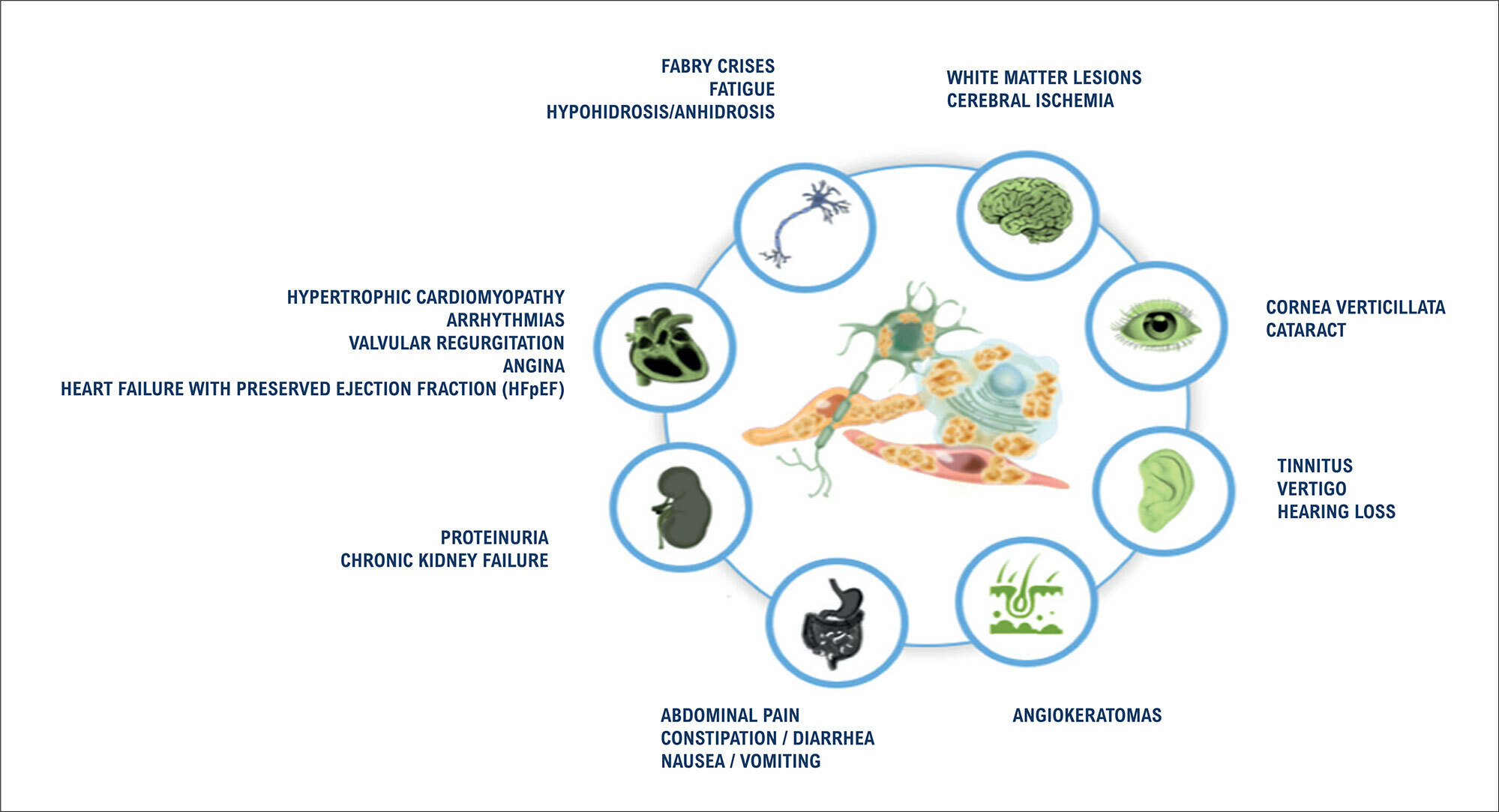
Fabry disease (FD) is an inherited lysosomal storage disorder caused by a deficiency of the enzyme alpha-galactosidase A (α-Gal A). This enzymatic defect leads to the cytoplasmic lysosomal accumulation of globotriaosylceramides (GB3 and LysoGB3), resulting in multisystemic clinical manifestations. Cardiovascular involvement, often mimicking hypertrophic cardiomyopathy, is the main determinant of morbidity and mortality, due to the development of arrhythmia, myocardial ischemia, and heart failure. Although FD is a rare condition in the general population, the availability of specific enzyme replacement therapy, which can alter the natural course of the disease, underscores the importance of including FD as a key differential diagnosis among storage cardiomyopathies. Diagnostic evaluation should encompass a thorough clinical assessment, with particular attention to patient history and physical examination, complemented by laboratory testing and imaging studies, such as electrocardiography and echocardiography. Cardiac magnetic resonance imaging, including late gadolinium enhancement and T1 and T2 parametric mapping, provides additional diagnostic and prognostic information and should ideally be performed at the time of initial diagnosis. Definitive diagnosis is established by genetic sequencing of the GLA gene, located on the long arm of the X chromosome, enabling the selection of the most appropriate therapeutic strategy for each patient.

  • Fabry Disease
  • Glycosphingolipids
  • Hypertrophic Cardiomyopathy
Read Full Article
Creative Commons Attribution (CC BY) Creative Commons license
01/07/2025 DOI: 10.36660/abcimg.20240091i
Figure 1
ABC
Original Article

GLA Gene Mutation in Hypertrophic Cardiomyopathy with a New Variant Description: Is it Fabry's Disease?

Ândrea Virgínia Chaves-Markman et al. Manuel Markman Eveline Barros Calado Ricardo Flores Pires … Marcelo Antônio Oliveira Santos-Veloso Catarina Maria Fonseca Pereira Andréa Bezerra de Melo da Silveira Lordsleem Sandro Gonçalves de Lima Brivaldo Markman Filho Dinaldo Cavalcanti de Oliveira

Abstract

Background:

Fabry disease (FD) is an X-linked lysosomal storage disorder caused by mutations in the alpha galactosidase A gene (GLA) that lead to the enzymatic deficiency of alpha galactosidase (α-Gal A), resulting in the accumulation of globotriaosylceramide (Gb3) and globotriaosylsphingosine (lyso-Gb3), causing multiple organ dysfunctions.

Objective:

To perform GLA gene screening in a group of patients with echocardiographic diagnosis of hypertrophic cardiomyopathy (HCM).

Methods:

a cross-sectional study was conducted with HCM patients from a university hospital. Patients with coronary artery disease and valvulopathies were excluded. Mutation analysis of the GLA gene was performed. In male subjects, the analysis was performed after evidence of low α-Gal A activity.

Results:

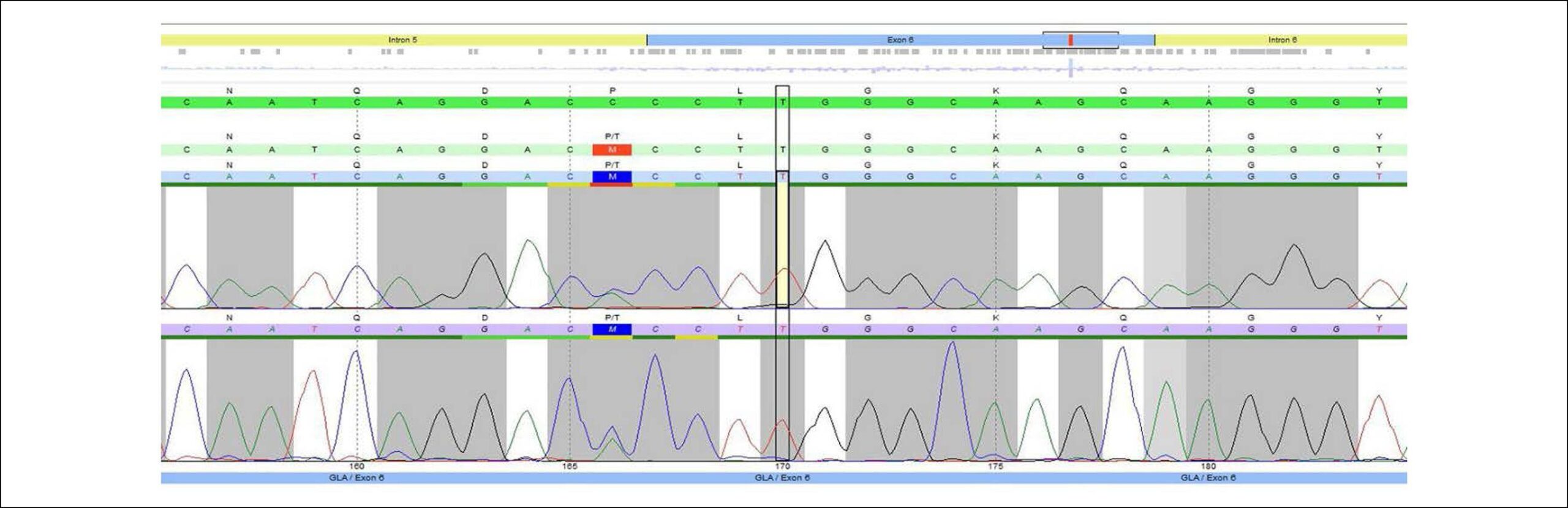
60 patients with echocardiographic diagnosis of HCM were included. Age ranged from 12 to 85 years and 60% were women. Mean myocardial fibrosis percentage on MRI was 10.7 ± 13.1% and mean ventricular thickness was18.7 ± 6.7 mm. Four patients had the following GLA gene mutations: c.967C>A (p.Pro323Thr), not yet described in the literature; c.937G>T (p.Asp313Tyr); and c.352C>T (p.Arg118Cys). All patients had normal levels of lyso-Gb3 and non-ischemic myocardial fibrosis on magnetic resonance imaging; one patient had proteinuria and one patient had ventricular tachycardia.

Conclusion:

in this study, the frequency of mutation in the GLA gene in patients with HCM was 6.7%. A novel mutation in exon 6 of the GLA gene, c.967C>A (p.Pro323Thr), was identified. Patients with HCM may have GLA mutations and FD should be ruled out. Plasma (lyso-Gb3) levels do not seem to be sufficient to attain a diagnosis and organ biopsy should be considered.

  • Cardiomyopathy, Hypertrophic
  • Fabry Disease/genetic
  • Glycosphingolipids
  • Hypertrophy Left Ventricular
Read Full Article
Creative Commons Attribution (CC BY) Creative Commons license
10/07/2019 DOI: 10.5935/abc.20190112 Views 2

How to cite this article

EndNote RIS

Electronic Document Format (Vancouver)

Silva SM. My Approach to Diagnose Fabry Disease. ABC Imagem Cardiovascular 2025;38(2):e20240091.

Electronic Document Format (ABNT)

Silva, Sandra Marques e. My Approach to Diagnose Fabry Disease. ABC Imagem Cardiovascular, v. 38, n. 2, e20240091, Jun. 2025.

Electronic Document Format (APA)

Silva, S. M. (2025). My Approach to Diagnose Fabry Disease. ABC Imagem Cardiovascular, 38(2), e20240091.

Electronic Document Format (ISO)

Silva, Sandra Marques e. My Approach to Diagnose Fabry Disease. ABC Imagem Cardiovascular [online]. 2025, vol. 38, n. 2, [cited 2026-10-14], e20240091. Available from: <https://journals.cardiol.br/en/article/my-approach-to-diagnose-fabry-disease/>. ISSN 2318-8219

EndNote RIS

Electronic Document Format (Vancouver)

Chaves-Markman V, Markman M, Calado EB, Pires RF, Santos-Veloso MAO, Pereira CMF, Lordsleem ABMS, et al. GLA Gene Mutation in Hypertrophic Cardiomyopathy with a New Variant Description: Is it Fabry’s Disease?. Arquivos Brasileiros de Cardiologia 2019;113(1):77-84.

Electronic Document Format (ABNT)

Chaves-Markman, Ândrea Virgínia; Markman, Manuel; Calado, Eveline Barros; Pires, Ricardo Flores; Santos-Veloso, Marcelo Antônio Oliveira; Pereira, Catarina Maria Fonseca; Lordsleem, Andréa Bezerra de Melo da Silveira; Lima, Sandro Gonçalves de; Markman Filho, Brivaldo; Oliveira, Dinaldo Cavalcanti de. GLA Gene Mutation in Hypertrophic Cardiomyopathy with a New Variant Description: Is it Fabry’s Disease?. Arquivos Brasileiros de Cardiologia, v. 113, n. 1, p. 77-84, Jul. 2019.

Electronic Document Format (APA)

Chaves-Markman, V., Markman, M., Calado, E. B., Pires, R. F., Santos-Veloso, M. A. O., Pereira, C. M. F., Lordsleem, A. B. M. S., Lima, S. G. , Markman Filho, B., & Oliveira, D. C. (2019). GLA Gene Mutation in Hypertrophic Cardiomyopathy with a New Variant Description: Is it Fabry’s Disease?. Arquivos Brasileiros de Cardiologia, 113(1), 77-84.

Electronic Document Format (ISO)

Chaves-Markman, Ândrea Virgínia and Markman, Manuel and Calado, Eveline Barros and Pires, Ricardo Flores and Santos-Veloso, Marcelo Antônio Oliveira and Pereira, Catarina Maria Fonseca and Lordsleem, Andréa Bezerra de Melo da Silveira and Lima, Sandro Gonçalves de and Markman Filho, Brivaldo and Oliveira, Dinaldo Cavalcanti de. GLA Gene Mutation in Hypertrophic Cardiomyopathy with a New Variant Description: Is it Fabry’s Disease?. Arquivos Brasileiros de Cardiologia [online]. 2019, vol. 113, n. 1, [cited 2026-10-14], pp. 77-84. Available from: <https://journals.cardiol.br/en/article/gla-gene-mutation-in-hypertrophic-cardiomyopathy-with-a-new-variant-description-is-it-fabrys-disease/>. ISSN 0066-782X

  • About ABC Family
  • Internal Regulation
  • Editorial Board
  • Brazilian Society of Cardiology (SBC)

Issues

SBC Guidelines

  • Videos
  • Podcasts
  • News