João Manoel Rossi Neto et al. Raphael Machado Rossi Victor B. M. Mattos Plinio J. W. Wolf … Marco Aurelio A. Finger Carolina Casadei dos Santos
Abstract
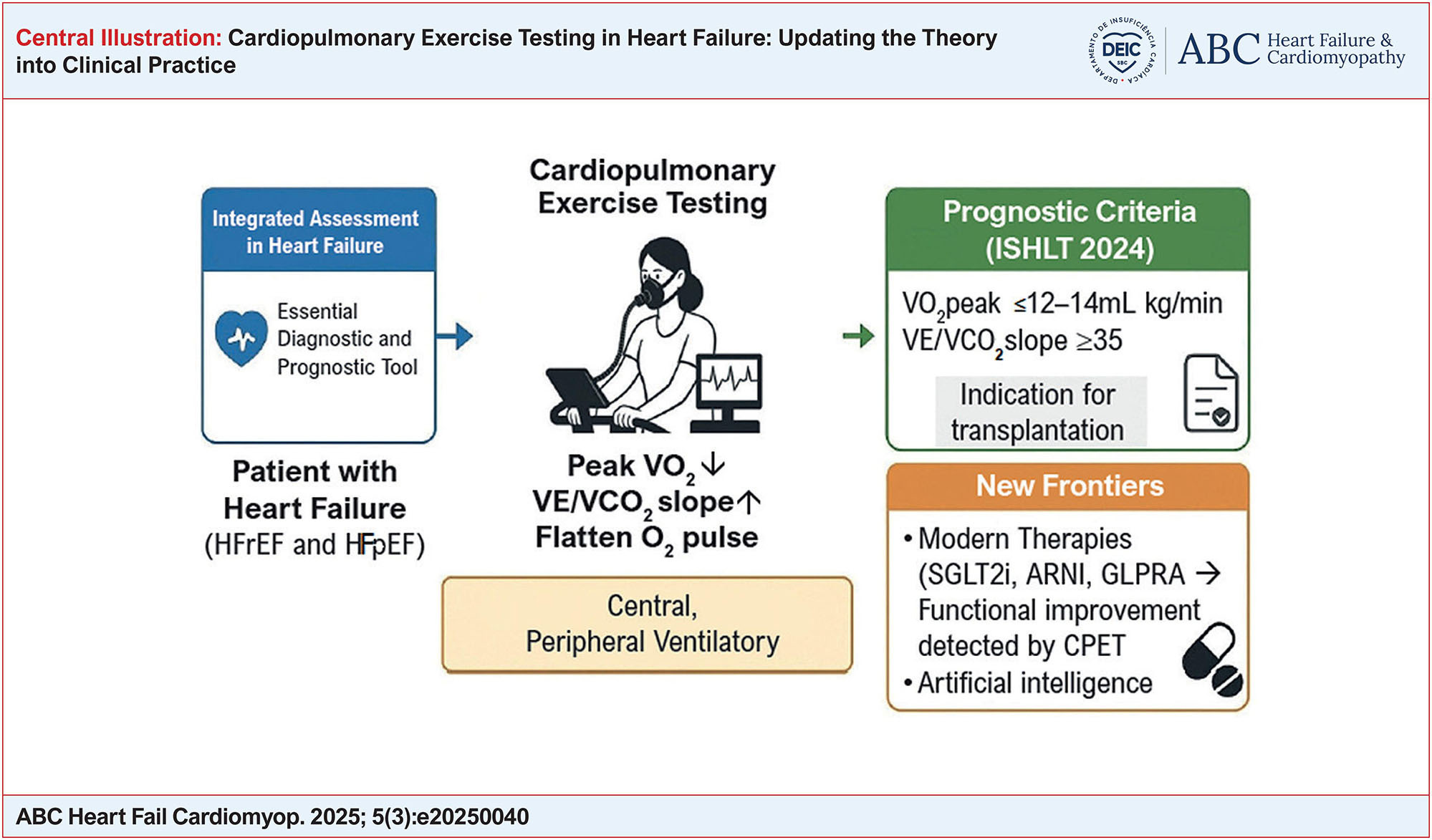
Cardiopulmonary exercise testing (CPET) is a central tool in the functional assessment of heart failure (HF), integrating cardiovascular, ventilatory, and metabolic responses into a single examination. In light of evidence published between 2023 and 2025, its diagnostic and prognostic role has been expanded, incorporating more refined pathophysiological foundations, submaximal parameters, and updated criteria for heart transplantation according to ISHLT 2024. This narrative review, based on studies indexed in PubMed, international consensus statements, and contemporary analyses, addresses the main mechanisms of exercise limitation in HF with reduced ejection fraction (HFrEF) and preserved ejection fraction (HFpEF), as well as the clinical relevance of key CPET variables, including peak VO2, VE/VCO2 slope, OUES, O2 pulse, chronotropic response, and VO2 recovery kinetics.
The body of evidence confirms that the CPET is the most comprehensive tool for characterizing cardiocirculatory, ventilatory, and peripheral limitations, with reduced peak VO2 and elevated VE/VCO2 slope remaining the most robust prognostic markers, even in submaximal tests. Recent studies also demonstrate that emerging therapies — such as SGLT2 inhibitors, ARNIs, and GLP-1 agonists — promote functional benefits detectable by CPET before cardiac structural changes, highlighting its role as a monitor of therapeutic response. Additionally, CPET remains fundamental in risk stratification and transplant decision-making, following the updated thresholds of the ISHLT. Thus, the examination is consolidated as an essential instrument in modern HF practice, integrating diagnosis, prognosis, and therapeutic monitoring, as well as guiding rehabilitation strategies and the selection of advanced therapies.