ABC Family Arquivos Brasileiros de Cardiologia International Journal of Cardiovascular Sciences ABC Heart Failure & Cardiomyopathy ABC Imagem Cardiovascular
Português English
ABC Family
Português English
  • About
    • About ABC Family
    • Internal Regulation
    • Editorial Board
    • Brazilian Society of Cardiology (SBC)
  • Issues
  • SBC Guidelines
  • Content
    • Videos
    • Podcasts
    • News
  • About
    • About ABC Family
    • Internal Regulation
    • Editorial Board
    • Brazilian Society of Cardiology (SBC)
  • Issues
  • SBC Guidelines
  • Content
    • Videos
    • Podcasts
    • News

ABC Family

  • ABC Family
  • Arquivos Brasileiros de Cardiologia
  • International Journal of Cardiovascular Sciences
  • ABC Heart Failure & Cardiomyopathy
  • ABC Imagem Cardiovascular
Search in

No content found.

Journals
Ordering
Article types
Others

  1. Home
  2. Keyword: Coronary Artery Disease/economics
ABC
Editorial

Analysis of FFR Measurement Clinical Impact and Cost-Effectiveness Compared to Angiography In Multi-Arterial Patients Undergoing PCI

Fernando Mendes Sant'Anna et al. Lucas Bonacossa Sant'Anna

The study by Quintella et al. published in this issue of the journal, brings us valuable information about the use of an important physiological evaluation tool in the hemodynamic laboratory. FFR-guided treatment (myocardial fractional flow reserve), used in the percutaneous coronary intervention (PCI) with bare-metal stent (BMS) implantation in multi-arterial patients treated in the Unified Health System (SUS) has been shown to be useful in decreasing the incidence of new revascularization of the target vessel (clinical restenosis), as well as being cost-effective when compared to the angiography-guided treatment.

The value of FFR to predict major adverse cardiovascular events (MCAEs) prior to PCIs has been established for many years. Its ability to detect ischemia and, with this, to guide the most appropriate treatment, has undergone the test of time, and passed. The 15-year follow-up of the DEFER study in single-vessel patients, and the 5-year studies, FAME 1, and FAME 2, in multiarterial patients, showed consistent and unquestionable results, with a better, or at least similar, clinical progression, in the FFR-guided groups, using less stents with fewer lesions and consequently lower costs, as well as evidenced the safety of leaving lesions whose FFR was not indicative of ischemia only on drug treatment.

[…]

  • Angioplasty, Balloon, Coronary
  • Coronary Artery Disease/economics
  • Cost-Benefit Analysis
  • fractional Flow Reserve,Myocardial
  • Stents
Read Full Article
Creative Commons Attribution (CC BY) Creative Commons license
01/01/2019 DOI: 10.5935/abc.20180261
Figure 1
ABC
Original Article

Clinical Outcomes and Cost-Effectiveness Analysis of FFR Compared with Angiography in Multivessel Disease Patient

Edgard Freitas Quintella et al. Esmeralci Ferreira Vitor Manuel Pereira Azevedo Denizar V. Araujo … Fernando Mendes Sant'Anna Bernardo Amorim Denilson Campos de Albuquerque

Abstract

Background:

In multivessel disease patients with moderate stenosis, fractional flow reserve (FFR) allows the analysis of the lesions and guides treatment, and could contribute to the cost-effectiveness (CE) of non-pharmacological stents (NPS).

Objectives:

To evaluate CE and clinical impact of FFR-guided versus angiography-guided angioplasty (ANGIO) in multivessel patients using NPS.

Methods:

Multivessel disease patients were prospectively randomized to FFR or ANGIO groups during a 5 year-period and followed for < 12 months. Outcomes measures were major adverse cardiac events (MACE), restenosis and CE.

Results:

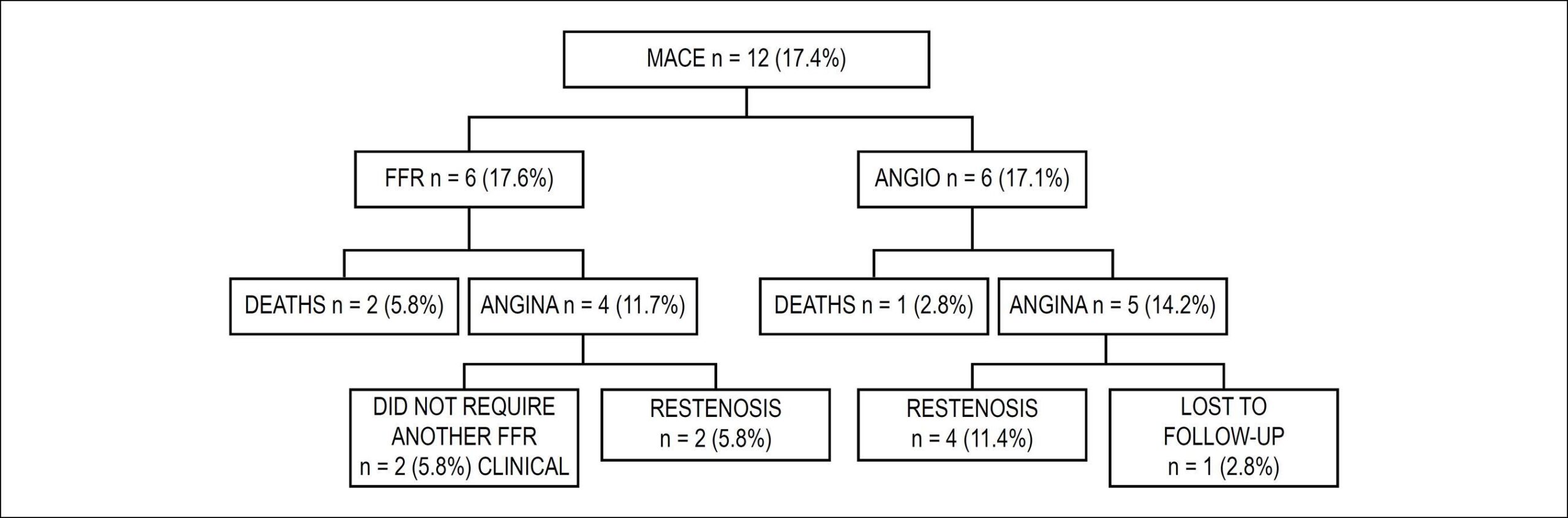
We studied 69 patients, 47 (68.1%) men, aged 62.0 ± 9.0 years, 34 (49.2%) in FFR group and 53 (50.7%) in ANGIO group, with stable angina or acute coronary syndrome. In FFR, there were 26 patients with biarterial disease (76.5%) and 8 (23.5%) with triarterial disease, and in ANGIO, 24 (68.6%) with biarterial and 11 (31.4%) with triarterial disease. Twelve MACEs were observed – 3 deaths: 2 (5.8%) in FFR and 1 (2.8%) in ANGIO, 9 (13.0%) angina: 4(11.7%) in FFR and 5(14.2%) in ANGIO, 6 restenosis: 2(5.8%) in FFR and 4 (11.4%) in ANGIO. Angiography detected 87(53.0%) lesions in FFR, 39(23.7%) with PCI and 48(29.3%) with medical treatment; and 77 (47.0%) lesions in ANGIO, all treated with angioplasty. Thirty-nine (33.3%) stents were registered in FFR (0.45 ± 0.50 stents/lesion) and 78 (1.05 ± 0.22 stents/lesion) in ANGIO (p = 0.0001), 51.4% greater in ANGIO than FFR. CE analysis revealed a cost of BRL 5,045.97 BRL 5,430.60 in ANGIO and FFR, respectively. The difference of effectiveness was of 1.82%.

Conclusion:

FFR reduced the number of lesions treated and stents, and the need for target-lesion revascularization, with a CE comparable with that of angiography.

  • Angioplasty, Balloon, Coronary
  • Coronary Artery Disease/economics
  • Cost-Benefit Analysis
  • Fractional Flow Reserve, Myocardial
  • Stents
Read Full Article
Creative Commons Attribution (CC BY) Creative Commons license
17/12/2018 DOI: 10.5935/abc.20180262

How to cite this article

EndNote RIS

Electronic Document Format (Vancouver)

Sant’Anna FM, Sant’Anna LB. Analysis of FFR Measurement Clinical Impact and Cost-Effectiveness Compared to Angiography In Multi-Arterial Patients Undergoing PCI. Arquivos Brasileiros de Cardiologia 2019;112(1):48-9.

Electronic Document Format (ABNT)

Sant’Anna, Fernando Mendes; Sant’Anna, Lucas Bonacossa. Analysis of FFR Measurement Clinical Impact and Cost-Effectiveness Compared to Angiography In Multi-Arterial Patients Undergoing PCI. Arquivos Brasileiros de Cardiologia, v. 112, n. 1, p. 48-49, Dec. 2018.

Electronic Document Format (APA)

Sant’Anna, F. M., & Sant’Anna, L. B. (2019). Analysis of FFR Measurement Clinical Impact and Cost-Effectiveness Compared to Angiography In Multi-Arterial Patients Undergoing PCI. Arquivos Brasileiros de Cardiologia, 112(1), 48-49.

Electronic Document Format (ISO)

Sant’Anna, Fernando Mendes and Sant’Anna, Lucas Bonacossa. Analysis of FFR Measurement Clinical Impact and Cost-Effectiveness Compared to Angiography In Multi-Arterial Patients Undergoing PCI. Arquivos Brasileiros de Cardiologia [online]. 2019, vol. 112, n. 1, [cited 2026-10-14], pp. 48-49. Available from: <https://journals.cardiol.br/en/article/analysis-of-ffr-measurement-clinical-impact-and-cost-effectiveness-compared-to-angiography-in-multi-arterial-patients-undergoing-pci/>. ISSN 0066-782X

EndNote RIS

Electronic Document Format (Vancouver)

Quintella EF, Ferreira E, Azevedo VMP, Araujo DV, Sant’Anna FM, Amorim B, Albuquerque DC, et al. Clinical Outcomes and Cost-Effectiveness Analysis of FFR Compared with Angiography in Multivessel Disease Patient. Arquivos Brasileiros de Cardiologia 2018;112(1):40-7.

Electronic Document Format (ABNT)

Quintella, Edgard Freitas; Ferreira, Esmeralci; Azevedo, Vitor Manuel Pereira; Araujo, Denizar V.; Sant’Anna, Fernando Mendes; Amorim, Bernardo; Albuquerque, Denilson Campos de. Clinical Outcomes and Cost-Effectiveness Analysis of FFR Compared with Angiography in Multivessel Disease Patient. Arquivos Brasileiros de Cardiologia, v. 112, n. 1, p. 40-47, Dec. 2018.

Electronic Document Format (APA)

Quintella, E. F., Ferreira, E., Azevedo, V. M. P., Araujo, D. V., Sant’Anna, F. M., Amorim, B., & Albuquerque, D. C. (2018). Clinical Outcomes and Cost-Effectiveness Analysis of FFR Compared with Angiography in Multivessel Disease Patient. Arquivos Brasileiros de Cardiologia, 112(1), 40-47.

Electronic Document Format (ISO)

Quintella, Edgard Freitas and Ferreira, Esmeralci and Azevedo, Vitor Manuel Pereira and Araujo, Denizar V. and Sant’Anna, Fernando Mendes and Amorim, Bernardo and Albuquerque, Denilson Campos de. Clinical Outcomes and Cost-Effectiveness Analysis of FFR Compared with Angiography in Multivessel Disease Patient. Arquivos Brasileiros de Cardiologia [online]. 2018, vol. 112, n. 1, [cited 2026-10-14], pp. 40-47. Available from: <https://journals.cardiol.br/en/article/clinical-outcomes-and-cost-effectiveness-analysis-of-ffr-compared-with-angiography-in-multivessel-disease-patient/>. ISSN 0066-782X

  • About ABC Family
  • Internal Regulation
  • Editorial Board
  • Brazilian Society of Cardiology (SBC)

Issues

SBC Guidelines

  • Videos
  • Podcasts
  • News