ABC Family Arquivos Brasileiros de Cardiologia International Journal of Cardiovascular Sciences ABC Heart Failure & Cardiomyopathy ABC Imagem Cardiovascular
Português English
ABC Family
Português English
  • About
    • About ABC Family
    • Internal Regulation
    • Editorial Board
    • Brazilian Society of Cardiology (SBC)
  • Issues
  • SBC Guidelines
  • Content
    • Videos
    • Podcasts
    • News
  • About
    • About ABC Family
    • Internal Regulation
    • Editorial Board
    • Brazilian Society of Cardiology (SBC)
  • Issues
  • SBC Guidelines
  • Content
    • Videos
    • Podcasts
    • News

ABC Family

  • ABC Family
  • Arquivos Brasileiros de Cardiologia
  • International Journal of Cardiovascular Sciences
  • ABC Heart Failure & Cardiomyopathy
  • ABC Imagem Cardiovascular
Search in

No content found.

Journals
Ordering
Article types
Others

  1. Home
  2. Keyword: Conduction
Figure 1
ABC
Research Letter

Coherent Map for Atypical Atrial Flutter – A Step Forward for the Understanding of the Arrhythmia Mechanism

Pedro A. Sousa et al. Sérgio Barra Mariana Pereira Luís Elvas

Case Presentation

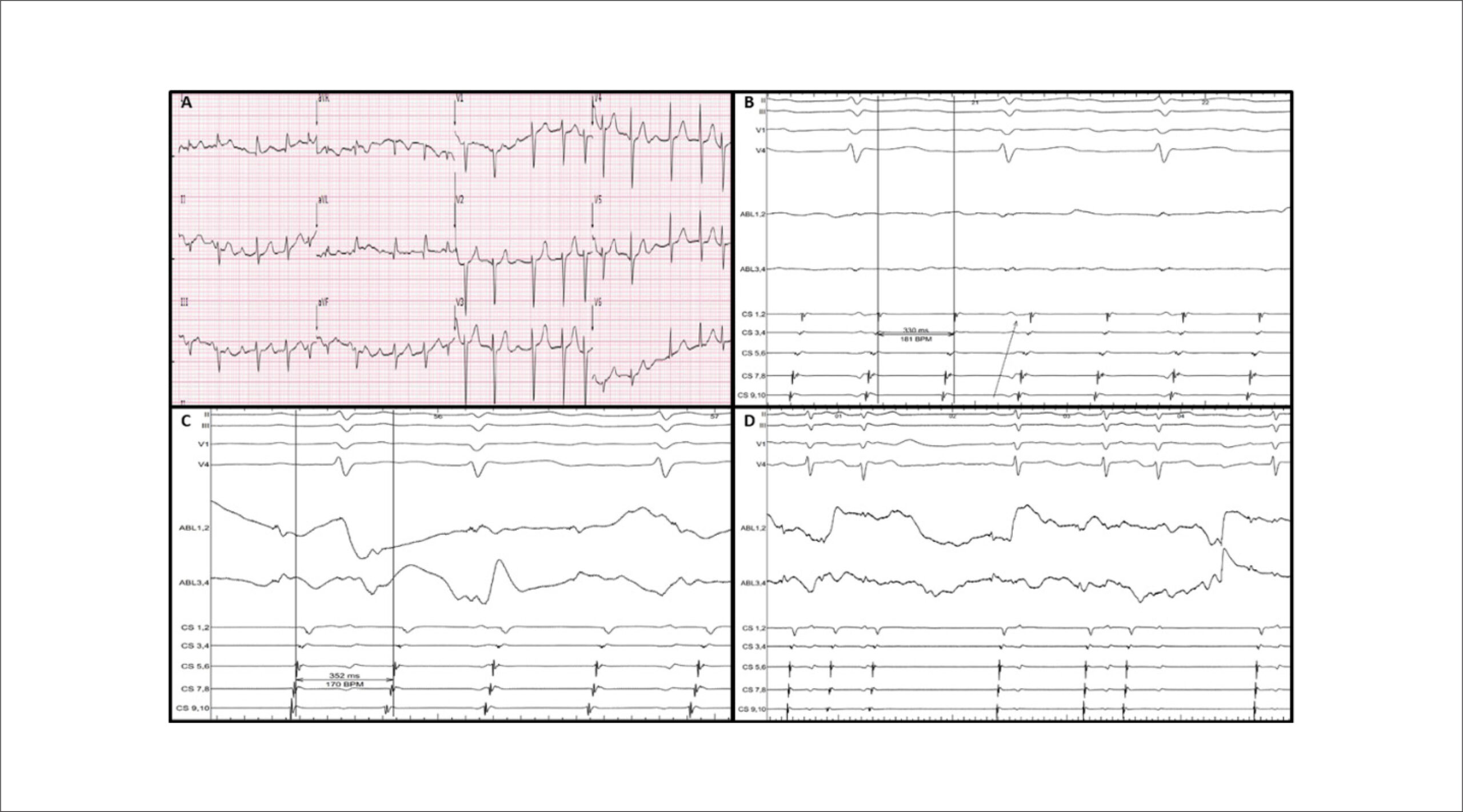
An 86-year-old woman with a previous history of paroxysmal atrial fibrillation was referred for atypical atrial flutter (AFL) ablation. She had never been submitted to catheter ablation before. The transthoracic echocardiogram revealed a left ventricular ejection fraction of 65%, a mildly dilated left atrium (42mm) and moderate mitral regurgitation. The baseline 12-lead ECG exhibited positive F waves in V1 and the lower limb leads, isoelectric F waves in DI and negative F wave in aVL. () Given the earlier concentric activation in the coronary sinus (CS), with a tachycardia cycle length (TCL) of 330ms, () a right atrial (RA) activation map, performed with the PentaRay® catheter, was initially analyzed using the HD Coloring tool (CARTO® 3V7, Biosense Webster, CA, USA). It revealed an earlier activation in the interatrial septum with only 1/3 of the TCL (). A subsequent left atrial (LA) activation map revealed a large area of scar with likely conduction block in almost all of the anterior wall, represented as a white line by the lower threshold Extended Early Meets Late (EEML) feature, and several areas with early local activation time (LAT) points – in the left atrial appendage (LAA), the anterior aspect of the mitral valve (MV) and the roof near the anterior segment of the right superior pulmonary vein (RSPV). It also showed two zones of re-entry as established by the Early Meets Late (EML) feature ( and ). These maps suggested a probable circuit around the right pulmonary veins but did not explain the color activation in the LAA and MV. A new mapping algorithm – Coherent (CARTO® 3V7, Biosense Webster) – unveiled the circuit ( and ). What is the mechanism of this atypical AFL?

[…]
  • Arrhytmias, Cardiac
  • Atrial Flutter/etiology
  • Coherent Mapping
  • Conduction
  • Electrophysiologic Techniques Cardiac/methods
  • HC Coloring
Read Full Article
Creative Commons Attribution (CC BY) Creative Commons license
03/12/2021 DOI: 10.36660/abc.20201311 Views 3
ABC
Editorial

Short Editorial: Risk of Atrial Fibrillation after Ablation of Cavotricuspid Isthmus-Dependent Atrial Flutter: Is Combined Ablation of Atrial Fibrillation Worthwhile?

Alvaro Valentim Lima Sarabanda

Cavotricuspid isthmus (CTI)-dependent atrial flutter (AFL) is a common cardiac arrhythmia that can cause significant symptoms and is associated with an increased risk of stroke and the development or worsening of heart failure. The anatomic/electrophysiological substrate underlying AFL is a combination of slow conduction in the isthmus of atrial tissue between the tricuspid annulus and the inferior vena cava and conduction block along the crista terminalis and Eustachian ridge, enabling the emergence and perpetuation of a macro-reentrant circuit in the right atrium.,

Because of the well-defined anatomic/electrophysiological substrate and the unsatisfactory results of antiarrhythmic drug therapy in treating AFL, radiofrequency catheter ablation, by means of creating a linear lesion from the tricuspid annulus to the inferior vena cava (cavotricuspid isthmus) under fluoroscopic and electrocardiographic guidance, is an established interventional procedure, with a low risk of complications (1% or less) and success rates over 90%.,

[…]

  • Arrhythmias Cardiac
  • Atrial Fibrillation/prevention and control
  • Atrial flutter
  • Conduction
  • Isthmus Cavo-Tricuspid
  • Radiofrequency Ablation
Read Full Article
Creative Commons Attribution (CC BY) Creative Commons license
01/06/2020 DOI: 10.36660/abc.20200316 Views 1
Figure 1
ABC
Original Article

Risk of Atrial Fibrillation after Ablation of Cavotricuspid Isthmus-Dependent Atrial Flutter: Is Combined Ablation of Atrial Fibrillation Worthwhile?

Isabella Bianco et al. Gabriel Odozynski da Silva Alexander Romeno Janner Dal Forno Helcio Garcia Nascimento … Andrei Lewandowski Elayne Pereira André d’Avila

Abstract

Background

Simultaneous ablation of atrial fibrillation (AF) and cavotricuspid isthmus (CTI)-dependent atrial flutter can be performed when both arrythmias had been recorded before the procedure. However, the best approach has not been defined in case of patients referred for ablation with CTI-dependent atrial flutter, without history of AF.

Objectives

To assess the prevalence and to identify predictors of the first episode of AF after ablation of CTI-dependent atrial flutter in patients without history of AF.

Methods

Retrospective cohort of patients with CTI-dependent atrial flutter without history of AF undergoing catheter ablation. Clinical characteristics were compared between patients who developed AF and those who did not have AF after the procedure. Significance level was set at 5%. In the analysis of predicting factors, the primary outcome was occurrence of AF after CTI-dependent atrial flutter ablation.

Results

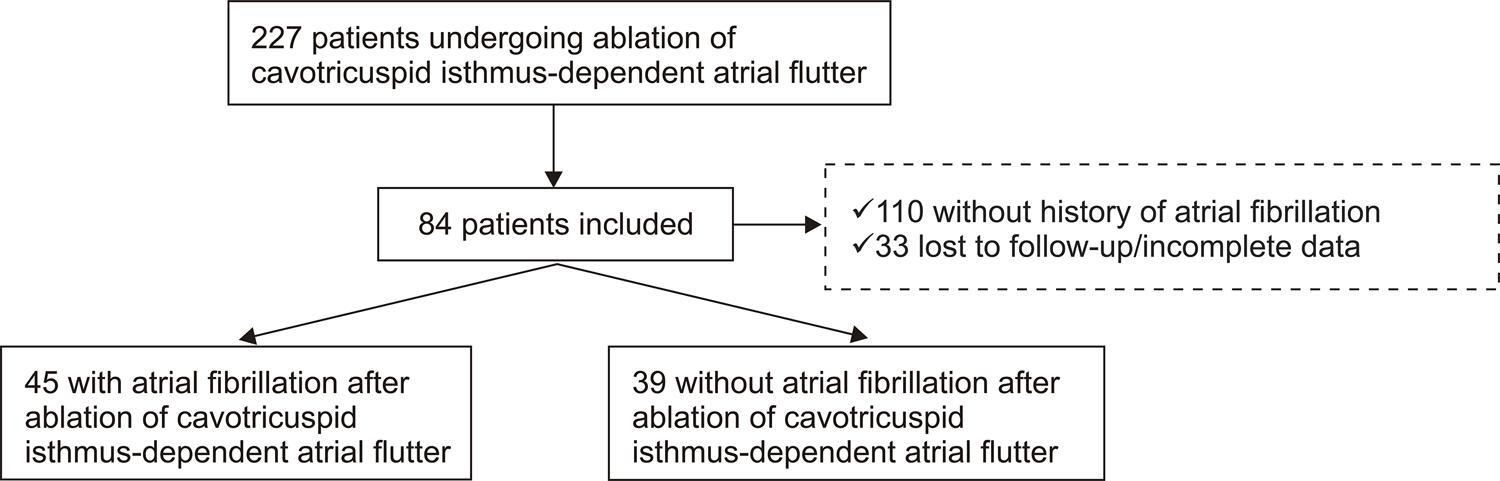
Of a total of 227 patients undergoing ablation of CTI-dependent atrial flutter (110 with history of AF and 33 without adequate follow-up), 84 were included, and 45 (53.6%) developed post-ablation AF. The HATCH and CHA2DS2-VASC scores were not different between the groups. Recurrence rate of CTI-dependent atrial flutter and complication rate were 11.5% and 1.2%, respectively, after ablation.

Conclusions

Although ablation of CTI-dependent atrial flutter is a safe and effective procedure, 50% of the patients developed AF after the procedure. However, the role of combined ablation (CTI-dependent atrial flutter plus AF) aiming at preventing AF is still uncertain. (Arq Bras Cardiol. 2020; [online].ahead print, PP.0-0)

  • Arial Fibrillation/prevention
  • Arrhythmias Cardiac
  • Atrial flutter
  • Conduction
  • Isthmus Cavo-Tricuspid
  • Radiofrequency Ablation
Read Full Article
Creative Commons Attribution (CC BY) Creative Commons license
30/03/2020 DOI: 10.36660/abc.20190238

How to cite this article

EndNote RIS

Electronic Document Format (Vancouver)

Sousa PA, Barra S, Pereira M, Elvas L. Coherent Map for Atypical Atrial Flutter – A Step Forward for the Understanding of the Arrhythmia Mechanism. Arquivos Brasileiros de Cardiologia 2021;117(6):1212-6.

Electronic Document Format (ABNT)

Sousa, Pedro A.; Barra, Sérgio; Pereira, Mariana; Elvas, Luís. Coherent Map for Atypical Atrial Flutter – A Step Forward for the Understanding of the Arrhythmia Mechanism. Arquivos Brasileiros de Cardiologia, v. 117, n. 6, p. 1212-1216, Dec. 2021.

Electronic Document Format (APA)

Sousa, P. A., Barra, S., Pereira, M., & Elvas, L. (2021). Coherent Map for Atypical Atrial Flutter – A Step Forward for the Understanding of the Arrhythmia Mechanism. Arquivos Brasileiros de Cardiologia, 117(6), 1212-1216.

Electronic Document Format (ISO)

Sousa, Pedro A. and Barra, Sérgio and Pereira, Mariana and Elvas, Luís. Coherent Map for Atypical Atrial Flutter – A Step Forward for the Understanding of the Arrhythmia Mechanism. Arquivos Brasileiros de Cardiologia [online]. 2021, vol. 117, n. 6, [cited 2026-10-14], pp. 1212-1216. Available from: <https://journals.cardiol.br/en/article/coherent-map-for-atypical-atrial-flutter-a-step-forward-for-the-understanding-of-the-arrhythmia-mechanism/>. ISSN 0066-782X

EndNote RIS

Electronic Document Format (Vancouver)

Sarabanda AVL. Short Editorial: Risk of Atrial Fibrillation after Ablation of Cavotricuspid Isthmus-Dependent Atrial Flutter: Is Combined Ablation of Atrial Fibrillation Worthwhile?. Arquivos Brasileiros de Cardiologia 2020;114(5):783-5.

Electronic Document Format (ABNT)

Sarabanda, Alvaro Valentim Lima. Short Editorial: Risk of Atrial Fibrillation after Ablation of Cavotricuspid Isthmus-Dependent Atrial Flutter: Is Combined Ablation of Atrial Fibrillation Worthwhile?. Arquivos Brasileiros de Cardiologia, v. 114, n. 5, p. 783-785, May. 2020.

Electronic Document Format (APA)

Sarabanda, A. V. L. (2020). Short Editorial: Risk of Atrial Fibrillation after Ablation of Cavotricuspid Isthmus-Dependent Atrial Flutter: Is Combined Ablation of Atrial Fibrillation Worthwhile?. Arquivos Brasileiros de Cardiologia, 114(5), 783-785.

Electronic Document Format (ISO)

Sarabanda, Alvaro Valentim Lima. Short Editorial: Risk of Atrial Fibrillation after Ablation of Cavotricuspid Isthmus-Dependent Atrial Flutter: Is Combined Ablation of Atrial Fibrillation Worthwhile?. Arquivos Brasileiros de Cardiologia [online]. 2020, vol. 114, n. 5, [cited 2026-10-14], pp. 783-785. Available from: <https://journals.cardiol.br/en/article/short-editorial-risk-of-atrial-fibrillation-after-ablation-of-cavotricuspid-isthmus-dependent-atrial-flutter-is-combined-ablation-of-atrial-fibrillation-worthwhile/>. ISSN 0066-782X

EndNote RIS

Electronic Document Format (Vancouver)

Bianco I, Silva GO, Forno ARJD, Nascimento HG, Lewandowski A, Pereira E, d’Avila A, et al. Risk of Atrial Fibrillation after Ablation of Cavotricuspid Isthmus-Dependent Atrial Flutter: Is Combined Ablation of Atrial Fibrillation Worthwhile?. Arquivos Brasileiros de Cardiologia 2020;114(5):775-82.

Electronic Document Format (ABNT)

Bianco, Isabella; Silva, Gabriel Odozynski da; Forno, Alexander Romeno Janner Dal; Nascimento, Helcio Garcia; Lewandowski, Andrei; Pereira, Elayne; d’Avila, André. Risk of Atrial Fibrillation after Ablation of Cavotricuspid Isthmus-Dependent Atrial Flutter: Is Combined Ablation of Atrial Fibrillation Worthwhile?. Arquivos Brasileiros de Cardiologia, v. 114, n. 5, p. 775-782, Mar. 2020.

Electronic Document Format (APA)

Bianco, I., Silva, G. O. , Forno, A. R. J. D., Nascimento, H. G., Lewandowski, A., Pereira, E., & d’Avila, A. (2020). Risk of Atrial Fibrillation after Ablation of Cavotricuspid Isthmus-Dependent Atrial Flutter: Is Combined Ablation of Atrial Fibrillation Worthwhile?. Arquivos Brasileiros de Cardiologia, 114(5), 775-782.

Electronic Document Format (ISO)

Bianco, Isabella and Silva, Gabriel Odozynski da and Forno, Alexander Romeno Janner Dal and Nascimento, Helcio Garcia and Lewandowski, Andrei and Pereira, Elayne and d’Avila, André. Risk of Atrial Fibrillation after Ablation of Cavotricuspid Isthmus-Dependent Atrial Flutter: Is Combined Ablation of Atrial Fibrillation Worthwhile?. Arquivos Brasileiros de Cardiologia [online]. 2020, vol. 114, n. 5, [cited 2026-10-14], pp. 775-782. Available from: <https://journals.cardiol.br/en/article/risk-of-atrial-fibrillation-after-ablation-of-cavotricuspid-isthmus-dependent-atrial-flutter-is-combined-ablation-of-atrial-fibrillation-worthwhile/>. ISSN 0066-782X

  • About ABC Family
  • Internal Regulation
  • Editorial Board
  • Brazilian Society of Cardiology (SBC)

Issues

SBC Guidelines

  • Videos
  • Podcasts
  • News