ABC Family Arquivos Brasileiros de Cardiologia International Journal of Cardiovascular Sciences ABC Heart Failure & Cardiomyopathy ABC Imagem Cardiovascular
Português English
ABC Family
Português English
  • About
    • About ABC Family
    • Internal Regulation
    • Editorial Board
    • Brazilian Society of Cardiology (SBC)
  • Issues
  • SBC Guidelines
  • Content
    • Videos
    • Podcasts
    • News
  • About
    • About ABC Family
    • Internal Regulation
    • Editorial Board
    • Brazilian Society of Cardiology (SBC)
  • Issues
  • SBC Guidelines
  • Content
    • Videos
    • Podcasts
    • News

ABC Family

  • ABC Family
  • Arquivos Brasileiros de Cardiologia
  • International Journal of Cardiovascular Sciences
  • ABC Heart Failure & Cardiomyopathy
  • ABC Imagem Cardiovascular
Search in

No content found.

Journals
Ordering
Article types
Others

  1. Home
  2. Keyword: Angiogenesis Inducing Agents
ABC
Editorial

Exercise and Garlic Modulate microRNAs Involved in Diabetic Cardiopathy

Aline Regina Ruiz Lima

Diabetes mellitus (DM) is a major risk factor for cardiovascular disorders and stroke development and is associated with increased morbidity and mortality. The prevalence of diabetes is increasing at an alarming rate worldwide. Indeed, according to estimates of the International Diabetes Federation, 552 million people are expected to be diabetic in 2030. Although a definitive cure is not on the horizon, with proper management, diabetic patients can attenuate the development of serious complications that reduce life quality and expectancy. Facing a considerable rate of occurrence and prognosis complications, studies focusing on high efficiency and low toxicity treatments are of great importance.

MicroRNAs are small non-coding RNAs controlling gene expression and participating in many physiopathological processes. These small molecules are getting a lot of attention nowadays since they are universally recognized as major regulators of gene expression and as key controllers of several biological and pathological processes. They are essential intracellular mediators in a variety of cellular processes, such as inflammation, mitochondrial metabolism, apoptosis, among others. Therefore, miRNAs could be potential targets to treat some chronic diseases. Besides, these molecules can also be used as early biomarkers, once they are released in urine and blood when in presence of tissue lesion. Recently, it was verified that miRNAs are also involved in cardiovascular disorders, especially those which impaired angiogenesis is observed.

[…]

  • Angiogenesis Inducing Agents
  • Diabetes Mellitus/complications
  • Exercise/prevention & control
  • Heart Diseases
  • MicroRNAs
Read Full Article
Creative Commons Attribution (CC BY) Creative Commons license
01/02/2019 DOI: 10.5935/abc.20180259 Views 1
Figure 1
ABC
Original Article

The Effect of Garlic and Voluntary Exercise on Cardiac Angiogenesis in Diabetes: The Role of MiR-126 and MiR-210

Roya Naderi et al. Gisou Mohaddes Mustafa Mohammadi Alireza Alihemmati … Amirmahdi Khamaneh Rafighe Ghyasi Rana Ghaznavi

Abstract

Background:

Diabetes mellitus (DM) is one of the major risk factors for cardiovascular disease, leading to endothelial dysfunction and angiogenesis impairment . MiR-126 and miR-210 support angiogenic response in endothelial cells.

Objective:

The present study sought to explore the effect of garlic and voluntary exercise, alone or together, on miR-126 and miR-210 expressions and cardiac angiogenesis in rats with type 1 diabetes.

Methods:

Male Wistar rats were divided into five groups (n = 7): Control, Diabetes, Diabetes+Garlic, Diabetes+Exercise, and Diabetes+Garlic+Exercise. Diabetes was induced in the animals by streptozotocin (ip, 50 mg/kg). The rats were then fed raw fresh garlic homogenate (250 mg/kg) or were subjected to voluntary exercise, or to combined garlic and voluntary exercise for 6 weeks. MiR-126 and miR-210 expressions in the myocardium were determined by real time PCR, and the serum lipid profile was measured by enzymatic kits. Angiogenesis was evaluated by immunostaining for PECAM-1/ CD31 in the myocardium.

Results:

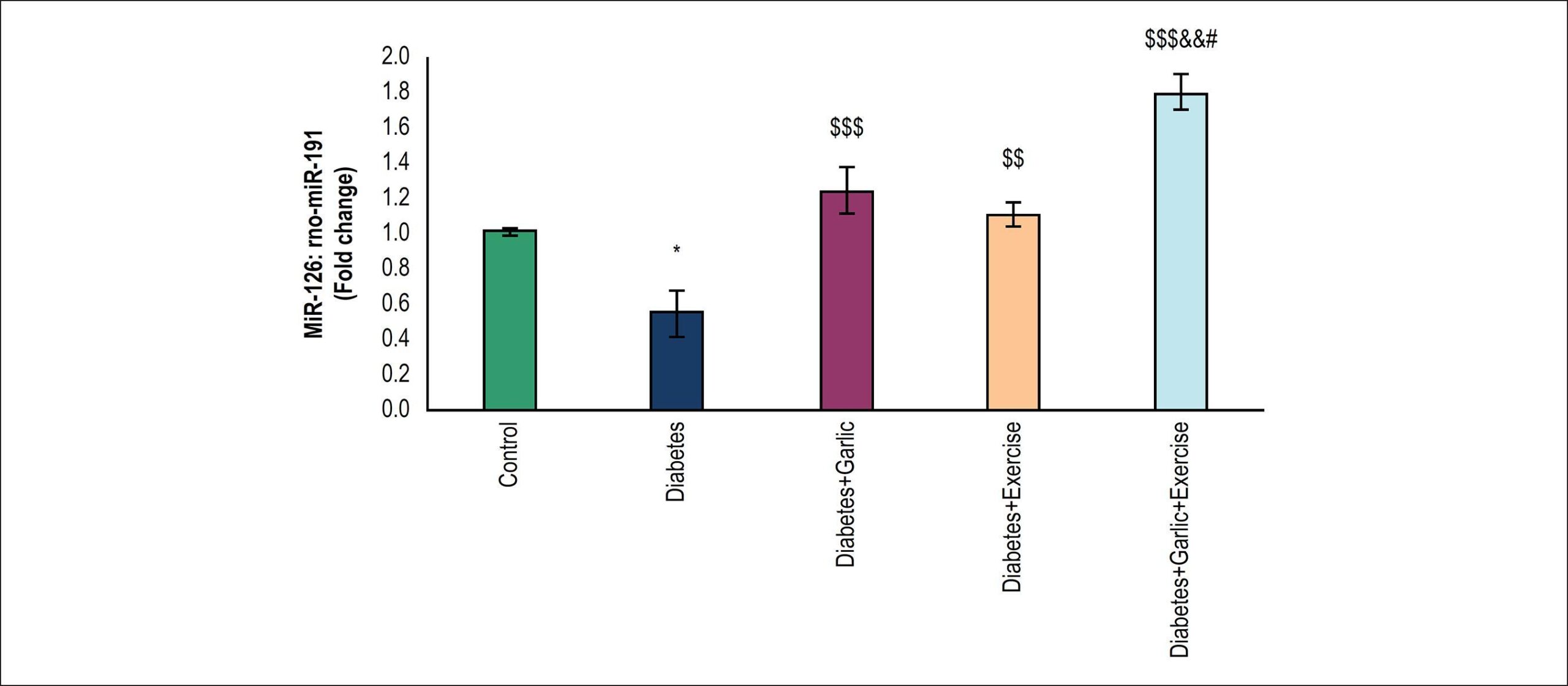
Diabetes reduced both cardiac miR-126 expression and angiogenesis (p < 0.05). On the other hand, there was a miR-210 expression increase in the myocardium of diabetic animals (p < 0.001). However, those effects reversed either with garlic or voluntary exercise (p < 0.01). Moreover, treating diabetic rats with garlic and voluntary exercise combined had an additional effect on the expressions of miR-126 and miR-210 (p < 0.001). Furthermore, both voluntary exercise and garlic significantly improved serum lipid profiles (p < 0.001).

Conclusion:

The induction of diabetes decreased angiogenesis in the myocardium, whereas our treatment using long-term voluntary exercise and garlic improved myocardial angiogenesis. These changes were possibly owing to the enhancement of myocardial miR-126 and miR-210 expressions.

  • Allium Sativum
  • Angiogenesis Inducing Agents
  • Diabetes Mellitus
  • Exercise
  • Garlic
  • MicroRNAs
  • Neovascularization
  • Physologic
  • Rats
Read Full Article
Creative Commons Attribution (CC BY) Creative Commons license
01/02/2019 DOI: 10.5935/abc.20190002

How to cite this article

EndNote RIS

Electronic Document Format (Vancouver)

Lima ARR. Exercise and Garlic Modulate microRNAs Involved in Diabetic Cardiopathy. Arquivos Brasileiros de Cardiologia 2019;112(2):163-4.

Electronic Document Format (ABNT)

Lima, Aline Regina Ruiz. Exercise and Garlic Modulate microRNAs Involved in Diabetic Cardiopathy. Arquivos Brasileiros de Cardiologia, v. 112, n. 2, p. 163-164, Jan. 2019.

Electronic Document Format (APA)

Lima, A. R. R. (2019). Exercise and Garlic Modulate microRNAs Involved in Diabetic Cardiopathy. Arquivos Brasileiros de Cardiologia, 112(2), 163-164.

Electronic Document Format (ISO)

Lima, Aline Regina Ruiz. Exercise and Garlic Modulate microRNAs Involved in Diabetic Cardiopathy. Arquivos Brasileiros de Cardiologia [online]. 2019, vol. 112, n. 2, [cited 2026-10-14], pp. 163-164. Available from: <https://journals.cardiol.br/en/article/exercise-and-garlic-modulate-micrornas-involved-in-diabetic-cardiopathy/>. ISSN 0066-782X

EndNote RIS

Electronic Document Format (Vancouver)

Naderi R, Mohaddes G, Mohammadi M, Alihemmati A, Khamaneh A, Ghyasi R, Ghaznavi R, et al. The Effect of Garlic and Voluntary Exercise on Cardiac Angiogenesis in Diabetes: The Role of MiR-126 and MiR-210. Arquivos Brasileiros de Cardiologia 2019;112(2):154-62.

Electronic Document Format (ABNT)

Naderi, Roya; Mohaddes, Gisou; Mohammadi, Mustafa; Alihemmati, Alireza; Khamaneh, Amirmahdi; Ghyasi, Rafighe; Ghaznavi, Rana. The Effect of Garlic and Voluntary Exercise on Cardiac Angiogenesis in Diabetes: The Role of MiR-126 and MiR-210. Arquivos Brasileiros de Cardiologia, v. 112, n. 2, p. 154-162, Jan. 2019.

Electronic Document Format (APA)

Naderi, R., Mohaddes, G., Mohammadi, M., Alihemmati, A., Khamaneh, A., Ghyasi, R., & Ghaznavi, R. (2019). The Effect of Garlic and Voluntary Exercise on Cardiac Angiogenesis in Diabetes: The Role of MiR-126 and MiR-210. Arquivos Brasileiros de Cardiologia, 112(2), 154-162.

Electronic Document Format (ISO)

Naderi, Roya and Mohaddes, Gisou and Mohammadi, Mustafa and Alihemmati, Alireza and Khamaneh, Amirmahdi and Ghyasi, Rafighe and Ghaznavi, Rana. The Effect of Garlic and Voluntary Exercise on Cardiac Angiogenesis in Diabetes: The Role of MiR-126 and MiR-210. Arquivos Brasileiros de Cardiologia [online]. 2019, vol. 112, n. 2, [cited 2026-10-14], pp. 154-162. Available from: <https://journals.cardiol.br/en/article/the-effect-of-garlic-and-voluntary-exercise-on-cardiac-angiogenesis-in-diabetes-the-role-of-mir-126-and-mir-210/>. ISSN 0066-782X

  • About ABC Family
  • Internal Regulation
  • Editorial Board
  • Brazilian Society of Cardiology (SBC)

Issues

SBC Guidelines

  • Videos
  • Podcasts
  • News