ABC Family Arquivos Brasileiros de Cardiologia International Journal of Cardiovascular Sciences ABC Heart Failure & Cardiomyopathy ABC Imagem Cardiovascular
Português English
ABC Family
Português English
  • About
    • About ABC Family
    • Internal Regulation
    • Editorial Board
    • Brazilian Society of Cardiology (SBC)
  • Issues
  • SBC Guidelines
  • Content
    • Videos
    • Podcasts
    • News
  • About
    • About ABC Family
    • Internal Regulation
    • Editorial Board
    • Brazilian Society of Cardiology (SBC)
  • Issues
  • SBC Guidelines
  • Content
    • Videos
    • Podcasts
    • News

ABC Family

  • ABC Family
  • Arquivos Brasileiros de Cardiologia
  • International Journal of Cardiovascular Sciences
  • ABC Heart Failure & Cardiomyopathy
  • ABC Imagem Cardiovascular
Search in

No content found.

Journals
Ordering
Article types
Others

  1. Home
  2. Keyword: Age Factors
ABC
Editorial

The “Coming of Age” of Coronary Calcium Score?

António Miguel Ferreira et al. Rita Lima Nuno Bettencourt

The use of coronary artery calcium (CAC) score to guide the primary prevention of atherosclerosis and its manifestations has grown in popularity in recent years. Its advantages over the current paradigm of risk-factor-based calculators include better discrimination and greater predictive power, with the promise of better treatment decisions and timely implementation of personalized preventive measures.–

CAC results are usually expressed as an absolute value and as a percentile among individuals of the same age and sex. Importantly, conveying this information to patients seems to improve their adherence to lifestyle modifications and pharmacological therapy. One of the ways developed for making patients understand their risk is the concept of vascular age. Quite simply, an individual’s vascular age assessed by CAC score is the average age at which people of the same sex have a similar degree of coronary calcification. So, if a person’s vascular age is higher than their chronological age, this indicates a higher risk of cardiovascular events than one would suppose. For instance, a 50-year-old female smoker with a vascular age of 70 may realize that she needs to take preventive measures to reduce her risk. Conversely, when vascular age is lower than chronological age, it suggests a lower risk compared to their age group. Although vascular age provides a clear and relatable way to communicate cardiovascular risk to patients, it should be noted that it might convey the false notion that atherosclerosis is part of the natural aging process. It is not. Nevertheless, despite this imprecision, its clinical usefulness remains.

[…]
  • Age Factors
  • Atherosclerosis
  • Calcium
Read Full Article
Creative Commons Attribution (CC BY) Creative Commons license
24/11/2023 DOI: 10.36660/abc.20230708 Views 1
Figure 1
ABC
Original Article

Pulmonary Embolism Mortality in Brazil from 1989 to 2010: Gender and Regional Disparities

Eduardo Sahade Darze et al. Juliana Borges Casqueiro Luisa Allen Ciuffo Jessica Mendes Santos … Iuri Resedá Magalhães Adriana Lopes Latado

Abstract

Background:

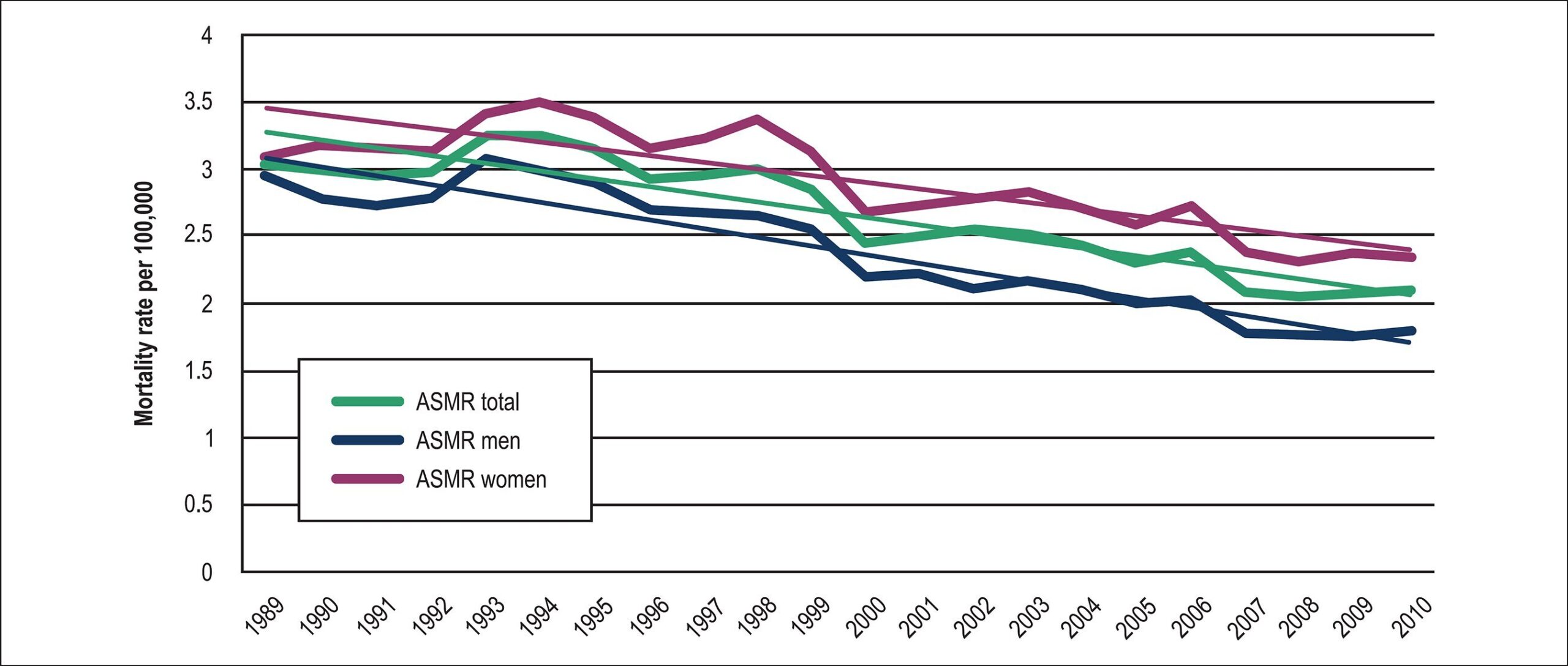
A significant variation in pulmonary embolism (PE) mortality trends have been documented around the world. We investigated the trends in mortality rate from PE in Brazil over a period of 21 years and its regional and gender differences.

Methods:

Using a nationwide database of death certificate information we searched for all cases with PE as the underlying cause of death between 1989 and 2010. Population data were obtained from the Brazilian Institute of Geography and Statistics (IBGE). We calculated age-, gender- and region-specific mortality rates for each year, using the 2000 Brazilian population for direct standardization.

Results:

Over 21 years the age-standardized mortality rate (ASMR) fell 31% from 3.04/100,000 to 2.09/100,000. In every year between 1989 and 2010, the ASMR was higher in women than in men, but both showed a significant declining trend, from 3.10/100,000 to 2.36/100,000 and from 2.94/100,000 to 1.80/100,000, respectively. Although all country regions showed a decline in their ASMR, the largest fall in death rates was concentrated in the highest income regions of the South and Southeast Brazil. The North and Northeast regions, the lowest income areas, showed a less marked fall in death rates and no distinct change in the PE mortality rate in women.

Conclusions:

Our study showed a reduction in the PE mortality rate over two decades in Brazil. However, significant variation in this trend was observed amongst the five country regions and between genders, pointing to possible disparities in health care access and quality in these groups.

  • Age Factors
  • Brazil / epidemiology
  • Pulmonary Embolism / epidemiology
  • Quality of Health Care
  • Regional Medical Programs
Read Full Article
Creative Commons Attribution (CC BY) Creative Commons license
10/11/2015 DOI: 10.5935/abc.20160001
Figure 1
ABC
Original Article

Proposal Intensity Adequacy of Expiratory Effort and Heart Rate Behavior During the Valsalva Maneuver in Preadolescents

Mario Augusto Paschoal et al. Bruno de Sousa Donato Flávia Baroni Neves

Background:

When performing the Valsalva maneuver (VM), adults and preadolescents produce the same expiratory resistance values.

Objective:

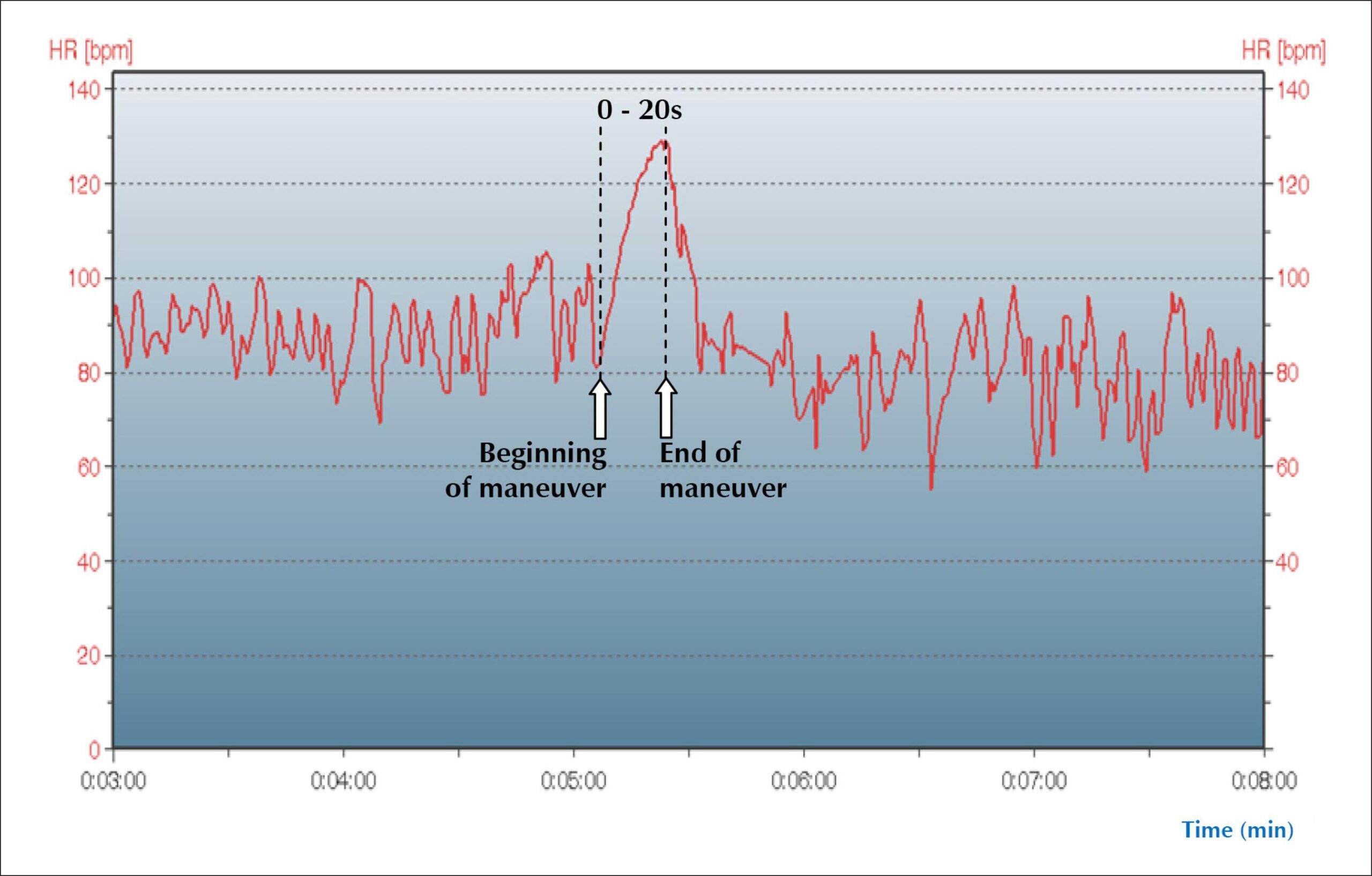
To analyze heart rate (HR) in preadolescents performing VM, and propose a new method for selecting expiratory resistance.

Method:

The maximal expiratory pressure (MEP) was measured in 45 sedentary children aged 9-12 years who subsequently performed VM for 20 s using an expiratory pressure of 60%, 70%, or 80% of MEP. HR was measured before, during, and after VM. These procedures were repeated 30 days later, and the data collected in the sessions (E1, E2) were analyzed and compared in periods before, during (0-10 and 10-20 s), and after VM using nonparametric tests.

Results:

All 45 participants adequately performed VM in E1 and E2 at 60% of MEP. However, only 38 (84.4%) and 25 (55.5%) of the participants performed the maneuver at 70% and 80% of MEP, respectively. The HR delta measured during 0-10 s and 10-20 s significantly increased as the expiratory effort increased, indicating an effective cardiac autonomic response during VM. However, our findings suggest the VM should not be performed at these intensities.

Conclusion:

HR increased with all effort intensities tested during VM. However, 60% of MEP was the only level of expiratory resistance that all participants could use to perform VM. Therefore, 60% of MEP may be the optimal expiratory resistance that should be used in clinical practice.

  • Age Factors
  • Child
  • Exhalation
  • Heart Rate
  • Valsalva Maneuvers
Read Full Article
Creative Commons Attribution (CC BY) Creative Commons license
15/07/2014 DOI: 10.5935/abc.20140092 Views 2

How to cite this article

EndNote RIS

Electronic Document Format (Vancouver)

Ferreira AM, Lima R, Bettencourt N. The “Coming of Age” of Coronary Calcium Score?. Arquivos Brasileiros de Cardiologia 2023;120(10):e20230708.

Electronic Document Format (ABNT)

Ferreira, António Miguel; Lima, Rita; Bettencourt, Nuno. The “Coming of Age” of Coronary Calcium Score?. Arquivos Brasileiros de Cardiologia, v. 120, n. 10, e20230708, Nov. 2023.

Electronic Document Format (APA)

Ferreira, A. M., Lima, R., & Bettencourt, N. (2023). The “Coming of Age” of Coronary Calcium Score?. Arquivos Brasileiros de Cardiologia, 120(10), e20230708.

Electronic Document Format (ISO)

Ferreira, António Miguel and Lima, Rita and Bettencourt, Nuno. The “Coming of Age” of Coronary Calcium Score?. Arquivos Brasileiros de Cardiologia [online]. 2023, vol. 120, n. 10, [cited 2026-10-14], e20230708. Available from: <https://journals.cardiol.br/en/article/the-coming-of-age-of-coronary-calcium-score/>. ISSN 0066-782X

EndNote RIS

Electronic Document Format (Vancouver)

Darze ES, Casqueiro JB, Ciuffo LA, Santos JM, Magalhães IR, Latado AL. Pulmonary Embolism Mortality in Brazil from 1989 to 2010: Gender and Regional Disparities. Arquivos Brasileiros de Cardiologia 2015;106(1):4-12.

Electronic Document Format (ABNT)

Darze, Eduardo Sahade; Casqueiro, Juliana Borges; Ciuffo, Luisa Allen; Santos, Jessica Mendes; Magalhães, Iuri Resedá; Latado, Adriana Lopes. Pulmonary Embolism Mortality in Brazil from 1989 to 2010: Gender and Regional Disparities. Arquivos Brasileiros de Cardiologia, v. 106, n. 1, p. 4-12, Nov. 2015.

Electronic Document Format (APA)

Darze, E. S., Casqueiro, J. B., Ciuffo, L. A., Santos, J. M., Magalhães, I. R., & Latado, A. L. (2015). Pulmonary Embolism Mortality in Brazil from 1989 to 2010: Gender and Regional Disparities. Arquivos Brasileiros de Cardiologia, 106(1), 4-12.

Electronic Document Format (ISO)

Darze, Eduardo Sahade and Casqueiro, Juliana Borges and Ciuffo, Luisa Allen and Santos, Jessica Mendes and Magalhães, Iuri Resedá and Latado, Adriana Lopes. Pulmonary Embolism Mortality in Brazil from 1989 to 2010: Gender and Regional Disparities. Arquivos Brasileiros de Cardiologia [online]. 2015, vol. 106, n. 1, [cited 2026-10-14], pp. 4-12. Available from: <https://journals.cardiol.br/en/article/pulmonary-embolism-mortality-in-brazil-from-1989-to-2010-gender-and-regional-disparities/>. ISSN 0066-782X

EndNote RIS

Electronic Document Format (Vancouver)

Paschoal MA, Donato BS, Neves FB. Proposal Intensity Adequacy of Expiratory Effort and Heart Rate Behavior During the Valsalva Maneuver in Preadolescents. Arquivos Brasileiros de Cardiologia 2014;103(2):146-53.

Electronic Document Format (ABNT)

Paschoal, Mario Augusto; Donato, Bruno de Sousa; Neves, Flávia Baroni. Proposal Intensity Adequacy of Expiratory Effort and Heart Rate Behavior During the Valsalva Maneuver in Preadolescents. Arquivos Brasileiros de Cardiologia, v. 103, n. 2, p. 146-153, Jul. 2014.

Electronic Document Format (APA)

Paschoal, M. A., Donato, B. S., & Neves, F. B. (2014). Proposal Intensity Adequacy of Expiratory Effort and Heart Rate Behavior During the Valsalva Maneuver in Preadolescents. Arquivos Brasileiros de Cardiologia, 103(2), 146-153.

Electronic Document Format (ISO)

Paschoal, Mario Augusto and Donato, Bruno de Sousa and Neves, Flávia Baroni. Proposal Intensity Adequacy of Expiratory Effort and Heart Rate Behavior During the Valsalva Maneuver in Preadolescents. Arquivos Brasileiros de Cardiologia [online]. 2014, vol. 103, n. 2, [cited 2026-10-14], pp. 146-153. Available from: <https://journals.cardiol.br/en/article/proposal-intensity-adequacy-of-expiratory-effort-and-heart-rate-behavior-during-the-valsalva-maneuver-in-preadolescents/>. ISSN 0066-782X

  • About ABC Family
  • Internal Regulation
  • Editorial Board
  • Brazilian Society of Cardiology (SBC)

Issues

SBC Guidelines

  • Videos
  • Podcasts
  • News