Forecasting Ischemic Heart Disease, Stroke, and Peripheral Artery Disease Mortality in Brazil Through 2040: A Bayesian Modeling Approach
Abstract
Background
Atherosclerotic cardiovascular disease — particularly ischemic heart disease (IHD), stroke, and peripheral artery disease (PAD) — is the leading cause of cardiovascular mortality in Brazil.
Objectives
This study aimed to project mortality trends for IHD, stroke, and PAD in Brazil through 2040.
Methods
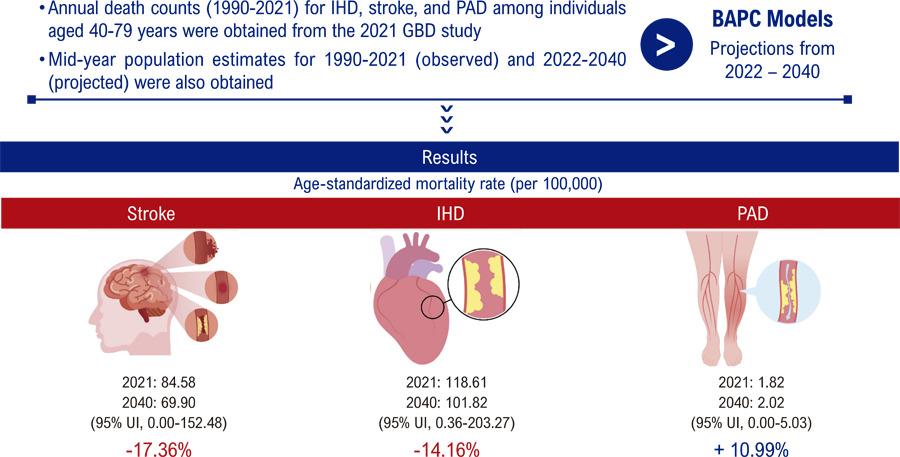
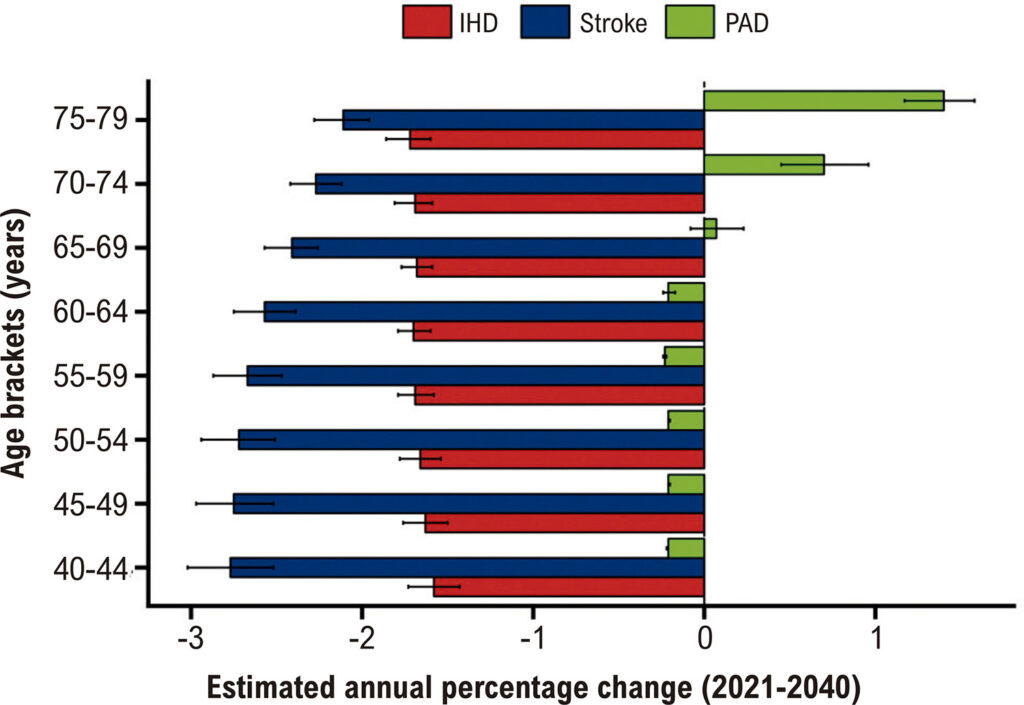
Annual death counts (1990-2021) for IHD, stroke, and PAD among individuals aged 40-79 years were obtained from the Global Burden of Disease (GBD) 2021 study. Mid-year population estimates for both observed (1990-2021) and projected (2022-2040) periods were used. Crude and age-standardized mortality rates were calculated. Bayesian age-period-cohort models were applied to project mortality rates from 2022 to 2040. Relative percentage changes and estimated annual percentage changes (EAPCs) were computed. Projections (per 100,000 population) are reported as medians with 95% uncertainty intervals (UIs), and EAPCs include bootstrap-derived confidence intervals (CIs).
Results
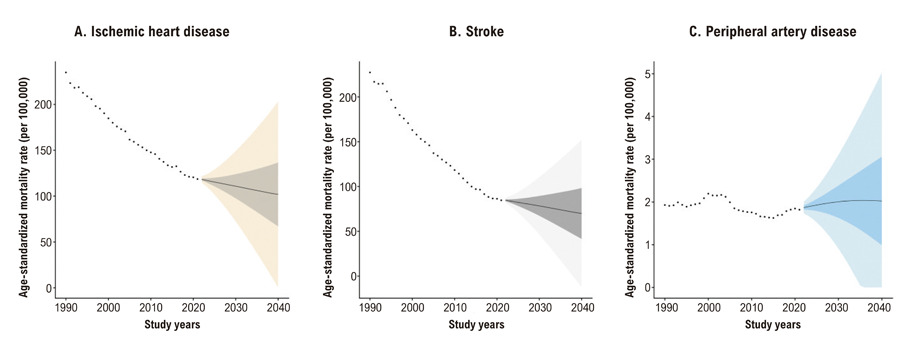
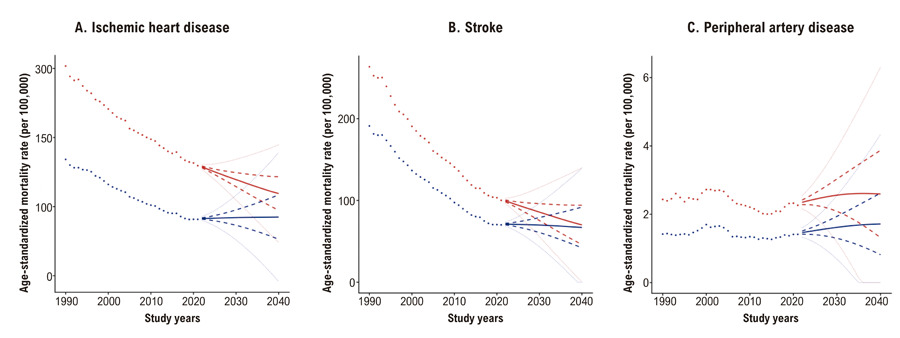
Between 1990 and 2040, Brazil’s population aged 40-79 years is projected to grow by 237.82%. The age-standardized mortality rate for IHD is expected to decline by 14.16% [from 118.61 in 2021 to 101.82 in 2040 (95% UI, 0.36-203.27)] (EAPC: -0.83% [95% CI, -0.84 to -0.83]); and for stroke by 17.36% [from 84.58 to 69.90 (95% UI, 0-152.48)] (EAPC: -1.07% [95% CI, -1.10 to -1.04]). In contrast, PAD mortality is projected to increase by 10.99% [from 1.82 to 2.02 (95% UI, 0-5.03)] (EAPC: 0.45% [95% CI, 0.30-0.59]). Additionally, sex-specific age-standardized mortality rates showed considerable variation. For IHD, rates are projected to decline by 25.31% among men (EAPC: -1.56% [95% CI, -1.57 to -1.55]), while increasing by 4.12% among women (EAPC: 0.14% [95% CI, 0.13-0.16]). Stroke mortality is expected to decrease by 30.00% in men (EAPC: -1.94% [95% CI, -1.96 to -1.91]) and by 4.52% in women (EAPC: -0.33% [95% CI, -0.37 to -0.29]). In contrast, PAD mortality is projected to rise by 14.64% in men (EAPC: 0.55% [95% CI, 0.38 to 0.71]) and by 21.92% in women (EAPC: 0.91% [95% CI, 0.78-1.02]).
Conclusion
While mortality rates for IHD and stroke are projected to decline, PAD mortality is expected to rise — particularly among women — highlighting the urgent need for sex-specific and disease-specific public health interventions.
Images
Image gallery fullscreen viewer
Comments are moderated by the editorial team before publication. Discussions should be evidence-based and use scientific language. Conflicts of interest should be declared.