Influence of Insertion/Deletion Polymorphism of the Angiotensin Converting Enzyme Gene on Adiposity and Cardiac Function in Patients with Heart Failure
Abstract
Background
The angiotensin-converting enzyme (ACE) insertion/deletion (I/D) polymorphism (rs4340) is associated with the pathogenesis of heart failure (HF). This polymorphism may contribute to a greater propensity for severe HF and excess weight.
Objective
To evaluate adiposity, cardiac function, and their association with ACE I/D polymorphism in HF patients.
Methods
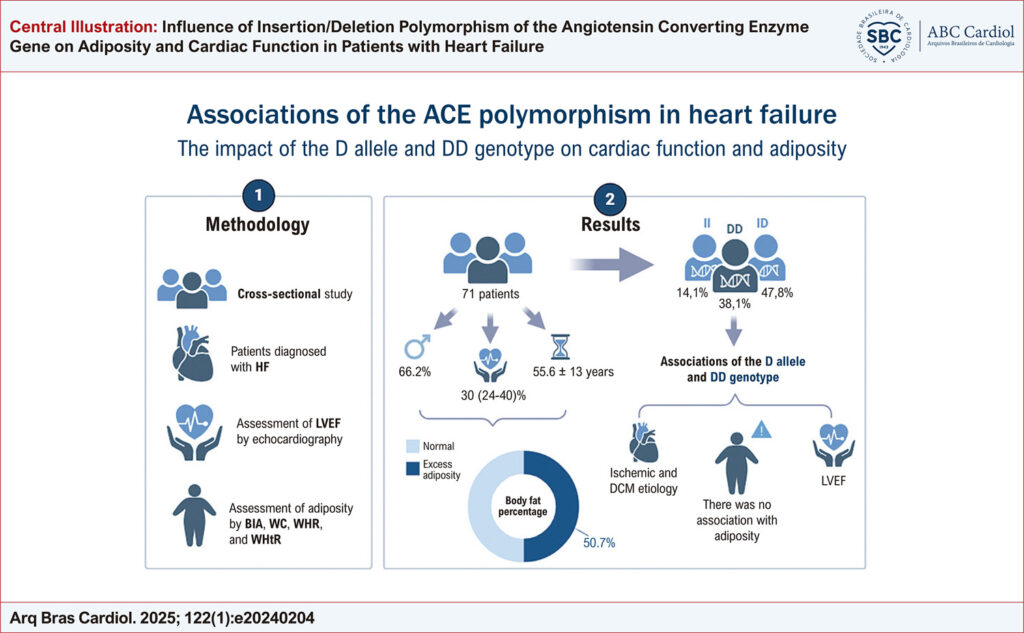
Cross-sectional study with ambulatory individuals ≥18 years diagnosed with HF. Genetic analysis was performed using polymerase chain reaction followed by agarose gel electrophoresis. Left ventricular ejection fraction (LVEF) was determined by echocardiography. Nutritional status was assessed using body mass index, while adiposity was analyzed using bioelectrical impedance analysis (BIA), waist circumference, waist-to-hip ratio, and waist-to-height ratio. The adopted significance level was 5% (p < 0.05).
Results
Seventy-one individuals were included, with a mean age of 55.8 ± 13.0 years, predominantly male (66.2%), with functional class I and II (90.9%), and a median LVEF of 30% (24-40). The prevalence of overweight was 38%, class I obesity was 23.9%, and class II and III obesity was 12.7%, with 50.7% exhibiting excess adiposity as assessed by BIA. A total of 88 D alleles and 54 I alleles of the ACE gene were identified. Regarding ACE genotypes, 38.1% were DD, 47.8% were ID, and 14.1% were II. In the multivariate analysis, the D allele (DD + ID genotypes versus II) was associated with LVEF (PR 0.995; 95% CI 0.991–1.000; p = 0.048) and with the etiology of HF (dilated cardiomyopathy: PR 1.283; 95% CI 1.039–1.583; p = 0.021). No independent association was found with adiposity.
Conclusion
The presence of the D allele of the ACE polymorphism is associated with LVEF and HF etiology. Despite overweight being prevalent in the sample, no independent associations were found.
Images
Image gallery fullscreen viewer
Comments are moderated by the editorial team before publication. Discussions should be evidence-based and use scientific language. Conflicts of interest should be declared.