Is Female Gender Associated with Mortality in Coronary Artery Bypass Grafting?
Abstract
Background
Women undergoing coronary artery bypass grafting (CABG) tend to have worse in-hospital outcomes, but it is unclear whether these differences are due to gender or to clinical factors.
Objective
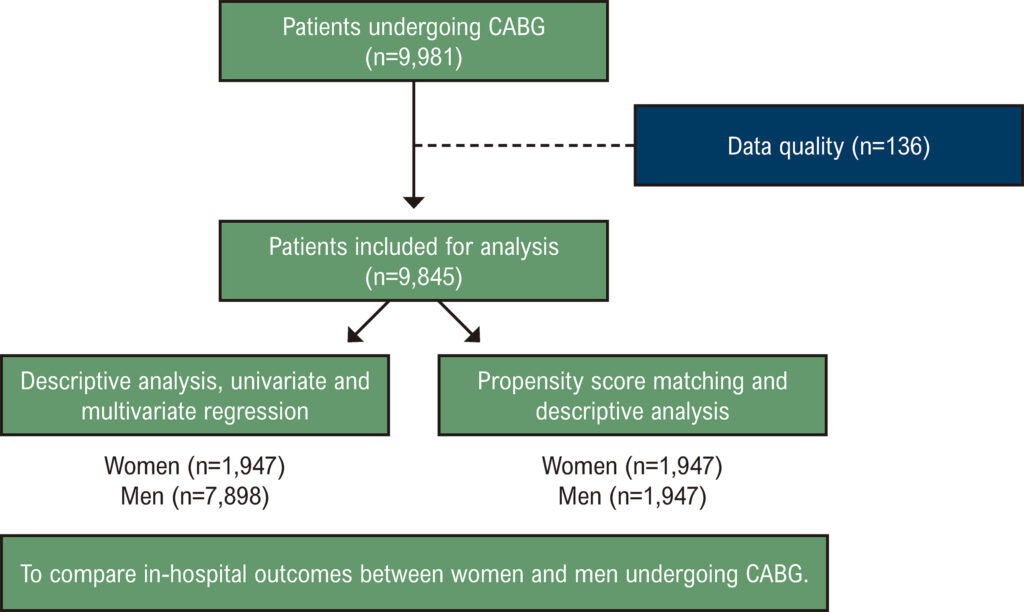
To compare in-hospital outcomes between women and men undergoing CABG.
Methods
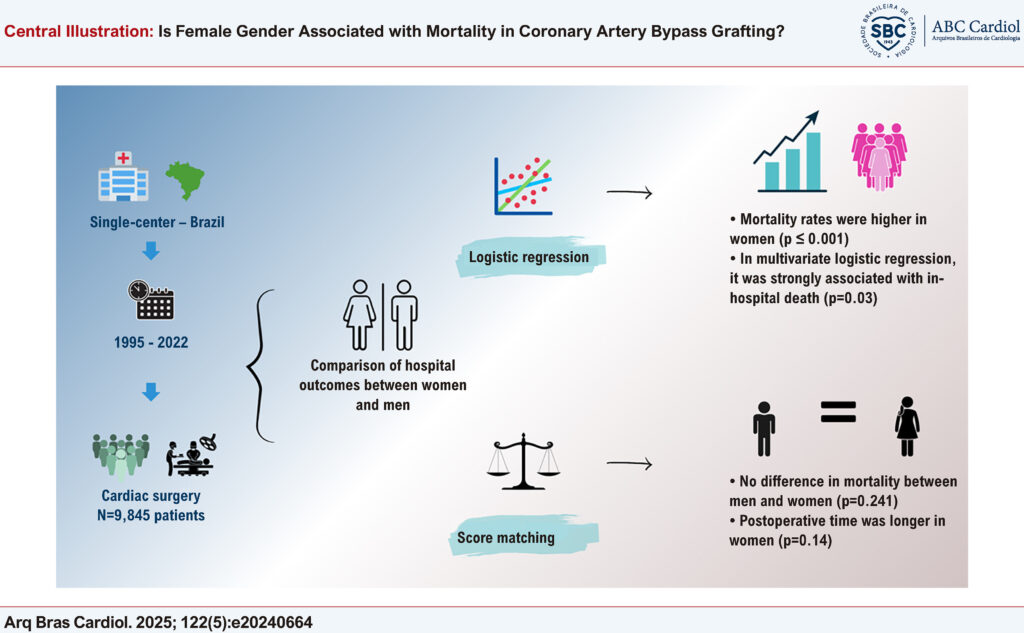
This was a single-center, retrospective observational study analyzing data from 9,845 patients who underwent CABG between 1995 and 2022, of whom 1,947 (19.8%) were women. To evaluate female gender as a prognostic factor for in-hospital mortality, we used descriptive statistics, univariate and multivariate logistic regression, and propensity score matching. The significance level was set at 5%.
Results
Women were older (66.7 vs 62.19 years, p<0.001), had lower body mass index (26.91 vs 27.64, p<0.001), and had a higher prevalence of diabetes mellitus (34.0% vs 31.6%, p=0.045). They also had longer hospital stays (14.84 vs 13.13 days, p<0.001) and higher operative mortality (4.8% vs 2.4%, p<0.001). In logistic regression, female gender was associated with higher mortality (OR=1.51; 95% CI: 1.15-1.99; p=0.003). After matching, there was no significant difference in mortality (OR=1.20; 95% CI: 0.88-1.64; p=0.241), but length of hospital stay remained longer in women.
Conclusion
When clinical factors were matched between men and women, the mortality difference disappeared. This suggests that targeted interventions to reduce disparities may help improve mortality outcomes in women undergoing CABG.
Images
Image gallery fullscreen viewer
Comments are moderated by the editorial team before publication. Discussions should be evidence-based and use scientific language. Conflicts of interest should be declared.